

Archive position — measured, not model output
3 likes on Devpost
128 of the 7,850 archived projects have more likes, and 93 share exactly 3 — so this project's #156 place in the like-ranked listing is a tie-break inside that group, not a ranking.
Projects (log scale)
Likes on Devpost. ▲ marks this project's group.
Show the figures
| Likes | Projects | Share of archive |
|---|---|---|
| 0 | 5,587 | 71.2% |
| 1 | 1,758 | 22.4% |
| 2 | 284 | 3.6% |
| 3–4 | 132 | 1.7% |
| 5–9 | 75 | 1.0% |
| 10+ | 14 | 0.2% |
 User Stories BotA demo video on every pull request
Get a demo video on every new feature
GitHub App that watches your pull requests and records a narrated, captioned demo.
Save time on demo prep and make informed decisions faster with a video walkthrough of every new feature.
Executive Summary
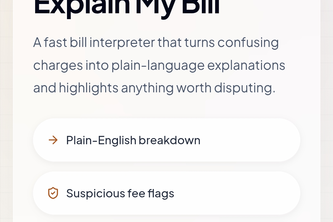
What the company appears to be: Explain My Bill is an AI-powered web application that allows users to upload bills (PDFs or images) and receive explanations of charges in plain English, with a focus on identifying hidden or suspicious fees.
What changed: The project was built as part of a hackathon submission. It represents a self-reported prototype or proof-of-concept for processing billing documents using AI and document parsing technologies.
The single most important open question: Is there evidence of any real-world usage, revenue, or customer traction beyond the author’s own description?
Analysis basis: This report is based entirely on the self-reported project description provided by the authors. No external verification, archived data, or third-party sources are available. All claims are attributed to the author's own account and are unverified.
What The Product Actually Is
The description states that Explain My Bill is an AI-powered web application designed to help users understand billing documents such as phone, utility, or insurance bills.
It supports uploading files in either PDF or image format, and performs the following actions:
- Extracts contents from uploaded bills.
- Identifies individual line items.
- Explains each charge in plain English.
- Flags suspicious or hidden fees.
- Displays analysis via an interactive dashboard with charts and summaries.
The application is built using a combination of frontend (Next.js, React, Tailwind CSS) and backend (FastAPI, Python) technologies, with AI integration through the Groq API.
Inference: The product appears to be a document processing tool that combines OCR, LLMs, and structured data output for financial transparency. It is not evidenced to have launched or scaled beyond its hackathon prototype.
Positioning & Claim Evolution
The project description positions Explain My Bill as an AI-powered solution aimed at increasing billing transparency by simplifying complex terminology and helping users identify unusual charges.
Key claims from the author:
- Users can upload any bill and instantly understand every charge.
- The tool flags hidden or suspicious fees.
- It helps users make smarter financial decisions.
- The system converts confusing bills into clear insights using AI.
The positioning has evolved from a hackathon prototype to a vision of becoming a trusted AI assistant for financial clarity across multiple bill types (e.g., medical, bank statements).
Claim vs Fact: These are self-reported claims about intent and functionality. No evidence exists regarding actual user adoption or impact.
Target Customer & ICP
The description implies that the target customer is any individual who receives regular bills, particularly those with complex or unclear charges — such as:
- Mobile phone users
- Utility bill recipients
- Insurance policyholders
There is no explicit segmentation beyond this general category. The authors do not describe specific personas, buyer roles, or use cases beyond personal financial decision-making.
Not evidenced: No information on whether the team has identified a specific ideal customer profile (ICP), nor any indication of market research or user interviews.
Business Model & Pricing Evidence
There is no evidence in the description of a business model or pricing strategy. The authors do not mention:
- How they plan to monetize the service
- Whether it will be free, subscription-based, or pay-per-use
- Any revenue streams or monetization plans
Not evidenced: No indication of how the product intends to generate income.
Technical & Delivery Signals
The project is built using modern web and AI stack components:
Frontend:
- Next.js (App Router)
- TypeScript
- Tailwind CSS
- Recharts
Backend:
- FastAPI
- Python
- pdfplumber
- Pydantic
AI:
- Groq API
- LLM-based processing for charge explanation and fee detection
Features:
- Drag-and-drop upload
- Support for PDFs and images
- Structured JSON output from AI
- Visual dashboards with summaries and alerts
The authors also mention challenges such as:
- Supporting different document formats (PDF vs image)
- Ensuring reliable AI outputs via Pydantic validation
- Designing a clean UI experience
Inference: The technical architecture suggests a functional prototype capable of handling basic document processing and AI integration. However, no evidence exists about scalability or production deployment.
Traction & Maturity Signals
The project is described as a hackathon submission, with no mention of:
- Users or customers
- Revenue or monetization
- Product usage metrics
- Beta testing or feedback loops
- Any form of product launch or growth
Not evidenced: No signs of traction, adoption, or maturity beyond the initial development phase.
Competitive Context
The description does not reference any competitors. However, based on the stated functionality — bill analysis, AI-driven explanations, fee flagging — there are likely existing tools in this space, such as:
- Financial analytics platforms
- Bill review services
- AI-powered document readers or summarizers
Not evidenced: No competitive landscape analysis or differentiation strategy provided.
Open Questions & Risks
Several potential risks and open questions emerge from the self-reported description:
- No revenue or traction evidence: The project is presented as a hackathon prototype with no indication of real-world usage.
- Unverified AI outputs: While Pydantic is used for validation, there’s no mention of how accuracy or reliability are ensured at scale.
- Limited scope: The tool currently supports only certain bill types (phone, utility, insurance), and expansion plans are speculative.
- No monetization strategy: No business model or pricing structure is described.
- Unproven market demand: There’s no evidence of user research or market validation.
Inference: The project lacks commercial viability indicators and appears to be in early-stage development with no clear path to product-market fit or profitability.
Questions the description leaves open
- What is the current status of the product? Is it live, in beta, or still a prototype?
- Have you conducted any user testing or gathered feedback from real users?
- How do you plan to monetize this tool? Are there any revenue models under consideration?
- What are your plans for scaling beyond the initial document types (phone, utility, insurance)?
- Do you have any partnerships or integrations in place with bill issuers or financial institutions?
- How do you ensure consistent and accurate AI-generated explanations across different bill formats?
- Are there any legal or compliance considerations around processing personal financial data?
Overall Assessment
At this stage, the project is best described as a conceptual prototype built during a hackathon. There is no evidence of traction, revenue, or customer adoption.
Confidence level: Low — due to lack of external validation and absence of any commercial data.
Assessment: Not ready for investment or partnership at this time. The idea shows promise in addressing a real pain point (billing complexity), but the project has not demonstrated sufficient maturity, traction, or business viability to warrant further diligence or commitment.
User Stories BotA demo video on every pull request
Get a demo video on every new feature
GitHub App that watches your pull requests and records a narrated, captioned demo.
Save time on demo prep and make informed decisions faster with a video walkthrough of every new feature.
Source
Submitted to the OpenAI 2026 hackathon on Devpost. Project home on Devpost. Back to the full gallery on Devpost.
This competitive analysis was produced by top-founders.com (opens in a new tab)
Generated by a language model from this project's public Devpost page — its tagline, the author's own write-up and any built-with tags listed there — as captured in August 2026. Short quotations are the author's words. It is an opinion on the idea as a business, not on the people behind it, and it reflects the description as published then. If the project has moved on, request a correction below. The analysis is not independent research and contains no verified traction, revenue or customer data.
An independent guide by KFG International LLC — not affiliated with, endorsed by, or connected to Devpost or OpenAI.