

Archive position — measured, not model output
0 likes on Devpost
2,263 of the 7,850 archived projects have more likes, and 5,587 share exactly 0 — so this project's #7,412 place in the like-ranked listing is a tie-break inside that group, not a ranking.
Projects (log scale)
Likes on Devpost. ▲ marks this project's group.
Show the figures
| Likes | Projects | Share of archive |
|---|---|---|
| 0 | 5,587 | 71.2% |
| 1 | 1,758 | 22.4% |
| 2 | 284 | 3.6% |
| 3–4 | 132 | 1.7% |
| 5–9 | 75 | 1.0% |
| 10+ | 14 | 0.2% |
 User Stories BotA demo video on every pull request
Get a demo video on every new feature
GitHub App that watches your pull requests and records a narrated, captioned demo.
Save time on demo prep and make informed decisions faster with a video walkthrough of every new feature.
Executive Summary
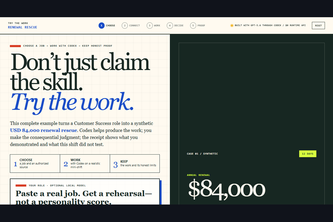
The company appears to be a solo project named "Try the Work", self-described as a platform that turns authorized job descriptions into AI-augmented mini-shifts for candidates to practice before applying. The author states this is built with TypeScript and submitted to the OpenAI 2026 hackathon.
What changed: The project evolved from an earlier effort called "Harmony", which explored how humans and intelligent tools can grow together without losing agency, into a practical tool focused on job preparation through realistic, evidence-based practice.
The single most important open question: Is there any evidence of traction, revenue or customer adoption beyond the author's own development work?
Analysis basis: This report is based entirely on the self-reported project description provided by the caller. No external verification or historical data is available. All claims are attributed to the author’s own account and should be treated as unverified.
What The Product Actually Is
- The description states that Try the Work turns an authorized job description into a realistic, AI-augmented mini-shift.
- Learners perform observable work using AI assistance (with optional local Ollama support).
- It outputs a candidate-owned "Work Receipt" with source citations, scored evidence, improvement recommendations, and explicit untested gaps.
- The system separates supported requirements from assumptions and checks observable evidence rather than personality traits.
- Human review is required before exporting any learner-owned receipt or deeper Codex work packet.
Inference: The product appears to be a prototype or proof-of-concept for job rehearsal using AI, focused on transparency and human control in the process. It does not appear to have a live product or marketplace yet.
Positioning & Claim Evolution
- The author states that Try the Work applies a philosophy from prior work ("Harmony") around keeping human judgment visible, carrying evidence with claims, and making learning lead to real capability.
- It positions itself as a safer way for candidates to practice before applying, and as a foundation for fairer, job-relevant tryouts for hiring teams.
- The author also frames it as supporting uptraining and cross-training without pretending one exercise measures a whole person.
Inference: The positioning has evolved from abstract exploration of human-AI collaboration to a concrete tool focused on job readiness and hiring fairness. However, no evidence suggests this has moved beyond the author’s own development or hackathon submission.
Target Customer & ICP
- For candidates: A way to practice before applying, showing what they can actually do.
- For hiring teams: A foundation for fairer, job-relevant tryouts.
- For employers: Support for uptraining and cross-training without pretending one exercise measures a whole person.
Not evidenced: No information is provided about specific customer segments, personas, or whether the product targets any particular industry or role type beyond general job descriptions.
Business Model & Pricing Evidence
- The description does not mention pricing, subscriptions, or monetization strategies.
- It mentions that the included shift runs without an API key or paid model.
- Optional Ollama support stays on numeric loopback and cannot take outside action.
- Codex is described as a deeper build-and-improve path, but no details are given about costs or access models.
Not evidenced: No evidence of business model, pricing tiers, or monetization strategy beyond the author’s own development work.
Technical & Delivery Signals
- Built with TypeScript.
- The system reads only the authorized role source.
- Separates supported requirements from assumptions.
- Uses deterministic guidance and optional localhost-only Ollama assistance.
- Requires human review before exporting results.
- Includes a reproducible local build and optional offline-assistance path.
- Has 17 focused tests covering various aspects like state, citations, math, prompt-like text, unsupported claims, hashes, approval, local lessons, and runtime-mode contracts.
Inference: The technical architecture is described as bounded and deterministic, with an emphasis on human control and transparency. There is no indication of scalability or production deployment beyond the author’s own testing.
Traction & Maturity Signals
- The project was submitted to the OpenAI 2026 hackathon.
- It includes a working end-to-end mini-shift.
- It has 17 focused tests covering multiple areas.
- It is described as a "reproducible local build and optional offline-assistance path."
Not evidenced: No evidence of revenue, customer adoption, usage metrics, or any form of traction beyond the author’s own development.
Competitive Context
- The description does not reference competitors or similar products.
- It does not state whether there are existing platforms for job rehearsal or AI-augmented skill practice.
Not evidenced: No competitive landscape is described. No evidence of market presence or differentiation from other tools.
Open Questions & Risks
- The project is a solo effort (team size: 1).
- It has no verified traction, revenue, or customer base.
- The product is described as a prototype or hackathon submission with no indication of production readiness.
- There is no mention of scalability, data privacy, or compliance considerations.
- The author retains all product, identity, claims, approval, and release decisions — suggesting limited external validation.
Inference: The lack of team, traction, and commercialization signals a high risk of failure to scale or gain market adoption without significant additional development or investment.
Questions the description leaves open
- What is the intended path from this prototype to a scalable product?
- How does the project plan to address concerns around data privacy, especially with AI-assisted job practice?
- Are there any plans for monetization or customer acquisition beyond the author’s own development?
- Has the author considered how to validate that the mini-shifts accurately reflect real-world job tasks?
- What are the key assumptions about user behavior and adoption in the hiring process?
Overall Assessment
- The project is currently a solo developer effort, submitted as a hackathon entry.
- There is no evidence of revenue, customers, or traction.
- It is described as a proof-of-concept with strong conceptual framing but no commercial execution.
- The author has not disclosed any funding, partnerships, or go-to-market strategy.
Assessment: Not ready for investment or partnership at this stage. This appears to be an early-stage idea with potential, but lacks the evidence of traction, scalability, or business model to support further due diligence or commitment.
User Stories BotA demo video on every pull request
Get a demo video on every new feature
GitHub App that watches your pull requests and records a narrated, captioned demo.
Save time on demo prep and make informed decisions faster with a video walkthrough of every new feature.
Source
Submitted to the OpenAI 2026 hackathon on Devpost. Project home on Devpost. Back to the full gallery on Devpost.
This competitive analysis was produced by top-founders.com (opens in a new tab)
Generated by a language model from this project's public Devpost page — its tagline, the author's own write-up and any built-with tags listed there — as captured in August 2026. Short quotations are the author's words. It is an opinion on the idea as a business, not on the people behind it, and it reflects the description as published then. If the project has moved on, request a correction below. The analysis is not independent research and contains no verified traction, revenue or customer data.
An independent guide by KFG International LLC — not affiliated with, endorsed by, or connected to Devpost or OpenAI.