

Archive position — measured, not model output
1 like on Devpost
505 of the 7,850 archived projects have more likes, and 1,758 share exactly 1 — so this project's #1,689 place in the like-ranked listing is a tie-break inside that group, not a ranking.
Projects (log scale)
Likes on Devpost. ▲ marks this project's group.
Show the figures
| Likes | Projects | Share of archive |
|---|---|---|
| 0 | 5,587 | 71.2% |
| 1 | 1,758 | 22.4% |
| 2 | 284 | 3.6% |
| 3–4 | 132 | 1.7% |
| 5–9 | 75 | 1.0% |
| 10+ | 14 | 0.2% |
 User Stories BotA demo video on every pull request
Get a demo video on every new feature
GitHub App that watches your pull requests and records a narrated, captioned demo.
Save time on demo prep and make informed decisions faster with a video walkthrough of every new feature.
Executive Summary
What the company appears to be
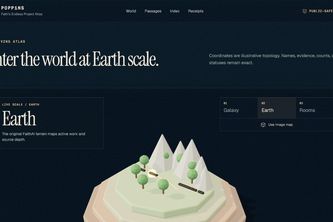
POPP1NS is a self-contained, privacy-preserving visualization tool that maps an individual's project ecosystem into a spatial and semantic graph. It presents a cinematic, interactive 3D world where projects are represented as rooms or galaxies, with metadata and evidence linked to them. The system uses audited source data, Codex activity, and website records to build a structured index, while maintaining strict privacy boundaries between public and private content.
What changed
The project is presented as an evolution of how personal or individual project portfolios are visualized and shared. It introduces a new form of digital curation that combines spatial navigation with semantic indexing, aiming for both accessibility and privacy. The author describes it as a "collaboration world" that allows for truthful maturity labeling and secure sharing.
Single most important open question
Is there any evidence of external adoption or usage beyond the creator’s own work? If not, what is the basis for believing this tool has commercial viability or traction?
What The Product Actually Is
The description states that POPP1NS turns an individual's audited project ecosystem into a spatial and semantic graph. Projects are visualized as:
- Galaxies (project families)
- Worlds and rooms (products)
- Constellations (Codex activity)
- Terrain shapes (source signals)
- Doors (verified websites)
The system includes:
- A local normalizer that combines Codex activity, filesystem signals, a ledger of tracked projects, and website records.
- A privacy projection that emits a versioned public graph and receipt.
- A browser-based interface using React, TypeScript, React Three Fiber, and Three.js.
- Lazy-loaded 3D assets (FaithAI GLBs) with automatic camera fitting.
- Support for progressive enhancement, including keyboard, mobile, reduced-motion, no-WebGL, model-failure, and image-only visitors.
The system is described as:
- Not exposing private data such as raw task titles, local paths, emails, session IDs, or credentials.
- Using deterministic routing as a baseline, with optional GPT-5.6 structured output for ranking public graphs.
- Fully functional even without access to model secrets.
Inference The product appears to be a personal portfolio visualization tool, not a platform for multiple users or teams.
Positioning & Claim Evolution
The author positions POPP1NS as:
- A cinematic, source-backed map of projects.
- An endless collaboration world with privacy-preserving receipts.
- A way to show the full topology of interrelated work while protecting archives underneath.
- A truthful maturity labeling system for project types (e.g., product-design vs. launched software).
The claim evolution shows:
- From a personal curation tool to a collaboration world.
- From portfolio flattening to spatial and semantic graphing.
- Emphasis on privacy, truthfulness, and accessibility.
Inference This is a self-contained personal tool, not a platform for others. It may evolve into a collaboration tool, but no evidence of that exists yet.
Target Customer & ICP
The description states:
- The system is built by one person: Faith Atwater-Cheltenham.
- It maps her own projects (e.g., Prince of Pricing, Movement Memory, The Children's Internet).
- The interface supports public-safe collaboration briefs, but the core functionality is for individual use.
There is no evidence of:
- External users or customers.
- A defined ICP beyond the creator’s own work.
- Any targeting of teams, agencies, or organizations.
Inference The current ICP is the creator herself, and there is no evidence of a broader target market.
Business Model & Pricing Evidence
The description does not state:
- Any pricing model.
- Revenue streams.
- Monetization strategy.
- Customer acquisition plans.
- Subscription or licensing models.
Inference No business model or pricing evidence is provided. The tool appears to be a personal project, not a commercial offering.
Technical & Delivery Signals
The system uses:
- Cloudflare, OpenAI, React, Three.js, TypeScript
- A local normalizer combining multiple data sources
- A privacy projection that separates public and private data
- Browser-based rendering with React Three Fiber and Three.js
- Lazy loading of 3D assets, offscreen suspension, image fallbacks
- Support for progressive enhancement, including accessibility features
The system is described as:
- Fully functional without WebGL or model secrets.
- Keeping the client under 400 KB raw.
- Passing 17 functional tests and a privacy scan.
Inference The technical stack is modern and focused on performance, accessibility, and privacy. It’s not a scalable SaaS platform but a personal tool with strong engineering design.
Traction & Maturity Signals
The description states:
- The project was submitted to the OpenAI 2026 hackathon.
- It includes 17 functional tests, a privacy scan, and exact GLB and public-graph hashes.
- It supports an image-first experience.
- It is described as a release, not a prototype.
However, there is no evidence of:
- External adoption or usage.
- Customer feedback or engagement.
- Revenue or monetization.
- Market traction beyond the creator’s own work.
Inference The tool is mature in engineering terms but lacks commercial or user traction. It is a personal release, not a product with market validation.
Competitive Context
The description does not mention:
- Competitors.
- Similar tools in the market.
- Market positioning relative to others.
Inference No competitive context is provided. The tool appears to be unique in its approach, but there is no evidence of a competitive landscape or market analysis.
Open Questions & Risks
- No commercial traction: The tool is described as personal and self-contained.
- No pricing or monetization strategy: No indication of how it might generate revenue.
- No external users or feedback: The system is not used by others, so no real-world validation exists.
- Limited scalability: It’s built for one person’s use, not a multi-user platform.
- Unproven market demand: There is no evidence that others want this type of tool.
Inference The project is a personal engineering showcase, not a commercial product. The risk is that it may not evolve into a viable business without significant repositioning or user adoption.
Questions the description leaves open
- What is the intended evolution from a personal tool to a potential platform for others?
- Are there any plans to monetize this tool, and if so, how?
- Has anyone else used or tested this system beyond yourself?
- How do you plan to scale this beyond one user?
- What are your thoughts on integrating third-party data sources or collaboration features?
- Is there a roadmap for adding authenticated users or private operator views?
Overall Assessment
Not evidenced.
There is no evidence of:
- Revenue, customers, or traction.
- A business model or monetization strategy.
- External adoption or user feedback.
- A scalable or market-ready product.
The project is described as a personal engineering effort, not a commercial venture. It may be an interesting technical showcase or prototype, but there is no basis for investment or partnership at this time.
Inference This is a self-contained personal tool with strong execution, but it lacks the commercial signals needed to justify further due diligence or investment.
User Stories BotA demo video on every pull request
Get a demo video on every new feature
GitHub App that watches your pull requests and records a narrated, captioned demo.
Save time on demo prep and make informed decisions faster with a video walkthrough of every new feature.
Source
Submitted to the OpenAI 2026 hackathon on Devpost. Project home on Devpost. Back to the full gallery on Devpost.
This competitive analysis was produced by top-founders.com (opens in a new tab)
Generated by a language model from this project's public Devpost page — its tagline, the author's own write-up and any built-with tags listed there — as captured in August 2026. Short quotations are the author's words. It is an opinion on the idea as a business, not on the people behind it, and it reflects the description as published then. If the project has moved on, request a correction below. The analysis is not independent research and contains no verified traction, revenue or customer data.
An independent guide by KFG International LLC — not affiliated with, endorsed by, or connected to Devpost or OpenAI.