

Archive position — measured, not model output
1 like on Devpost
505 of the 7,850 archived projects have more likes, and 1,758 share exactly 1 — so this project's #1,690 place in the like-ranked listing is a tie-break inside that group, not a ranking.
Projects (log scale)
Likes on Devpost. ▲ marks this project's group.
Show the figures
| Likes | Projects | Share of archive |
|---|---|---|
| 0 | 5,587 | 71.2% |
| 1 | 1,758 | 22.4% |
| 2 | 284 | 3.6% |
| 3–4 | 132 | 1.7% |
| 5–9 | 75 | 1.0% |
| 10+ | 14 | 0.2% |
 User Stories BotA demo video on every pull request
Get a demo video on every new feature
GitHub App that watches your pull requests and records a narrated, captioned demo.
Save time on demo prep and make informed decisions faster with a video walkthrough of every new feature.
Executive Summary
Company: PortBar
Self-reported basis: The analysis is based entirely on the author's own description of PortBar, submitted as part of a hackathon entry. No external verification or independent sources are available.
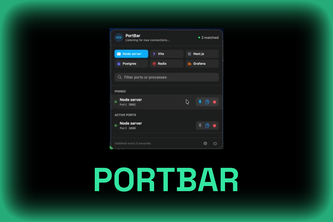
What it appears to be: A developer tool that displays running development servers, databases, and daemons in macOS Menu Bar, using AI-assisted development tools.
What changed: The project was built over a few days during a hackathon, using GPT-5.6 Terra and Codex CLI for development.
Key open question: Does PortBar have any commercial traction or evidence of developer adoption beyond the author's personal use case?
What The Product Actually Is
The description states that PortBar shows you every dev server, database, and daemon in your Mac's Menu Bar. It is described as a tool that displays information about processes running on localhost, specifically targeting developers working with tools like Next.js, which often use port 3000.
It also claims to support "popular dev tools that run on localhost on a specific port", suggesting it scans and reports on such services.
- Evidenced: PortBar is described as a macOS Menu Bar tool.
- Inferred: It likely uses system-level process scanning or port monitoring, but the exact technical implementation is not detailed.
Positioning & Claim Evolution
The author positions PortBar as a solution to a common developer pain point: managing multiple dev servers on localhost that may conflict over ports like 3000. The tagline — "Stop guessing what's on port 3000" — reflects this positioning.
- Evidenced: The tool is described as addressing port conflicts in development environments.
- Inferred: It positions itself as a utility for developers working with local dev servers, but no explicit market or competitive positioning beyond that is stated.
Target Customer & ICP
The author describes their own use case: spinning up many Next.js projects and dealing with port conflicts. The tool is aimed at developers who work locally on macOS and use tools like next dev or similar dev servers.
- Evidenced: The target is developers using local development environments, particularly those working with Node.js-based frameworks.
- Inferred: It may appeal to teams using Docker or multiple local services, but no explicit segmentation or targeting beyond personal developer use is stated.
Business Model & Pricing Evidence
No business model or pricing information is provided in the description. The project was built as a hackathon submission and does not appear to have any commercial offering at this time.
- Not evidenced: No pricing, monetization strategy, or business model is described.
Technical & Delivery Signals
The tool was built using:
- Codex CLI
- GPT-5.6 Terra
- Swift and SwiftUI for macOS development
The author notes that GPT-5.6 Terra required more manual steering than expected but was effective for straightforward tasks.
- Evidenced: The tech stack includes Swift, SwiftUI, and AI tools like Codex and GPT-5.6.
- Inferred: The tool likely integrates with macOS system APIs to monitor ports and processes.
Traction & Maturity Signals
The project was built in a hackathon over a few days. It is described as a personal tool, not yet commercialized or adopted by others.
- Not evidenced: No customer data, usage metrics, or adoption signals are provided.
- Inferred: The tool has no known traction beyond the author’s own use case.
Competitive Context
No explicit competitive analysis or market context is provided. The author does not reference similar tools or platforms in the developer ecosystem.
- Not evidenced: No information on existing tools or competitors is given.
Open Questions & Risks
- Unproven commercial viability: The tool was built as a hackathon project and lacks any evidence of market traction.
- AI dependency: Reliance on GPT-5.6 Terra for development may not be scalable or reliable in production.
- Limited scope: The tool is described as targeting local dev environments, which may limit its broader appeal.
- No monetization path: No indication of how the tool would be monetized or whether it has a sustainable business model.
Questions the description leaves open
- What specific use cases beyond your own have you observed in the developer community?
- Have you tested PortBar with other developers or teams? If so, what feedback did you get?
- How do you plan to scale beyond a single-person hackathon project?
- Are there any technical limitations or edge cases where PortBar might fail to detect services?
- What is your long-term vision for the product — is it intended to be a standalone tool or part of a larger ecosystem?
Overall Assessment
Not evidenced: There is no evidence of revenue, customers, or traction that would support an investment or partnership decision.
- Inferred: The project appears to be a proof-of-concept built by one developer in a short timeframe. It has not yet demonstrated commercial viability or market demand.
- Confidence level: Low — based on self-reported, unverified information and no external validation.
User Stories BotA demo video on every pull request
Get a demo video on every new feature
GitHub App that watches your pull requests and records a narrated, captioned demo.
Save time on demo prep and make informed decisions faster with a video walkthrough of every new feature.
Source
Submitted to the OpenAI 2026 hackathon on Devpost. Project home on Devpost. Back to the full gallery on Devpost.
This competitive analysis was produced by top-founders.com (opens in a new tab)
Generated by a language model from this project's public Devpost page — its tagline, the author's own write-up and any built-with tags listed there — as captured in August 2026. Short quotations are the author's words. It is an opinion on the idea as a business, not on the people behind it, and it reflects the description as published then. If the project has moved on, request a correction below. The analysis is not independent research and contains no verified traction, revenue or customer data.
An independent guide by KFG International LLC — not affiliated with, endorsed by, or connected to Devpost or OpenAI.