

Archive position — measured, not model output
1 like on Devpost
505 of the 7,850 archived projects have more likes, and 1,758 share exactly 1 — so this project's #1,692 place in the like-ranked listing is a tie-break inside that group, not a ranking.
Projects (log scale)
Likes on Devpost. ▲ marks this project's group.
Show the figures
| Likes | Projects | Share of archive |
|---|---|---|
| 0 | 5,587 | 71.2% |
| 1 | 1,758 | 22.4% |
| 2 | 284 | 3.6% |
| 3–4 | 132 | 1.7% |
| 5–9 | 75 | 1.0% |
| 10+ | 14 | 0.2% |
 User Stories BotA demo video on every pull request
Get a demo video on every new feature
GitHub App that watches your pull requests and records a narrated, captioned demo.
Save time on demo prep and make informed decisions faster with a video walkthrough of every new feature.
Executive Summary
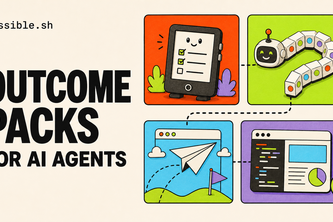
What the company appears to be: Possible.sh is an open-source library of Outcome Packs designed for use with Codex (an AI agent platform). The system allows users to describe a rough idea, which then triggers an automated workflow that produces a multidisciplinary outcome through reusable execution prompts and agent skills. It emphasizes independent verification and operational judgment.
What changed: The project evolved from a broad skill library into a focused interaction model: describe an ambition, approve a pack, execute the work, and verify completion. This shift was driven by challenges in integration failures and the need for clearer boundaries between outcome definition and consequential actions like deployment or fabrication.
Single most important open question: Does Possible.sh have any commercial traction, revenue, or customer adoption beyond its self-reported demo and GitHub presence?
Note: All findings are based on the author’s own description. No independent verification or external data is available. The project has no documented revenue, customers, or usage metrics.
What The Product Actually Is
The description states that Possible.sh is an open-source library of Outcome Packs. Each pack combines execution prompts and agent skills to turn rough ideas into expert-shaped, independently verified outcomes for Codex.
- Product type: A TypeScript-based tooling system.
- Core functionality: Converts user ambition into structured workflows using reusable components called "Outcome Packs".
- Technology stack: Built with TypeScript, Next.js, React, Node.js, npm, Three.js, MuJoCo, Rerun, build123d, Vitest, and Codex (GPT-5.6).
- Delivery mechanism: Delivered via an npm installer (
npx @fraylabs/possible@0.1.9 init) and a Next.js site. - Execution model: Uses deterministic compiler logic to generate agent-skill install commands and execution prompts.
Inference: The system appears to be built for developers or technical users who want to automate complex multidisciplinary tasks using AI agents, particularly in domains like robotics, web development, and hardware prototyping.
Positioning & Claim Evolution
The author claims that:
- AI agents can execute specialized tasks.
- Most people do not know every discipline, dependency, safeguard, or quality check their ambition requires.
- Possible supplies that missing operational knowledge.
This positioning evolved from a broad skill library to a focused interaction model:
- Initially: A wide range of skills and tools.
- Later: One interaction: describe an outcome → approve a pack → execute → verify completion.
Claim: The system aims to make operational judgment accessible through AI-assisted workflows.
Inference: The evolution reflects a move toward clarity in user experience and task boundaries, likely due to early integration issues.
Target Customer & ICP
The description does not explicitly state target customers or ideal customer profiles (ICP). However, it implies:
- Users who are describing ambitious ideas but lack full operational knowledge.
- Developers or engineers working on multidisciplinary projects involving robotics, hardware, web games, and presentations.
- Teams using Codex for AI agent workflows.
Inference: Likely early adopters would be developers or technical teams in fields such as robotics, software engineering, and product design who are looking to automate complex workflows with AI agents.
Business Model & Pricing Evidence
There is no evidence of pricing, monetization strategy, or business model in the description.
- The project is open-source.
- It uses an npm package (
@fraylabs/possible) for installation. - No mention of paid features, subscriptions, or licensing models.
Claim: The product is free to use via npm and open source.
Inference: If monetization exists, it's not evident from the provided description.
Technical & Delivery Signals
The system includes:
- A TypeScript manifest for each Outcome Pack.
- Deterministic compiler that turns manifests into agent-skill install commands and execution prompts.
- Integration with Codex (GPT-5.6) for task execution.
- Support for multiple disciplines: CAD, URDF/SRDF, MuJoCo control, simulation, telemetry, firmware compilation, etc.
- Four public Outcome Packs:
- Still / Hardware Launch
- Robot Snake / Robot Prototype
- Fold / Playable Web Game
- Possible / Web Presentation
Claim: The system supports multidisciplinary workflows and integrates with various tools and platforms.
Inference: Technical maturity is evident in the use of typed manifests, deterministic compilation, and integration with multiple domains (robotics, web, hardware).
Traction & Maturity Signals
There is no evidence of traction, revenue, or customer adoption beyond the project’s own demos and GitHub presence.
- The project was submitted to an OpenAI hackathon.
- It includes four public Outcome Packs and demo videos.
- It has a live site (
possible.sh) and GitHub repository. - No mention of users, customers, or usage statistics.
Claim: The system is in early development with limited real-world application.
Inference: Lack of traction signals that this is likely an experimental or prototype-level product, not yet adopted at scale.
Competitive Context
The description does not provide information about competitors or market positioning.
- No mention of similar tools or platforms.
- No indication of competitive advantages or differentiation strategies.
Claim: No competitive landscape is described.
Inference: Without external context, it's unclear whether Possible.sh competes with other AI agent platforms or workflow automation tools.
Open Questions & Risks
Several risks and open questions are evident from the description:
- No commercial traction or revenue: The project lacks any evidence of monetization or customer base.
- Limited scope: Only four public Outcome Packs exist, suggesting limited functionality or maturity.
- Dependency on Codex: Relies heavily on a specific AI agent platform (Codex), which may limit its applicability.
- Verification challenges: Early integration failures were noted, indicating potential instability in execution pipelines.
- Self-reported nature: All claims are unverified and based solely on the author’s account.
Inference: The project is experimental and not yet proven in production environments or at scale.
Questions the description leaves open
- What specific use cases have you tested outside of the four public Outcome Packs?
- How do you plan to scale beyond the current open-source model?
- Have you identified any real-world users or teams currently using Possible.sh?
- What are your plans for monetization, if any?
- How does Possible.sh handle edge cases or failures in agent execution that aren’t covered by existing Outcome Packs?
- Are there any known limitations or constraints of the system when used with different AI agents beyond Codex?
Overall Assessment
Not evidenced.
Claim: There is no evidence to support a conclusion about investment or partnership viability.
Inference: Given the lack of traction, revenue, or customer data, and the experimental nature of the product, there is insufficient basis for evaluating its potential as an investment or partnership opportunity.
User Stories BotA demo video on every pull request
Get a demo video on every new feature
GitHub App that watches your pull requests and records a narrated, captioned demo.
Save time on demo prep and make informed decisions faster with a video walkthrough of every new feature.
Source
Submitted to the OpenAI 2026 hackathon on Devpost. Project home on Devpost. Back to the full gallery on Devpost.
This competitive analysis was produced by top-founders.com (opens in a new tab)
Generated by a language model from this project's public Devpost page — its tagline, the author's own write-up and any built-with tags listed there — as captured in August 2026. Short quotations are the author's words. It is an opinion on the idea as a business, not on the people behind it, and it reflects the description as published then. If the project has moved on, request a correction below. The analysis is not independent research and contains no verified traction, revenue or customer data.
An independent guide by KFG International LLC — not affiliated with, endorsed by, or connected to Devpost or OpenAI.