

Archive position — measured, not model output
1 like on Devpost
505 of the 7,850 archived projects have more likes, and 1,758 share exactly 1 — so this project's #1,694 place in the like-ranked listing is a tie-break inside that group, not a ranking.
Projects (log scale)
Likes on Devpost. ▲ marks this project's group.
Show the figures
| Likes | Projects | Share of archive |
|---|---|---|
| 0 | 5,587 | 71.2% |
| 1 | 1,758 | 22.4% |
| 2 | 284 | 3.6% |
| 3–4 | 132 | 1.7% |
| 5–9 | 75 | 1.0% |
| 10+ | 14 | 0.2% |
 User Stories BotA demo video on every pull request
Get a demo video on every new feature
GitHub App that watches your pull requests and records a narrated, captioned demo.
Save time on demo prep and make informed decisions faster with a video walkthrough of every new feature.
Executive Summary
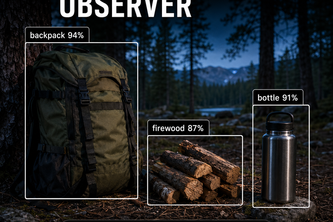
The description states that pov-agent (also known as "Local AI Observer") is a real-time multimodal AI agent for mobile phones that can see, hear, and talk back using on-device AI. It runs entirely offline after an initial model download, uses YOLO for object detection, Qwen3 for language processing, and Sherpa-ONNX + Piper for speech recognition and synthesis.
The author claims this is a private, object-aware assistant designed to function without internet connectivity, particularly useful in situations where there is no connection. The system stabilizes noisy visual detections into structured scene descriptions before feeding them to the language model.
Key commercial due-diligence questions include:
- What is the actual product capability and performance?
- How does it compare with existing solutions in terms of privacy, offline functionality, and usability?
- Is there any evidence of traction or user feedback beyond this single developer's account?
Most important open question
Does the described technical architecture support the claimed real-time multimodal capabilities, especially under resource constraints on mobile devices?
What The Product Actually Is
The description states that pov-agent is a:
- Real-time multimodal AI agent for phones
- Runs entirely offline after initial model download
- Uses YOLO for object detection and Qwen3 for language processing
- Integrates speech recognition (Sherpa-ONNX) and synthesis (Piper)
- Operates on mobile devices with Flutter-based architecture
It is described as a "local AI observer" that:
- Analyzes camera frames continuously
- Converts noisy detections into stable scene descriptions
- Answers typed questions with current visual context
- Responds to hands-free queries after a wake phrase
- Speaks responses using local TTS
Inference The product appears to be an experimental or proof-of-concept mobile application built by one developer, focused on privacy-preserving, on-device multimodal AI interaction.
Positioning & Claim Evolution
The description states that the project was inspired by a hiking trip where the author and friends were unable to find shelter and had no internet connection. This led to the idea of creating an AI assistant that works without connectivity.
The positioning claim is:
- A calm companion for situations with no internet
- Private, object-aware assistant
- Runs directly on the phone (no cloud processing)
- Never uploads or saves camera frames, audio, prompts, or conversations
Inference The author positions this as a privacy-first, offline-capable AI assistant that leverages local compute to provide situational awareness and interaction. However, no evidence of market positioning, branding, or competitive differentiation beyond the self-reported narrative.
Target Customer & ICP
The description states:
- The target use case is for people in environments with poor or no internet connectivity
- It's designed as a "calm companion" that understands approximate situations around you
- Intended to be useful when there is no connection
Inference Based on the author’s own account, the ICP seems to be individuals who may find themselves in remote locations or offline scenarios where traditional cloud-based AI assistants are not usable. However, no explicit customer segments, personas, or market data are provided.
Business Model & Pricing Evidence
The description does not state any business model or pricing information.
Not evidenced
Technical & Delivery Signals
The description states:
- Built with Flutter
- Uses feature-oriented architecture with BLoC for orchestration
- Combines YOLO, Qwen3 (via llama.cpp), Sherpa-ONNX, Piper, Ultralytics, and other tools
- Model manager handles downloading, verifying, caching, loading, and releasing models
- Checksums are validated before model usage
- Supports iOS only in MVP version; Android compatibility is pending
Inference The technical stack suggests a system built for performance and privacy. However, the author notes that Android packaging remains incomplete due to runtime compatibility issues, indicating potential delivery challenges.
Traction & Maturity Signals
The description states:
- One-person team (Ivan Chabanov)
- MVP submitted to OpenAI 2026 hackathon
- No revenue, customers, or adoption data provided
- The project is described as a personal experiment and proof-of-concept
Not evidenced
Competitive Context
The description does not mention any competitors.
Not evidenced
Open Questions & Risks
Key risks identified from the description:
- Single developer team: No evidence of scaling or team structure beyond one person.
- Incomplete platform support: Only iOS version submitted; Android compatibility is pending.
- Unproven performance under load: The author notes challenges in managing multiple native runtimes on low-memory devices.
- No commercial traction or user feedback: This is a self-reported personal project with no external validation.
- Limited scope of functionality: The system focuses on basic visual and audio understanding, not full agent capabilities.
Inference While technically ambitious, the product lacks evidence of real-world deployment, scalability, or commercial viability.
Questions the description leaves open
- What are the actual performance metrics for object detection accuracy and response latency?
- How does the system handle edge cases like low-light conditions or fast-moving objects?
- Can you demonstrate how the stabilization algorithm works in practice?
- What is the current status of Android support, and what are the expected timelines?
- Are there any plans to expand beyond basic visual understanding (e.g., object tracking over time)?
- How does the system manage memory usage across different device types?
- Has the author tested this on multiple devices or just one specific model?
Overall Assessment
The description states that this is a personal hackathon project submitted to the OpenAI 2026 hackathon, built by a single developer.
There is no evidence of:
- Revenue
- Customers
- Traction
- Commercial viability
- Team structure beyond one person
- Product-market fit or competitive positioning
Assessment Not ready for investment or partnership. This is an experimental prototype with strong technical execution but no demonstrated commercial potential or traction. The author’s own account indicates it's a proof-of-concept, not a product in development.
User Stories BotA demo video on every pull request
Get a demo video on every new feature
GitHub App that watches your pull requests and records a narrated, captioned demo.
Save time on demo prep and make informed decisions faster with a video walkthrough of every new feature.
Source
Submitted to the OpenAI 2026 hackathon on Devpost. Project home on Devpost. Back to the full gallery on Devpost.
This competitive analysis was produced by top-founders.com (opens in a new tab)
Generated by a language model from this project's public Devpost page — its tagline, the author's own write-up and any built-with tags listed there — as captured in August 2026. Short quotations are the author's words. It is an opinion on the idea as a business, not on the people behind it, and it reflects the description as published then. If the project has moved on, request a correction below. The analysis is not independent research and contains no verified traction, revenue or customer data.
An independent guide by KFG International LLC — not affiliated with, endorsed by, or connected to Devpost or OpenAI.