

Archive position — measured, not model output
1 like on Devpost
505 of the 7,850 archived projects have more likes, and 1,758 share exactly 1 — so this project's #1,695 place in the like-ranked listing is a tie-break inside that group, not a ranking.
Projects (log scale)
Likes on Devpost. ▲ marks this project's group.
Show the figures
| Likes | Projects | Share of archive |
|---|---|---|
| 0 | 5,587 | 71.2% |
| 1 | 1,758 | 22.4% |
| 2 | 284 | 3.6% |
| 3–4 | 132 | 1.7% |
| 5–9 | 75 | 1.0% |
| 10+ | 14 | 0.2% |
 User Stories BotA demo video on every pull request
Get a demo video on every new feature
GitHub App that watches your pull requests and records a narrated, captioned demo.
Save time on demo prep and make informed decisions faster with a video walkthrough of every new feature.
Executive Summary
What the company appears to be
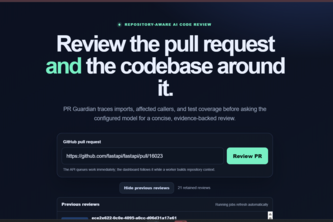
PR-Guardian-AI is a repository-aware pull-request review tool that uses AI to analyze code changes in context of dependencies and related tests. The author states it combines diff analysis with repository metadata, dependency graphs, and test impact to generate structured findings.
What changed
The project was built as a hackathon submission (Devpost entry for OpenAI 2026 hackathon). It represents an early-stage prototype with no evidence of commercial traction or revenue generation.
Single most important open question
Is there any evidence of actual developer adoption, customer feedback, or usage beyond the author's own development work?
The description is self-reported and unverified. There is no evidence of revenue, customers, partnerships, or market traction. The project appears to be a proof-of-concept built by one person (Chandan Kumar) in a hackathon setting.
What The Product Actually Is
The description states that PR-Guardian-AI is:
- A repository-aware pull-request review tool
- An asynchronous distributed system for code reviews
- A dashboard that accepts GitHub PR URLs and returns structured reviews with risk scores, findings, evidence, and suggested tests
- A system that builds dependency graphs and identifies affected callers
The author describes it as a "repository-aware" tool that goes beyond simple diff analysis to consider:
- Repository context
- Import relationships
- Code chunks
- Dependency relationships
- Affected callers
- Related test files
It uses an asynchronous architecture with separate services for API, workers, and indexing.
Positioning & Claim Evolution
The author states PR-Guardian-AI addresses the limitation of traditional pull-request reviews that "focus only on the changed lines of code" and instead asks "what else in the repository can this change affect?"
Positioning claims:
- Repository-aware asynchronous PR reviews
- Traces dependency impact before producing evidence-backed findings
- Combines pull-request diff with repository context, dependency relationships, affected callers, and related tests
The project appears to be positioned as a developer tool that improves code review quality by providing more comprehensive analysis than standard diff-based tools.
Target Customer & ICP
The description states PR-Guardian-AI is designed for developers who submit pull requests through GitHub. The author's own write-up indicates the target is:
- Developers working with GitHub PRs
- Teams looking to improve code review processes
- Users who want more comprehensive impact analysis than standard diff-only reviews
No specific customer segments or personas are identified beyond "developers." The project appears to be aimed at software development teams, but no evidence of actual customer targeting or segmentation exists.
Business Model & Pricing Evidence
Not evidenced. The description does not contain any information about pricing models, monetization strategies, or business models. No revenue streams, subscription tiers, or commercial arrangements are mentioned.
Technical & Delivery Signals
The author states PR-Guardian-AI was built with:
- Next.js dashboard
- Express API
- Redis and BullMQ for background job processing
- PostgreSQL with pgvector for metadata storage
- Support for multiple AI providers (Gemini, Groq, OpenAI)
- Docker-based architecture
- Asynchronous distributed system
Key technical elements mentioned:
- Asynchronous architecture with separate services
- Repository indexing with PostgreSQL and pgvector
- Dependency graph building
- Structured review generation with risk scoring
- Job status polling for long-running reviews
- Fallback behavior when AI providers are unavailable
The author notes challenges around large repository support, incremental indexing, and Docker networking issues.
Traction & Maturity Signals
Not evidenced. The description contains no information about:
- Revenue or monetization
- Customer base or user adoption
- Product usage metrics
- Market traction
- Commercial relationships
- Product maturity beyond the hackathon prototype
The project is described as a hackathon submission with no evidence of commercial deployment or customer feedback.
Competitive Context
Not evidenced. The description does not mention:
- Competitors in the code review space
- Direct or indirect substitutes
- Market positioning relative to existing tools
- Competitive advantages claimed by the author
No competitive analysis or market context is provided beyond the author's own claims about what the tool does.
Open Questions & Risks
Inferences based on self-reported information:
- Single-person development team (1 person) suggests limited capacity for scaling or rapid iteration
- Hackathon submission indicates early-stage prototype with no commercial validation
- No evidence of customer feedback, usage metrics, or revenue generation
- Technical challenges around large repositories suggest potential scalability issues
- Asynchronous architecture complexity may increase operational risk
- AI provider dependency creates single points of failure if providers become unavailable
Questions the description leaves open
- What specific problems are you trying to solve for developers that current PR review tools don't address?
- Have you conducted any user research or gathered feedback from actual developers using your tool?
- What is your plan for addressing scalability challenges with large repositories?
- How do you intend to monetize this product and what is your go-to-market strategy?
- What are the key technical limitations of your current architecture that need to be overcome?
- Are there any specific enterprise or team use cases you've identified as most promising?
- What is your timeline for moving beyond the prototype stage?
Overall Assessment
Not evidenced. The description contains no information about:
- Financial performance
- Market opportunity size
- Competitive positioning
- Team experience
- Commercial traction
- Product-market fit validation
The project appears to be an early-stage hackathon prototype with no evidence of commercial viability or investment readiness. The author states it was built for a hackathon, suggesting this is an experimental proof-of-concept rather than a commercial product in development.
User Stories BotA demo video on every pull request
Get a demo video on every new feature
GitHub App that watches your pull requests and records a narrated, captioned demo.
Save time on demo prep and make informed decisions faster with a video walkthrough of every new feature.
Source
Submitted to the OpenAI 2026 hackathon on Devpost. Project home on Devpost. Back to the full gallery on Devpost.
This competitive analysis was produced by top-founders.com (opens in a new tab)
Generated by a language model from this project's public Devpost page — its tagline, the author's own write-up and any built-with tags listed there — as captured in August 2026. Short quotations are the author's words. It is an opinion on the idea as a business, not on the people behind it, and it reflects the description as published then. If the project has moved on, request a correction below. The analysis is not independent research and contains no verified traction, revenue or customer data.
An independent guide by KFG International LLC — not affiliated with, endorsed by, or connected to Devpost or OpenAI.