

Archive position — measured, not model output
0 likes on Devpost
2,263 of the 7,850 archived projects have more likes, and 5,587 share exactly 0 — so this project's #6,007 place in the like-ranked listing is a tie-break inside that group, not a ranking.
Projects (log scale)
Likes on Devpost. ▲ marks this project's group.
Show the figures
| Likes | Projects | Share of archive |
|---|---|---|
| 0 | 5,587 | 71.2% |
| 1 | 1,758 | 22.4% |
| 2 | 284 | 3.6% |
| 3–4 | 132 | 1.7% |
| 5–9 | 75 | 1.0% |
| 10+ | 14 | 0.2% |
 User Stories BotA demo video on every pull request
Get a demo video on every new feature
GitHub App that watches your pull requests and records a narrated, captioned demo.
Save time on demo prep and make informed decisions faster with a video walkthrough of every new feature.
Executive Summary
Company: Polaris AI
Self-reported basis: The description is entirely self-reported and unverified, based on a Devpost submission for the OpenAI 2026 hackathon. No independent evidence of revenue, customers, traction or operational history exists beyond what is stated by the author.
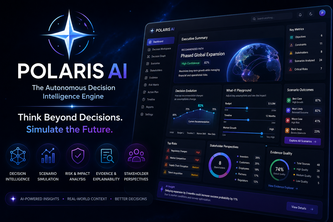
What it appears to be: Polaris AI is described as an "Autonomous Decision Intelligence Engine" that uses GPT-5.6 to create interactive decision workspaces for complex strategic problems. It aims to support collaborative reasoning and adaptive decision-making through structured modeling, scenario simulation, and evidence-based recommendations.
What changed: The author states they built this platform to move beyond static AI responses toward a dynamic, interactive experience where decisions evolve with changing assumptions. This represents a shift from question-answering to reasoning-as-a-service for strategic planning.
Single most important open question: Is there a real market need for an AI-powered decision workspace that supports structured reasoning and multi-stakeholder collaboration — or is this a speculative prototype?
What The Product Actually Is
The description states that Polaris AI is an "Autonomous Decision Intelligence Engine" that transforms complex documents, business ideas, and strategic questions into interactive decision workspaces.
It uses GPT-5.6 for structured reasoning, decision analysis, evidence synthesis, stakeholder modeling, and scenario generation.
Key components include:
- A decision graph
- Scenario simulation (best case, worst case, most likely, black swan)
- What-if playground with interactive sliders
- Evidence explorer
- Stakeholder intelligence
- Executive reports
The platform is built using:
- Frontend: React, TypeScript, Tailwind CSS, Framer Motion, React Flow, Recharts
- Backend: Python, FastAPI, PostgreSQL
- AI tools: GPT-5.6, Codex
Inference: The product appears to be a prototype or proof-of-concept built for a hackathon. It is not evidenced to have been deployed in production or used by customers.
Positioning & Claim Evolution
The author claims that Polaris AI is designed to move beyond simple question-answering to support collaborative reasoning and adaptive decision-making.
It positions itself as:
- An AI-native decision intelligence platform
- A tool for transforming complex problems into structured models
- A system that supports evidence-based recommendations and stakeholder alignment
Inference: The positioning reflects a shift from conversational AI toward systems that model uncertainty, trade-offs, and evolving inputs — though no evidence is provided that such a product has been validated in real-world use.
Target Customer & ICP
The description does not explicitly name target customers or define an ideal customer profile (ICP). However, it implies the platform targets:
- Strategic planners
- Executives making resource allocation decisions
- Teams working on complex business problems
- Organizations seeking to improve decision-making processes
Inference: The product seems aimed at enterprise-level users who need structured support for multi-objective, high-stakes decisions — but no evidence supports whether such a market exists or how large it might be.
Business Model & Pricing Evidence
There is no mention of pricing, monetization strategy, or business model in the description. The author does not state how the product would be sold or who would pay for it.
Inference: No commercial structure is evident beyond the fact that this was a hackathon project.
Technical & Delivery Signals
The platform is built with:
- Frontend: React, TypeScript, Tailwind CSS, Framer Motion, React Flow, Recharts
- Backend: Python, FastAPI, PostgreSQL
- AI tools: GPT-5.6, Codex
It uses GPT-5.6 for structured reasoning and decision analysis.
Inference: The stack suggests a modern full-stack application with a focus on visualization and interactive UIs. However, no evidence of deployment, scalability, or performance is provided.
Traction & Maturity Signals
The description states that this was built for the OpenAI 2026 hackathon and includes no data about:
- Users
- Revenue
- Customers
- Product adoption
- Market feedback
- Iteration history
Inference: This is a prototype or early-stage product with no demonstrated traction or maturity.
Competitive Context
The description does not mention competitors. It also does not describe how Polaris AI differs from existing tools for decision modeling, strategic planning, or AI-powered business intelligence.
Inference: No competitive positioning or differentiation strategy is evident.
Open Questions & Risks
- Unproven market demand: The author describes a need but provides no evidence of customer validation.
- Speculative technology stack: GPT-5.6 is not publicly available; its use is unverified.
- No commercial viability: No pricing, monetization or go-to-market strategy is described.
- Prototype nature: Built for a hackathon with no indication of production readiness.
- Single founder: The team size is listed as one person.
Inference: This is a speculative idea without any demonstrated traction, market validation, or business model.
Questions the description leaves open
- What specific strategic decisions are you trying to solve for? Who are the users?
- How do you plan to validate demand for this product in the real world?
- Is GPT-5.6 a real tool, and how is it being used in practice?
- What would a minimum viable product (MVP) look like, and when will it be ready?
- Are there any early adopters or pilot users?
- How do you intend to monetize this platform?
- What are the key technical challenges that remain unresolved?
Overall Assessment
Not evidenced: There is no evidence of revenue, customers, traction, or a clear business model.
Confidence level: Low — based on a single self-reported description from a hackathon submission.
Assessment: This appears to be an early-stage idea or prototype with no demonstrated commercial viability. It lacks any evidence of market demand, user feedback, or product-market fit. Any investment or partnership would be highly speculative and contingent on further development and validation.
User Stories BotA demo video on every pull request
Get a demo video on every new feature
GitHub App that watches your pull requests and records a narrated, captioned demo.
Save time on demo prep and make informed decisions faster with a video walkthrough of every new feature.
Source
Submitted to the OpenAI 2026 hackathon on Devpost. Project home on Devpost. Back to the full gallery on Devpost.
This competitive analysis was produced by top-founders.com (opens in a new tab)
Generated by a language model from this project's public Devpost page — its tagline, the author's own write-up and any built-with tags listed there — as captured in August 2026. Short quotations are the author's words. It is an opinion on the idea as a business, not on the people behind it, and it reflects the description as published then. If the project has moved on, request a correction below. The analysis is not independent research and contains no verified traction, revenue or customer data.
An independent guide by KFG International LLC — not affiliated with, endorsed by, or connected to Devpost or OpenAI.