

Archive position — measured, not model output
2 likes on Devpost
221 of the 7,850 archived projects have more likes, and 284 share exactly 2 — so this project's #279 place in the like-ranked listing is a tie-break inside that group, not a ranking.
Projects (log scale)
Likes on Devpost. ▲ marks this project's group.
Show the figures
| Likes | Projects | Share of archive |
|---|---|---|
| 0 | 5,587 | 71.2% |
| 1 | 1,758 | 22.4% |
| 2 | 284 | 3.6% |
| 3–4 | 132 | 1.7% |
| 5–9 | 75 | 1.0% |
| 10+ | 14 | 0.2% |
 User Stories BotA demo video on every pull request
Get a demo video on every new feature
GitHub App that watches your pull requests and records a narrated, captioned demo.
Save time on demo prep and make informed decisions faster with a video walkthrough of every new feature.
Executive Summary
What the company appears to be
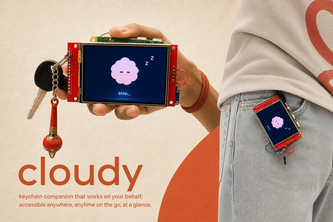
Cloudy! is a self-reported AI-powered keychain companion that aims to bring important digital decisions directly to users in a glanceable format. It connects to tools like GitHub, Gmail, and Codex, and sends notifications (called "Pings") to a physical device — a Raspberry Pi Zero 2 W with a touchscreen — where users can review, approve, or reject actions without needing to open their laptop or phone.
What changed
The project is described as an evolution from a basic notification display into a system that handles real-time updates, integrates with backend services (via Supabase and Hono), supports offline behavior, and allows for voice interaction and decision-making. It was built as part of the OpenAI 2026 hackathon.
Single most important open question
Is there any evidence of traction or early adoption beyond the prototype? The description does not indicate whether Cloudy has moved beyond a proof-of-concept stage, nor if it has been tested in real-world usage by users.
Note: This analysis is based entirely on the self-reported project description provided by the authors. No independent verification, historical data, or external sources are available.
What The Product Actually Is
- The description states that Cloudy is an AI-powered keychain companion.
- It uses a Raspberry Pi Zero 2 W with an ILI9341-compatible touchscreen and XPT2046 touch controller.
- The interface is written in Python using Pygame, rendering directly to the Linux framebuffer.
- A dashboard built with Next.js allows users to connect services, configure Pings, and simulate scenarios.
- Backend uses Hono with Supabase for authentication, data storage, and real-time updates.
- It supports authenticated server-sent events and fallback polling for communication.
- Approvals and rejections are handled via HTTP requests to ensure explicit and secure decisions.
Inference: The product is a hybrid of hardware and software — a physical device (keychain) with an integrated UI that receives and acts on AI-generated actions from connected tools. It is not a standalone app or SaaS offering but rather a prototype system designed for personal use.
Positioning & Claim Evolution
- The author claims Cloudy brings "your most important digital decisions" to a keychain companion.
- It positions itself as an alternative to opening laptops or phones for quick HITL (Human-in-the-Loop) approvals.
- The goal is to reduce friction in decision-making by bringing context and action directly to the user’s hand.
- The product evolves from a simple display into one that supports real-time updates, offline behavior, and voice interaction.
Inference: Cloudy's positioning shifts from a novelty or hackathon prototype to a potential personal AI assistant that sits at the intersection of agent workflows and human control. However, no evidence suggests this has been validated beyond internal development.
Target Customer & ICP
- The description does not name specific customer segments.
- It implies a user who works with AI agents (e.g., Codex, GitHub, Gmail) and needs to make fast but important decisions.
- The target is likely developers or technical professionals who rely on automation tools and need to approve or reject agent-generated outputs.
Inference: Based on the tech stack and use cases described, the ICP appears to be early-stage technical users — possibly developers or engineers — who are active in AI agent workflows. No explicit segmentation or persona data is provided.
Business Model & Pricing Evidence
- There is no mention of pricing models, monetization strategies, or business model assumptions.
- The project is described as a hackathon submission and prototype.
- No indication of whether Cloudy intends to sell hardware, software, or SaaS services.
Inference: No evidence exists regarding how the product would be monetized. It remains unclear if it will be sold as a consumer device, offered as part of an enterprise platform, or used internally by teams.
Technical & Delivery Signals
- Built with Raspberry Pi Zero 2 W and a 2.8-inch SPI touchscreen.
- Uses Python (Pygame), Next.js, Hono, Supabase, OpenAI, Node.js, React, and other technologies.
- Implements real-time communication via server-sent events and Supabase Realtime.
- Supports offline behavior with cached state and fallback polling.
- Includes voice interaction capabilities in future plans.
Inference: The technical architecture shows a strong focus on embedded systems, real-time data delivery, and minimalistic UI design. However, the description lacks details about scalability or production readiness.
Traction & Maturity Signals
- The project is described as a prototype built during a hackathon.
- It includes realistic flows for GitHub PRs, email replies, deployments, and Codex plans.
- The team reports having fixed hardware and interaction bugs.
- No mention of user testing, beta programs, or adoption metrics.
Inference: There is no evidence of traction beyond the prototype stage. The project has not demonstrated any real-world usage or customer feedback.
Competitive Context
- The description does not reference direct competitors.
- It aligns with trends in AI agent interfaces and HITL decision-making tools.
- Similar concepts may exist in the marketplace, but no competitive analysis is included.
Inference: While Cloudy fits into a broader category of AI workflow tools, there is no evidence of competitive positioning or awareness of existing solutions.
Open Questions & Risks
- The product is described as a hackathon prototype — not validated for real-world use.
- No evidence of revenue, customers, or traction.
- Hardware design and physical integration are still in early stages (e.g., jumper wires, custom board).
- Lack of clarity on how the system scales beyond one user or device.
- No mention of security practices beyond authentication.
Inference: The biggest risk is that Cloudy remains a conceptual prototype without any commercial viability or market validation. Physical hardware challenges and limited integration points raise concerns about long-term feasibility.
Questions the description leaves open
- Has the prototype been tested with real users in real-world settings?
- What are the plans for scaling beyond one device/user?
- How does Cloudy handle sensitive data, especially when integrating with tools like GitHub and Gmail?
- Are there any existing partnerships or integrations with AI agents or platforms (e.g., OpenAI, LangChain)?
- What is the roadmap for hardware improvements, including battery life, size, and enclosure design?
- Is there a plan to move from a personal device to a more scalable or shared model?
Overall Assessment
- The project is described as a hackathon prototype with no evidence of traction, revenue, or customer validation.
- It shows technical capability in building a hardware-software hybrid but lacks commercial maturity.
- No indication of a clear path to monetization or market fit.
Assessment: Not ready for investment or partnership at this stage. The product is an interesting concept and early-stage prototype, but lacks the evidence required to assess its viability as a business or scalable solution.
User Stories BotA demo video on every pull request
Get a demo video on every new feature
GitHub App that watches your pull requests and records a narrated, captioned demo.
Save time on demo prep and make informed decisions faster with a video walkthrough of every new feature.
Source
Submitted to the OpenAI 2026 hackathon on Devpost. Project home on Devpost. Back to the full gallery on Devpost.
This competitive analysis was produced by top-founders.com (opens in a new tab)
Generated by a language model from this project's public Devpost page — its tagline, the author's own write-up and any built-with tags listed there — as captured in August 2026. Short quotations are the author's words. It is an opinion on the idea as a business, not on the people behind it, and it reflects the description as published then. If the project has moved on, request a correction below. The analysis is not independent research and contains no verified traction, revenue or customer data.
An independent guide by KFG International LLC — not affiliated with, endorsed by, or connected to Devpost or OpenAI.