

Archive position — measured, not model output
0 likes on Devpost
2,263 of the 7,850 archived projects have more likes, and 5,587 share exactly 0 — so this project's #4,205 place in the like-ranked listing is a tie-break inside that group, not a ranking.
Projects (log scale)
Likes on Devpost. ▲ marks this project's group.
Show the figures
| Likes | Projects | Share of archive |
|---|---|---|
| 0 | 5,587 | 71.2% |
| 1 | 1,758 | 22.4% |
| 2 | 284 | 3.6% |
| 3–4 | 132 | 1.7% |
| 5–9 | 75 | 1.0% |
| 10+ | 14 | 0.2% |
 User Stories BotA demo video on every pull request
Get a demo video on every new feature
GitHub App that watches your pull requests and records a narrated, captioned demo.
Save time on demo prep and make informed decisions faster with a video walkthrough of every new feature.
Executive Summary
What the company appears to be
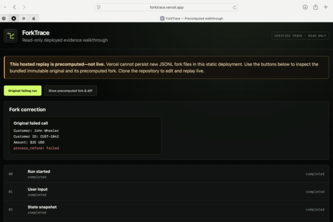
ForkTrace is a time-travel debugging tool for AI agents, designed to allow developers to inspect failed agent runs, fork at a specific step, modify one input, and replay only the downstream path while comparing outcomes.
What changed
The project was submitted as part of the OpenAI 2026 hackathon. It represents an early-stage prototype built with TypeScript, React, Vite, and the OpenAI Agents SDK. The author describes it as a self-contained demo with no live replay in its deployed version, but with full local functionality.
Single most important open question
Is there evidence of traction or commercial interest from developers using this tool? The description states no revenue, customers, or adoption data beyond the hackathon submission and public repository.
What The Product Actually Is
The description states that ForkTrace is a time-travel debugging tool for AI agents. It records observable execution events such as user input, model messages, tool calls, tool results, state snapshots, errors, and final outputs. A developer can select a failed event, create an immutable fork, edit one tool argument, and replay the downstream path.
It uses a five-layer architecture:
- A recorder stores each agent event in append-only JSONL.
- A fork engine copies the trace up to a selected event and records full lineage.
- A replay engine reuses recorded tool results when inputs are unchanged.
- Changed tool calls are executed safely and marked DIVERGED.
- A diff engine compares the original and forked outcomes using recorded evidence.
The author notes that it was built with TypeScript, React, Vite, the OpenAI Agents SDK, Codex, and GPT-5.6.
Confidence High — this is a self-reported technical description of the product’s architecture and functionality.
Positioning & Claim Evolution
The author states that ForkTrace was inspired by the question: “What if a developer could pause an agent run at the failed step, change one value, and replay only what follows—without changing the original evidence?”
It positions itself as a debugging tool for AI agents, aiming to improve upon existing tracing tools that show sequences but do not allow developers to test corrections without rerunning the entire workflow.
The product claims to support:
- Immutable recording of agent events.
- Forking at any point in an execution trace.
- Replay of downstream paths with clear divergence markers.
- Comparison between original and forked outcomes.
It explicitly states it does not claim to expose private chain-of-thought or hidden reasoning, only observable evidence.
Confidence High — the positioning is clearly articulated by the author.
Target Customer & ICP
The description indicates that the target customer is developers working with AI agents, particularly those using tools like the OpenAI Agents SDK. The tool is aimed at improving debugging workflows for agent-based systems where failures are hard to isolate and test.
There is no mention of specific industries, roles, or use cases beyond general developer needs in AI agent development.
Confidence Medium — the description implies a developer audience but does not define a precise ICP.
Business Model & Pricing Evidence
The description provides no evidence of a business model or pricing structure. It describes a hackathon project with a public repository and a read-only demo, without any indication of monetization, subscriptions, or paid features.
Confidence Very low — no commercial elements are described.
Technical & Delivery Signals
- The tool is built using TypeScript, React, Vite, OpenAI Agents SDK, Codex, and GPT-5.6.
- It uses a five-layer architecture: recorder, fork engine, replay engine, divergence detection, and diff engine.
- The system supports append-only JSONL storage of events.
- It marks changed tool calls as DIVERGED and reuses memoized results for unchanged calls.
- The demo is deployed via Vercel but only shows a read-only walkthrough; live editing and replay work locally.
Confidence High — the technical details are self-reported and consistent with the stated architecture.
Traction & Maturity Signals
The project was submitted to the OpenAI 2026 hackathon. The author states:
- It includes a public repository.
- The deployed demo is read-only, but local functionality supports full replay.
- It passed the planted failure audit 10 out of 10 times.
- Three consecutive end-to-end replay rehearsals were completed.
There is no evidence of revenue, customers, or adoption beyond this submission and its demonstration.
Confidence Low — no traction data is provided.
Competitive Context
The description does not mention any competitors. It focuses on the problem of debugging AI agents and how ForkTrace addresses it differently from existing tracing tools.
Confidence Very low — no competitive analysis or market positioning beyond the author’s own claims.
Open Questions & Risks
- The deployed demo is read-only, suggesting that live functionality is not available in production.
- The tool does not claim perfect determinism; future model calls may not be reproduced identically.
- It is a hackathon project with no evidence of commercial traction or product-market fit.
- No pricing, monetization, or customer data are provided.
Confidence Medium — risks are inferred from the lack of production-ready features and absence of commercial signals.
Questions the description leaves open
- What is the current state of the product beyond the hackathon demo? Is there a working prototype or alpha?
- Are there any early adopters or users who have tested this in real-world agent workflows?
- How does ForkTrace handle edge cases where model outputs differ even with identical inputs?
- What are the plans for integrating with other AI agent platforms beyond OpenAI?
- Is there a roadmap for monetization or commercial deployment?
Confidence Medium — these questions aim to probe gaps in the self-reported information.
Overall Assessment
The description presents ForkTrace as an early-stage hackathon project with no evidence of revenue, customers, or traction. It is not yet clear whether it has evolved into a viable product or business model.
Assessment Not evidenced — there is insufficient data to assess investment or partnership potential at this stage. The tool shows promise in solving a real problem for AI agent developers but lacks commercial signals or maturity indicators.
Confidence Very low — the project is described as a prototype, not a product with traction or market validation.
User Stories BotA demo video on every pull request
Get a demo video on every new feature
GitHub App that watches your pull requests and records a narrated, captioned demo.
Save time on demo prep and make informed decisions faster with a video walkthrough of every new feature.
Source
Submitted to the OpenAI 2026 hackathon on Devpost. Project home on Devpost. Back to the full gallery on Devpost.
This competitive analysis was produced by top-founders.com (opens in a new tab)
Generated by a language model from this project's public Devpost page — its tagline, the author's own write-up and any built-with tags listed there — as captured in August 2026. Short quotations are the author's words. It is an opinion on the idea as a business, not on the people behind it, and it reflects the description as published then. If the project has moved on, request a correction below. The analysis is not independent research and contains no verified traction, revenue or customer data.
An independent guide by KFG International LLC — not affiliated with, endorsed by, or connected to Devpost or OpenAI.