

Archive position — measured, not model output
2 likes on Devpost
221 of the 7,850 archived projects have more likes, and 284 share exactly 2 — so this project's #264 place in the like-ranked listing is a tie-break inside that group, not a ranking.
Projects (log scale)
Likes on Devpost. ▲ marks this project's group.
Show the figures
| Likes | Projects | Share of archive |
|---|---|---|
| 0 | 5,587 | 71.2% |
| 1 | 1,758 | 22.4% |
| 2 | 284 | 3.6% |
| 3–4 | 132 | 1.7% |
| 5–9 | 75 | 1.0% |
| 10+ | 14 | 0.2% |
 User Stories BotA demo video on every pull request
Get a demo video on every new feature
GitHub App that watches your pull requests and records a narrated, captioned demo.
Save time on demo prep and make informed decisions faster with a video walkthrough of every new feature.
Executive Summary
What the company appears to be
Plaza Cartas is a peer-to-peer (P2P) marketplace for trading collectible cards, such as Pokémon, Magic: The Gathering, Yu-Gi-Oh!, Digimon, and One Piece. It operates within local markets in Bolivia, Argentina, Chile, and Mexico, with listings tied to the seller’s country, currency, and location at publication time. The platform facilitates discovery, inventory management, communication between buyers and sellers, and reputation systems, while keeping final commercial agreements directly between users.
What changed
The project is a self-reported MVP built by one developer (Joaquin Cartagena Villarroel) as part of the OpenAI 2026 hackathon. It includes a full-stack web application with modular monolith architecture, integration with card APIs, real-time messaging, and local market intelligence features.
Single most important open question
Is there any evidence of user adoption or revenue generation beyond the author's own description?
Note: This analysis is based entirely on the self-reported project description provided by the author. No external verification, traction data, customer names, or financials are available. All claims in this report are stated by the author and not independently confirmed.
What The Product Actually Is
The description states that Plaza Cartas is a peer-to-peer marketplace for collectible cards. It supports trading across multiple card games including Pokémon, Magic: The Gathering, Yu-Gi-Oh!, Digimon, and One Piece.
Key functional elements include:
- Structured card catalog with filtering by price, condition, language, finish, availability, and market.
- Cart functionality that turns purchases into inquiries instead of immediate payments.
- Private in-app messaging between buyer and seller for negotiation.
- Seller tools to create profiles, publish cards individually or in bulk, manage inventory, and receive purchase inquiries.
- Inventory reservation system where units are reserved upon inquiry acceptance and returned if cancelled.
- Local-first approach: listings are tied to the seller’s country, currency, and location at publication time.
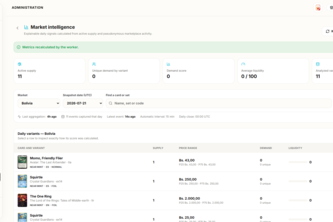
- Market intelligence panel showing supply, demand, liquidity, and confidence metrics derived from pseudonymous activity.
The platform is intentionally decentralized — it does not hold payments or act as an escrow service. Instead, it focuses on coordination between users through public profiles, transaction-based reviews, reporting tools, and moderation.
Claim: The product is a full-stack web application built with Next.js, React, PostgreSQL, Prisma, and other technologies.
Evidence: Author's own write-up.
Positioning & Claim Evolution
The description states that Plaza Cartas brings together people who want to buy, sell, and collect cards in one local-first platform. It positions itself as a decentralized marketplace that avoids centralization of payment or logistics, focusing instead on facilitating safe peer-to-peer coordination.
It also claims to generate local market signals from pseudonymous user activity (searches, views, cart additions, etc.) to inform supply, demand, and liquidity trends — though these are described as operational signals, not guarantees or predictions.
The platform is presented as a structured, local-first marketplace, not a global checkout flow. It supports multiple card games and markets but avoids mixing currencies or silently moving listings between regions.
Claim: Plaza Cartas organizes discovery, listings, inventory reservations, communication, reputation, and local market insight.
Evidence: Author's own write-up.
Target Customer & ICP
The description indicates that the target customers are:
- Buyers looking to purchase collectible cards (e.g., Pokémon, Magic: The Gathering).
- Sellers who want to list their cards for sale in a local market context.
- Users within specific geographic markets: Bolivia, Argentina, Chile, and Mexico.
Each listing is tied to the seller's country, currency, and location at publication time. This implies that users are primarily interested in local transactions, not international trade.
Claim: The platform supports local markets without mixing currencies or silently moving listings between regions.
Evidence: Author's own write-up.
Business Model & Pricing Evidence
The description does not provide explicit information about pricing models, fees, or monetization strategies. It states that Plaza Cartas does not hold card-sale payments, process shipping, or act as an escrow service — meaning it is not taking a cut of transactions.
There is no mention of subscription plans, listing fees, or any form of revenue generation beyond the platform being used for P2P trading.
Claim: The platform does not process payments or act as an escrow.
Evidence: Author's own write-up.
Claim: No pricing or fee structure described.
Evidence: Not evidenced.
Technical & Delivery Signals
The project is built using:
- Frontend: Next.js, React, Tailwind CSS, TanStack Query
- Backend: PostgreSQL, Prisma, Node.js (via Docker)
- Authentication: Better Auth
- Real-time communication: Socket.IO
- Catalog data integration: Pokémon TCG API, Scryfall API
- Image hosting: Cloudflare R2, Cloudinary
- Analytics engine: Python 3.12 with psycopg 3 and standard libraries
The architecture is described as a modular monolith, which allows faster iteration while keeping responsibilities clearly separated.
Key technical features include:
- Server-controlled lifecycle for purchase inquiries (pending, accepted, completed, cancelled)
- Inventory consistency via database-level operations
- Pseudonymous market intelligence engine using deterministic heuristics
- Admin-only dashboard with market summaries and visualizations
Claim: Modular monolith architecture used.
Evidence: Author's own write-up.
Traction & Maturity Signals
There is no evidence of traction, revenue, or customer adoption beyond the author’s own description. The project is described as an MVP built for a hackathon by one developer.
The platform currently supports only four local markets (Bolivia, Argentina, Chile, Mexico), and there are no mentions of user growth, retention, or monetization metrics.
Claim: Platform is an MVP built for a hackathon.
Evidence: Author's own write-up.
Claim: No traction data provided.
Evidence: Not evidenced.
Competitive Context
The description does not provide any information about competitors or competitive positioning. It does not reference existing platforms like eBay, Facebook Marketplace, or specialized card trading apps.
It is unclear whether Plaza Cartas operates in a niche space or competes with broader P2P marketplaces.
Claim: No mention of competitors.
Evidence: Not evidenced.
Open Questions & Risks
Several potential risks and open questions are implied by the self-reported nature of the project:
- The platform is built by a single developer, raising concerns about scalability, maintenance, and long-term viability.
- It relies heavily on external APIs (Pokémon TCG API, Scryfall) for catalog data — which may introduce dependency risks or rate-limiting issues.
- The lack of revenue or customer data raises questions about product-market fit or commercial traction.
- The absence of any monetization strategy suggests the platform may not yet be viable as a business model.
- The use of pseudonymous analytics and deterministic scoring systems, while transparent, does not guarantee accuracy or predictive power.
Inference: Lack of revenue or customer data implies no proven commercial viability.
Evidence: Not evidenced.
Questions the description leaves open
- What is the current user base? Are there any active buyers or sellers?
- How many listings have been published, and how many transactions have occurred?
- Has the platform been tested in real-world conditions beyond the hackathon?
- What are the plans for monetization or scaling beyond the current markets?
- How is data integrity maintained when relying on external APIs?
- Are there any known issues with inventory consistency or messaging reliability?
- Is there a plan to expand beyond the current four countries?
Overall Assessment
At this stage, Plaza Cartas appears to be an early-stage MVP built by one individual for a hackathon. It demonstrates technical capability and a clear understanding of local P2P card trading dynamics.
However, there is no evidence of traction, revenue, or customer adoption beyond the author’s own description. Without independent verification or data on user engagement, commercial viability remains unproven.
Inference: The project lacks commercial due-diligence signals.
Evidence: Not evidenced.
User Stories BotA demo video on every pull request
Get a demo video on every new feature
GitHub App that watches your pull requests and records a narrated, captioned demo.
Save time on demo prep and make informed decisions faster with a video walkthrough of every new feature.
Source
Submitted to the OpenAI 2026 hackathon on Devpost. Project home on Devpost. Back to the full gallery on Devpost.
This competitive analysis was produced by top-founders.com (opens in a new tab)
Generated by a language model from this project's public Devpost page — its tagline, the author's own write-up and any built-with tags listed there — as captured in August 2026. Short quotations are the author's words. It is an opinion on the idea as a business, not on the people behind it, and it reflects the description as published then. If the project has moved on, request a correction below. The analysis is not independent research and contains no verified traction, revenue or customer data.
An independent guide by KFG International LLC — not affiliated with, endorsed by, or connected to Devpost or OpenAI.