

Archive position — measured, not model output
1 like on Devpost
505 of the 7,850 archived projects have more likes, and 1,758 share exactly 1 — so this project's #2,227 place in the like-ranked listing is a tie-break inside that group, not a ranking.
Projects (log scale)
Likes on Devpost. ▲ marks this project's group.
Show the figures
| Likes | Projects | Share of archive |
|---|---|---|
| 0 | 5,587 | 71.2% |
| 1 | 1,758 | 22.4% |
| 2 | 284 | 3.6% |
| 3–4 | 132 | 1.7% |
| 5–9 | 75 | 1.0% |
| 10+ | 14 | 0.2% |
 User Stories BotA demo video on every pull request
Get a demo video on every new feature
GitHub App that watches your pull requests and records a narrated, captioned demo.
Save time on demo prep and make informed decisions faster with a video walkthrough of every new feature.
Executive Summary
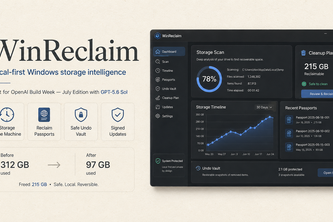
What the company appears to be: WinReclaim is a local-first Windows desktop application designed to help users understand and reclaim disk space by identifying what is consuming storage, classifying its ownership and safety, and enabling reversible cleanup actions.
What changed: The author built this tool after manually investigating their own drive using AI assistance (Codex), which revealed that common assumptions about storage usage were incorrect. They then developed a structured system to automate this process with deterministic safety checks and local AI interpretation.
The single most important open question: Does the author’s self-reported experience of reclaiming 27.55 GB represent typical user outcomes, or is this an outlier case? This is critical for assessing whether WinReclaim delivers meaningful value at scale.
What The Product Actually Is
The description states that WinReclaim is a local-first Windows storage intelligence application. It performs the following functions:
- Identifies what is consuming disk space.
- Determines which application or development workload likely owns it.
- Shows changes since an earlier scan.
- Evaluates whether data is eligible for cleanup.
- Indicates if the operation can be reversed.
- Creates local snapshots to compare storage over time.
- Provides "Reclaim Passports" that describe each finding’s ownership, safety class, and consequences of removal.
- Offers a simulation mode before execution to show estimated reclaimable space and affected actions.
- Includes a safe undo vault for temporary files and crash dumps.
- Uses deterministic cleanup rules implemented in Rust.
- Has an optional local AI assistant (Qwen3.5-2B) that interprets scan results but does not control cleanup.
The product is built as a Windows desktop application using technologies including Rust, Tauri 2, React/TypeScript, and llama.cpp for local inference.
Claim: WinReclaim is a Windows storage intelligence tool.
Evidence: The author describes it as such in the write-up.
Inference: It is a desktop app with AI interpretation capabilities.
Evidence: The description mentions Tauri, React/TypeScript, and Qwen3.5-2B inference runtime.
Positioning & Claim Evolution
The author positions WinReclaim as a solution to the problem of unclear storage ownership on Windows systems — particularly for developers who accumulate large caches, models, emulators, etc.
It evolved from a personal investigation into one’s own drive (using Codex) into a reusable tool, aiming to prevent others from spending hours or AI limits on similar tasks.
The positioning emphasizes:
- Local-first design: No reliance on cloud APIs.
- Safety and reversibility: Cleanups are simulated, hash-verified, and undoable.
- Contextual understanding: Explains what created folders and whether they can be safely removed.
- Developer-focused: Targets users with complex development environments.
Claim: WinReclaim helps developers reclaim disk space without risking important data.
Evidence: The author says it was built to avoid spending hours or AI limits manually investigating drives.
Inference: It targets a niche but high-value segment — developers with large local caches and tools.
Evidence: The write-up lists many developer-specific storage consumers like Docker, Gradle, npm, Ollama, etc.
Target Customer & ICP
The description implies that WinReclaim is aimed at Windows users who work with software development tools, especially those using:
- AI models (e.g., Ollama)
- Package managers (npm, Gradle)
- Emulators (Android, Docker)
- Build systems (Rust, Python virtual environments)
These users likely have drives filled with large, often unknown or unmanaged caches and generated outputs.
Claim: WinReclaim targets developers managing complex local toolchains.
Evidence: The write-up lists numerous developer tools that consume disk space.
Inference: It may also appeal to power users or IT professionals who manage multiple machines.
Evidence: Not directly stated, but the tool’s structure suggests it could be useful beyond individual developers.
Business Model & Pricing Evidence
There is no evidence of a business model or pricing strategy in the description. The project is presented as a personal hackathon submission and not as a commercial product.
Claim: No commercial model or pricing information provided.
Evidence: The author states this was submitted to an OpenAI Build Week hackathon, with no mention of monetization plans.
Technical & Delivery Signals
The technical stack includes:
- Rust for core logic (scanning, classification, safety enforcement, cleanup planning, execution).
- Tauri 2 for the desktop shell and signed updates.
- React/TypeScript for UI.
- Qwen3.5-2B via llama.cpp for local AI interpretation.
- GitHub Actions for CI/CD.
- Vercel for landing page.
Key delivery signals:
- All model inference happens locally.
- Cleanup actions are deterministic and implemented in Rust adapters.
- Scans produce structured findings with immutable cleanup plans verified by hash.
- Vault entries preserve original paths and can be restored without overwriting existing files.
- The assistant cannot control cleanup or override safety boundaries.
Claim: WinReclaim is built with strong security and determinism.
Evidence: The description details Rust-based safety enforcement, hash verification of plans, and local-only AI use.
Inference: It is designed to be secure and predictable in its behavior.
Evidence: The emphasis on deterministic cleanup rules, protected roots, and no shell injection.
Traction & Maturity Signals
There is no evidence of traction or adoption beyond the author’s own experience. No customers, revenue, usage metrics, or user feedback are mentioned.
Claim: No traction data available.
Evidence: The description does not include any numbers, users, or market validation.
Competitive Context
The description does not provide information about competitors or similar tools in the market. It is unclear whether there are existing solutions for Windows disk space management or local AI-based storage analysis.
Claim: No competitive landscape described.
Evidence: The author does not reference other tools or platforms.
Open Questions & Risks
- No commercial traction or revenue: This is a personal project, not a scalable business.
- Limited scope: Designed for Windows only; no cross-platform support.
- Self-reported effectiveness: The 27.55 GB figure may be an outlier case.
- Single-person team: No evidence of scaling beyond one developer.
- Hackathon origin: Likely not mature enough for enterprise adoption.
Inference: Lack of commercial viability or scalability.
Evidence: The project is described as a hackathon submission with no mention of monetization, users, or growth plans.
Questions the description leaves open
- How many users have tried WinReclaim beyond yourself?
- What percentage of users actually perform cleanup actions after scanning?
- Are there any performance bottlenecks in NTFS-aware scanning or incremental updates?
- How do you plan to handle edge cases like locked files, permissions, or system-level caches?
- Have you considered integrating with package managers or cloud storage providers?
- What is the long-term roadmap for expanding support beyond developer tools?
Overall Assessment
Not evidenced: There is no evidence of revenue, customers, traction, or a clear path to monetization.
Claim: No investment or partnership potential based on available information.
Evidence: The project is self-reported as a hackathon submission with no commercial data.
Inference: It may be a useful tool for developers but lacks signs of a scalable business model.
Evidence: The lack of any mention of users, monetization, or market traction.
User Stories BotA demo video on every pull request
Get a demo video on every new feature
GitHub App that watches your pull requests and records a narrated, captioned demo.
Save time on demo prep and make informed decisions faster with a video walkthrough of every new feature.
Source
Submitted to the OpenAI 2026 hackathon on Devpost. Project home on Devpost. Back to the full gallery on Devpost.
This competitive analysis was produced by top-founders.com (opens in a new tab)
Generated by a language model from this project's public Devpost page — its tagline, the author's own write-up and any built-with tags listed there — as captured in August 2026. Short quotations are the author's words. It is an opinion on the idea as a business, not on the people behind it, and it reflects the description as published then. If the project has moved on, request a correction below. The analysis is not independent research and contains no verified traction, revenue or customer data.
An independent guide by KFG International LLC — not affiliated with, endorsed by, or connected to Devpost or OpenAI.