

Archive position — measured, not model output
0 likes on Devpost
2,263 of the 7,850 archived projects have more likes, and 5,587 share exactly 0 — so this project's #5,962 place in the like-ranked listing is a tie-break inside that group, not a ranking.
Projects (log scale)
Likes on Devpost. ▲ marks this project's group.
Show the figures
| Likes | Projects | Share of archive |
|---|---|---|
| 0 | 5,587 | 71.2% |
| 1 | 1,758 | 22.4% |
| 2 | 284 | 3.6% |
| 3–4 | 132 | 1.7% |
| 5–9 | 75 | 1.0% |
| 10+ | 14 | 0.2% |
 User Stories BotA demo video on every pull request
Get a demo video on every new feature
GitHub App that watches your pull requests and records a narrated, captioned demo.
Save time on demo prep and make informed decisions faster with a video walkthrough of every new feature.
Executive Summary
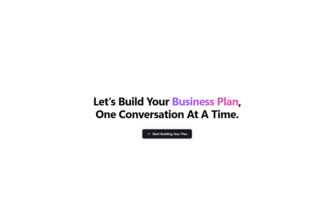
Plan Forge is an AI-powered startup mentor tool built by a single founder (Maya Shayya) for students and inexperienced founders. The product uses a conversational interface to guide users through an interview process, then auto-generates three outputs: a business plan, a pitch coach, and an actionable roadmap. It was developed as part of the OpenAI 2026 hackathon.
The description states that Plan Forge aims to reduce friction in startup documentation so founders can focus on execution. It is built with Next.js, shadcn, and TypeScript, using OpenAI's ChatGPT as its core reasoning engine.
Key commercial due-diligence read
The author claims Plan Forge removes the "cognitive load" of writing business plans and building pitches, but there is no evidence of actual traction, revenue, or customer adoption. The tool appears to be a prototype or proof-of-concept built in a short timeframe, with no indication it has moved beyond the ideation stage.
Most important open question
Is there any evidence that users have actually used Plan Forge beyond the hackathon context, and if so, what was their experience?
What The Product Actually Is
The description states that Plan Forge is an AI-powered startup mentor. It operates through a conversational chat interface where it conducts a guided interview to extract user vision.
It generates three outputs:
- A business plan maker
- A pitch coach
- An actionable roadmap
These are described as being derived from the conversation, with specialized prompt chains used for each output.
The tool uses OpenAI's ChatGPT as its core reasoning engine and is built using Next.js, shadcn, and TypeScript.
Inference The product appears to be a prototype or hackathon project, not a production-ready SaaS offering. It is described as being built in a compressed timeframe (less than a week) for a hackathon.
Positioning & Claim Evolution
The description states that Plan Forge was inspired by the founder's personal frustration with writing business plans and the gap between idea and execution. The product positions itself as an "accessible, infinitely patient AI co-founder" that removes friction from technical documentation so founders can focus on execution.
It claims to bridge the gap between ideation and execution by transforming raw ideas into structured outputs like business plans, pitches, and roadmaps.
Inference The positioning is aspirational — it positions itself as a solution for inexperienced founders who lack time or expertise in writing business plans. However, there is no evidence of actual user feedback or market validation beyond the author's own account.
Target Customer & ICP
The description states that Plan Forge targets students and inexperienced founders who are starting their first businesses. It is designed to help those who begin with passion and innovation but struggle with operational realities like financial formatting, investor communication, and timeline mapping.
It also mentions that it helps people who "end up spending 80% of your time figuring out how to write a business plan rather than actually building the business."
Inference The target customer is likely early-stage founders or students with limited experience in business planning. However, there is no evidence of actual customers or user personas beyond the author’s own description.
Business Model & Pricing Evidence
The description does not provide any information about pricing, monetization strategy, or business model. It only describes what the tool does and how it works.
Not evidenced No mention of revenue streams, subscription models, freemium tiers, or any commercial framework.
Technical & Delivery Signals
Plan Forge is built with:
- Next.js
- shadcn
- TypeScript
- OpenAI ChatGPT as core reasoning engine
It uses an orchestrator to manage conversation state and employs prompt chaining across three modules:
- Gathering agent for interview
- Business plan generator
- Pitch coach
- Roadmap builder
The architecture is described as relying on "complex prompt chaining" and "structured data extraction."
Inference The tool appears to be a prototype built in a short time, likely using AI-as-a-service rather than proprietary tech. It shows some technical sophistication but lacks evidence of scalability or production deployment.
Traction & Maturity Signals
The description states that this project was submitted to the OpenAI 2026 hackathon and was developed in a compressed timeline (less than a week). The author notes they had to prioritize core functionality over aesthetics due to time constraints.
There is no evidence of:
- Users beyond the founder
- Revenue or monetization
- Customer adoption or retention
- Product usage metrics
- Market validation
Not evidenced No traction data, user feedback, or performance indicators are provided.
Competitive Context
The description does not mention any competitors. It does not describe how Plan Forge compares to existing tools for business planning, pitch coaching, or startup roadmapping.
Not evidenced No competitive landscape analysis or differentiation strategy is described.
Open Questions & Risks
- Prototype only: Built as a hackathon project with no indication of production readiness.
- No traction or revenue: No evidence of users, customers, or monetization.
- Unverified claims: All benefits are self-reported without external validation.
- Single founder: The entire product is built by one person (Maya Shayya).
- Limited scope: The tool only generates outputs based on a conversation; no integration with real-time data or external tools beyond ChatGPT.
- No market validation: No evidence of user testing, feedback loops, or iterative development beyond the hackathon.
Inference The product is likely in an early-stage prototype phase and has not yet demonstrated viability or scalability.
Questions the description leaves open
- What specific problems do users face when trying to write business plans or pitch decks?
- Have you conducted any user interviews or testing beyond the hackathon?
- How do you plan to monetize this tool if it is currently only a prototype?
- What are your plans for scaling beyond a single-user, conversational interface?
- Are there any existing tools that solve similar problems, and how does Plan Forge differ?
- Do you have any data on user engagement or retention post-hackathon?
Overall Assessment
Plan Forge is described as a hackathon project built by one person (Maya Shayya). It has no demonstrated traction, revenue, or customer base. The tool is presented as a prototype that aims to automate business planning and pitch coaching through AI.
Assessment Not ready for investment or partnership at this stage. The product lacks evidence of commercial viability, user adoption, or market validation. It may be a promising concept, but there is no substantiated proof of progress beyond the initial idea and prototype phase.
Confidence level Low — based entirely on self-reported information with no external corroboration or performance data.
User Stories BotA demo video on every pull request
Get a demo video on every new feature
GitHub App that watches your pull requests and records a narrated, captioned demo.
Save time on demo prep and make informed decisions faster with a video walkthrough of every new feature.
Source
Submitted to the OpenAI 2026 hackathon on Devpost. Project home on Devpost. Back to the full gallery on Devpost.
This competitive analysis was produced by top-founders.com (opens in a new tab)
Generated by a language model from this project's public Devpost page — its tagline, the author's own write-up and any built-with tags listed there — as captured in August 2026. Short quotations are the author's words. It is an opinion on the idea as a business, not on the people behind it, and it reflects the description as published then. If the project has moved on, request a correction below. The analysis is not independent research and contains no verified traction, revenue or customer data.
An independent guide by KFG International LLC — not affiliated with, endorsed by, or connected to Devpost or OpenAI.