

Archive position — measured, not model output
1 like on Devpost
505 of the 7,850 archived projects have more likes, and 1,758 share exactly 1 — so this project's #1,665 place in the like-ranked listing is a tie-break inside that group, not a ranking.
Projects (log scale)
Likes on Devpost. ▲ marks this project's group.
Show the figures
| Likes | Projects | Share of archive |
|---|---|---|
| 0 | 5,587 | 71.2% |
| 1 | 1,758 | 22.4% |
| 2 | 284 | 3.6% |
| 3–4 | 132 | 1.7% |
| 5–9 | 75 | 1.0% |
| 10+ | 14 | 0.2% |
 User Stories BotA demo video on every pull request
Get a demo video on every new feature
GitHub App that watches your pull requests and records a narrated, captioned demo.
Save time on demo prep and make informed decisions faster with a video walkthrough of every new feature.
Executive Summary
PIPO Emergency Layer is a self-reported prototype for a digital emergency response system that aims to structure alerts, support human triage, and preserve institutional traceability without replacing official emergency services. The project was built by one individual (Pagnini Angel Adrian) during the OpenAI 2026 hackathon, using tools like OpenAI Codex, HTML, CSS, JavaScript, and GitHub Pages.
The description states that PIPO is organized into three layers: citizen-facing alert activation, institutional operator console, and a digital governance layer focused on identity, roles, auditability, privacy, and security. It includes simulated functionality such as incident-type selection, risk classification, referral to response areas, status tracking, and an auditable timeline.
The system is explicitly described as not replacing official emergency services, not collecting personal data, not accessing real device sensors, and not connecting to official infrastructure. All elements are simulated for demonstration purposes only.
What changed: The project evolved from a visual prototype to an AI-assisted workflow during the OpenAI Build Week, focusing on transforming free-text reports into structured information and supporting human decision-making.
Single most important open question: Is there any evidence of institutional interest or pilot testing beyond this public prototype? The description does not indicate any real-world deployment or engagement with emergency services.
What The Product Actually Is
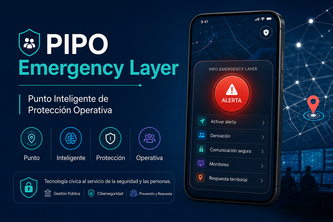
The description states that PIPO Emergency Layer is a public and responsible prototype of a digital emergency layer designed to connect people at risk with institutional and territorial response systems.
It includes:
- A rapid and accessible emergency activation interface
- Incident-type selection
- Structured alert creation
- A simulated institutional reception console
- Preliminary risk classification
- Referral to appropriate response areas
- Incident status tracking
- An auditable action timeline
- Mandatory incident closure
The system is organized into three connected layers:
- Citizen layer: Alert activation, minimum incident information, location and available evidence.
- Institutional layer: Operator reception, classification, referral, follow-up and closure.
- Digital governance layer: Identity, roles, minimum privilege, auditability, privacy and security-by-design.
The prototype is built using HTML, CSS, JavaScript, deployed via GitHub Pages, and supported by OpenAI Codex for iterative design and prototyping.
Inference: The system appears to be a conceptual framework for digital emergency response with an emphasis on human-in-the-loop AI assistance and institutional accountability. It is not a production-ready tool but a demonstration of how such a system might function.
Positioning & Claim Evolution
The description states that PIPO was created from the principle: "access to emergency assistance should not depend on which application is open on a person's device."
It positions itself as:
- A digital emergency layer that connects citizens with institutional response systems.
- An AI-assisted triage system, designed to support human operators rather than replace them.
- A responsible public prototype, clearly distinguishing its simulated nature from real-world implementation.
The project evolved during the OpenAI Build Week to focus more on AI assistance, including:
- Transforming free-text reports into structured incident information
- Suggesting preliminary risk categories
- Identifying missing critical information
- Recommending possible institutional destinations
Inference: The positioning has shifted from a general emergency response prototype to one that emphasizes human-in-the-loop AI assistance, while maintaining its stance on not replacing official services or automating autonomous dispatch decisions.
Target Customer & ICP
The description states that PIPO is designed for:
- Citizens at risk who need to activate an emergency alert.
- Institutional operators (e.g., emergency response teams, public monitoring centers) who receive and manage incidents.
- Governance bodies responsible for digital safety, privacy, and institutional accountability.
It does not specify any named customer segments or use cases beyond these broad categories. The system is described as being built with a three-layer architecture, suggesting it targets both end-users and institutional stakeholders.
Inference: The ICP appears to be public sector emergency response teams, local government agencies, and emergency management institutions, though no specific customer names or use cases are provided.
Business Model & Pricing Evidence
The description does not provide any evidence of a business model, pricing structure, or monetization strategy. It explicitly states that the prototype is not a production-ready system and that real-world implementation would require legal authorization, institutional agreements, cybersecurity controls, privacy impact assessments, trained operators, auditing, and validated emergency protocols.
Inference: There is no evidence of a business model or pricing structure in the description. The project is presented as a public prototype, not a commercial product.
Technical & Delivery Signals
The project was built using:
- HTML5, CSS3, JavaScript
- OpenAI Codex for prototyping and iterative design
- GitHub Pages for deployment
- Responsive web design
It includes:
- Functional architecture documentation
- MVP definition
- Visual flows
- Security principles
- Privacy boundaries
- Responsible-use documentation
The system is described as being iteratively designed, with a focus on human-in-the-loop AI assistance.
Inference: The technical stack and delivery approach suggest a lightweight, web-based prototype built for demonstration purposes. It is not evident that the project has moved beyond the prototype stage or has any production-grade infrastructure.
Traction & Maturity Signals
The description states that PIPO was developed during the OpenAI 2026 hackathon, with a public visual prototype already in place before Build Week. During Build Week, it was extended toward an AI-assisted incident workflow.
It includes:
- A navigable public emergency-layer prototype
- A citizen-facing alert experience
- A simulated operator console
- An institutional referral workflow
- A three-layer governance architecture
- Technical, security and functional documentation
However, there is no evidence of real-world adoption, customer feedback, or traction beyond the prototype stage.
Inference: The project shows early-stage development maturity with a public prototype and documentation. It has not demonstrated any real-world usage or institutional engagement.
Competitive Context
The description does not mention any competitors or existing solutions in the emergency response space. It emphasizes that PIPO is not replacing official emergency services, nor does it claim to be part of an existing ecosystem.
Inference: No competitive landscape is described, and there is no evidence of prior market analysis or differentiation from other systems. The project appears to be a standalone prototype with no known competitors in its current form.
Open Questions & Risks
- No real-world implementation or pilot testing: The system is described as a public prototype with no evidence of institutional use.
- Unverified claims about AI assistance: While it states that AI supports human triage, there is no demonstration of actual AI performance or validation.
- Lack of business model or monetization strategy: No indication of how the project might scale or generate revenue.
- No customer or stakeholder engagement: The description does not mention any feedback from emergency services or end-users beyond its own claims.
- High-risk assumptions about institutional adoption: Real-world implementation would require legal authorization, trained operators, and cybersecurity controls — none of which are evidenced in the description.
Questions the description leaves open
- What specific institutional partners or emergency response teams have shown interest in this prototype?
- Has there been any usability testing with actual emergency operators or citizens?
- How does the AI-assisted triage module work in practice, and what is its accuracy or reliability?
- What are the legal and regulatory barriers to implementing this system at scale?
- Are there any plans for a production version, and if so, what would be the key milestones?
- What are the technical limitations of the current prototype that would need to be addressed in a real-world deployment?
Overall Assessment
The description states that PIPO is a public and responsible prototype with no evidence of revenue, customers, or traction beyond its own claims.
It is not evident that the project has moved beyond the prototype stage or has any institutional engagement. The system is described as not replacing official emergency services, not collecting personal data, and not connecting to real infrastructure — all of which are consistent with a demonstration-level product.
Inference: There is no evidence of commercial viability, traction, or institutional adoption. The project appears to be an early-stage prototype with potential for future development but lacks any indication that it is ready for investment or partnership at this time.
User Stories BotA demo video on every pull request
Get a demo video on every new feature
GitHub App that watches your pull requests and records a narrated, captioned demo.
Save time on demo prep and make informed decisions faster with a video walkthrough of every new feature.
Source
Submitted to the OpenAI 2026 hackathon on Devpost. Project home on Devpost. Back to the full gallery on Devpost.
This competitive analysis was produced by top-founders.com (opens in a new tab)
Generated by a language model from this project's public Devpost page — its tagline, the author's own write-up and any built-with tags listed there — as captured in August 2026. Short quotations are the author's words. It is an opinion on the idea as a business, not on the people behind it, and it reflects the description as published then. If the project has moved on, request a correction below. The analysis is not independent research and contains no verified traction, revenue or customer data.
An independent guide by KFG International LLC — not affiliated with, endorsed by, or connected to Devpost or OpenAI.