

Archive position — measured, not model output
0 likes on Devpost
2,263 of the 7,850 archived projects have more likes, and 5,587 share exactly 0 — so this project's #3,628 place in the like-ranked listing is a tie-break inside that group, not a ranking.
Projects (log scale)
Likes on Devpost. ▲ marks this project's group.
Show the figures
| Likes | Projects | Share of archive |
|---|---|---|
| 0 | 5,587 | 71.2% |
| 1 | 1,758 | 22.4% |
| 2 | 284 | 3.6% |
| 3–4 | 132 | 1.7% |
| 5–9 | 75 | 1.0% |
| 10+ | 14 | 0.2% |
 User Stories BotA demo video on every pull request
Get a demo video on every new feature
GitHub App that watches your pull requests and records a narrated, captioned demo.
Save time on demo prep and make informed decisions faster with a video walkthrough of every new feature.
Executive Summary
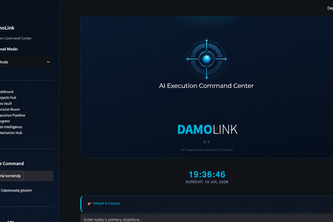
What the company appears to be: DamoLink OS is a self-reported AI execution operating system built as a Python/Streamlit application. The author describes it as an AI-powered system designed to turn ideas into verified wins by structuring workflows around execution contracts, measurable completion criteria, and evidence-based validation.
What changed: The project was submitted to the OpenAI 2026 hackathon on Devpost. It represents a single-person effort (team size: 1) with no external funding or traction reported.
The single most important open question: Is there sufficient evidence that DamoLink OS can scale beyond a prototype, or does it remain a proof-of-concept without demonstrated commercial viability?
What The Product Actually Is
- The description states DamoLink OS is an AI execution operating system built with Python and Streamlit.
- It includes modules such as Dashboard, Idea Vault, Decision Room, Projects Hub, Execution Pipeline, and Wins Archive.
- GPT-5.6 is used within the workflow to generate execution contracts, define completion criteria, review evidence, and validate outcomes.
- The system uses deterministic validation in addition to AI processing to control project state, evidence requirements, and Win Receipt creation.
- Codex was used during development for architecture, testing, documentation, security review, and release preparation.
- It is described as a public repository with application code, tests, environment documentation, demo instructions, and screenshots.
Not evidenced: No revenue data, customer base, or actual usage metrics. The product is presented only as a prototype built for a hackathon.
Positioning & Claim Evolution
- The author claims DamoLink OS addresses the gap between idea generation and execution by ensuring “completion should be demonstrated, not assumed.”
- It positions itself as an execution layer that turns ideas into verified wins through structured workflows.
- The system introduces concepts like execution contracts, measurable completion criteria, and Win Receipts to track outcomes.
- A key claim is that it moves AI from idea generation toward accountable execution.
- The product emphasizes the importance of evidence-based validation over simple task completion or AI-generated outputs.
Inference: The positioning suggests a shift from generic task management tools toward systems focused on accountability and verifiable results. However, this is based on self-description alone.
Target Customer & ICP
- The description does not explicitly identify target customers or personas.
- It implies use cases for individuals or small teams who want to move beyond idea generation to execution with measurable outcomes.
- The system appears tailored for users seeking structured workflows and accountability in project execution.
- There is no mention of enterprise adoption, B2B targeting, or specific industry verticals.
Not evidenced: No evidence of customer segments, buyer personas, or market segmentation. The ICP remains undefined.
Business Model & Pricing Evidence
- The description does not provide any information about pricing models, monetization strategies, or business models.
- It is presented as a public GitHub repository with no indication of commercial offerings or paid features.
- No mention of subscriptions, licensing, SaaS delivery, or revenue streams.
Not evidenced: No evidence of a business model or pricing strategy beyond the open-source nature of the project.
Technical & Delivery Signals
- Built using Python and Streamlit.
- Uses GPT-5.6 for AI-driven workflow elements including contract generation, completion criteria definition, and evidence review.
- Implements deterministic validation to supplement AI decision-making.
- Utilizes Codex throughout development lifecycle (architecture, debugging, testing, documentation).
- Includes modular components: Dashboard, Idea Vault, Decision Room, Projects Hub, Execution Pipeline, Wins Archive.
- Security measures included in preparation for public release: removal of credentials, separation of Demo Mode from authenticated modes, Git history cleanup.
Inference: The technical stack and modular design suggest a structured approach to building an execution system. However, no evidence of scalability or production readiness is provided.
Traction & Maturity Signals
- The project was submitted to the OpenAI 2026 hackathon.
- It has a public GitHub repository with application code, tests, documentation, and demo instructions.
- The author notes that it was prepared for a public demonstration in under three minutes.
- There is no evidence of user adoption, customer feedback, or product usage beyond the author’s own development.
Not evidenced: No traction data, user base, or performance metrics. The project remains unproven in real-world settings.
Competitive Context
- The description does not reference direct competitors or similar products.
- It implies a niche within AI execution tools and task management systems that emphasize accountability and verification.
- The focus on execution contracts, measurable outcomes, and Win Receipts suggests differentiation from standard productivity tools.
Not evidenced: No competitive analysis, market positioning relative to existing tools, or benchmarking against other platforms.
Open Questions & Risks
- The entire project is a single-person effort (team size: 1), raising questions about long-term sustainability and scalability.
- It is presented as a hackathon submission with no indication of commercial viability or product-market fit.
- No evidence of revenue, customers, or traction beyond the author’s own development.
- The use of GPT-5.6 implies reliance on proprietary AI services, which may pose risks related to availability, cost, and control.
- The system relies heavily on human-in-the-loop validation and deterministic checks, suggesting limited automation at scale.
Inference: The lack of commercial traction or evidence of real-world adoption raises concerns about whether this is a viable product or merely a prototype.
Questions the description leaves open
- What specific use cases have you identified for DamoLink OS beyond the hackathon context?
- How does the system handle edge cases where AI-generated execution contracts are ambiguous or incorrect?
- Are there plans to integrate with existing project management tools or platforms (e.g., Jira, Notion)?
- What is your roadmap for moving from prototype to a scalable product?
- How do you plan to monetize or commercialize DamoLink OS if at all?
- Have you tested the system with any external users or teams beyond yourself?
Overall Assessment
- The project is described as a hackathon submission by one individual.
- There is no evidence of revenue, customers, traction, or a clear business model.
- The product shows potential in addressing a gap in AI execution accountability but lacks validation in real-world usage.
- It appears to be an experimental prototype rather than a mature product or scalable solution.
Confidence Level: Low. This analysis is based entirely on self-reported information and does not include any independent verification or historical data.
User Stories BotA demo video on every pull request
Get a demo video on every new feature
GitHub App that watches your pull requests and records a narrated, captioned demo.
Save time on demo prep and make informed decisions faster with a video walkthrough of every new feature.
Source
Submitted to the OpenAI 2026 hackathon on Devpost. Project home on Devpost. Back to the full gallery on Devpost.
This competitive analysis was produced by top-founders.com (opens in a new tab)
Generated by a language model from this project's public Devpost page — its tagline, the author's own write-up and any built-with tags listed there — as captured in August 2026. Short quotations are the author's words. It is an opinion on the idea as a business, not on the people behind it, and it reflects the description as published then. If the project has moved on, request a correction below. The analysis is not independent research and contains no verified traction, revenue or customer data.
An independent guide by KFG International LLC — not affiliated with, endorsed by, or connected to Devpost or OpenAI.