

Archive position — measured, not model output
0 likes on Devpost
2,263 of the 7,850 archived projects have more likes, and 5,587 share exactly 0 — so this project's #7,554 place in the like-ranked listing is a tie-break inside that group, not a ranking.
Projects (log scale)
Likes on Devpost. ▲ marks this project's group.
Show the figures
| Likes | Projects | Share of archive |
|---|---|---|
| 0 | 5,587 | 71.2% |
| 1 | 1,758 | 22.4% |
| 2 | 284 | 3.6% |
| 3–4 | 132 | 1.7% |
| 5–9 | 75 | 1.0% |
| 10+ | 14 | 0.2% |
 User Stories BotA demo video on every pull request
Get a demo video on every new feature
GitHub App that watches your pull requests and records a narrated, captioned demo.
Save time on demo prep and make informed decisions faster with a video walkthrough of every new feature.
Executive Summary
What the company appears to be
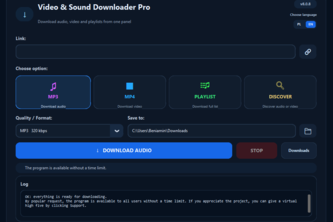
A self-reported Windows desktop application for downloading and converting publicly available video and audio from the web. The author describes it as a graphical interface wrapper around yt-dlp and FFmpeg, intended to make these tools accessible to non-technical users.
What changed
The project evolved from a simple tool for downloading audio/video to a more feature-rich application with Discover mode, subtitle support, playlist handling, and improved error messaging. It also incorporated AI assistance (GPT-5.6 and Codex) in development.
Single most important open question
Is there any evidence of actual user adoption or revenue generation beyond the author’s own use and demonstration?
What The Product Actually Is
The description states that Video And Sound Downloader Pro v8.0.8 is a Windows application designed to detect, download, and convert publicly available video and audio from hundreds of websites into formats optimized for everyday devices.
It supports:
- Downloading video or audio in multiple formats,
- Automatic merging of separate video and audio streams,
- Playlist detection and multi-file downloading,
- Subtitle downloading and embedding,
- Presets for Android TV, Blu-ray, and HEVC,
- Automatic file conversion with FFmpeg,
- Unique filenames to prevent overwriting,
- Polish and English interface versions,
- Discover mode for finding media on public webpages,
- A stop button for active downloads and conversions.
The application does not attempt to bypass DRM or other protections but instead explains why something cannot be downloaded (e.g., due to DRM, paywall, region restriction, login requirement, unsupported service).
Evidence
- The author's own write-up.
- Technology stack: Python, CustomTkinter, yt-dlp, FFmpeg.
Inference The tool is built as a GUI wrapper around command-line tools (yt-dlp and FFmpeg), suggesting it aims to simplify access for non-technical users.
Positioning & Claim Evolution
The author claims the product addresses an ordinary problem: wanting to download only audio from a video, but finding existing tools either limited, full of ads, or difficult to use.
It started with a basic need (audio-only download) and evolved into a more comprehensive tool through iterative improvements:
- Format selection,
- Automatic conversion,
- Playlist support,
- Subtitle handling,
- Stream merging,
- Better error messages,
- Discover mode for finding media on webpages.
The author emphasizes that the tool makes powerful tools like yt-dlp and FFmpeg accessible to users who would never use a terminal.
Evidence
- The author’s narrative of how the app grew from an idea to a full-featured tool.
- Claim that it hides complexity behind a GUI.
Inference The positioning has shifted from solving one specific user pain point to becoming a general-purpose media downloader with added utility features.
Target Customer & ICP
The author states that the application is intended for ordinary users, particularly those who are not technically inclined and would never use a terminal or command-line interface.
It targets people looking to:
- Save time,
- Simplify everyday tasks,
- Use helpful technology without specialist knowledge.
There is no explicit mention of enterprise customers, developers, or niche audiences. The focus appears to be on end-user convenience rather than business or professional use cases.
Evidence
- Author’s statement: “I wanted to download only the audio from a video... but the tools I found were either limited, full of advertisements, or difficult to use.”
- Emphasis on making complex tools accessible to non-technical users.
- Mention of portable Windows program for ease-of-use.
Inference The core customer segment seems to be general consumers, not businesses or developers. The app is positioned as a utility tool for personal use.
Business Model & Pricing Evidence
There is no evidence provided about pricing, monetization strategy, or business model.
The author does not mention:
- Any paid features,
- Subscription plans,
- Freemium models,
- Ad-supported versions,
- Licensing fees,
- Revenue streams.
It is described as a portable Windows program, implying it may be distributed freely or at cost, but no details are given.
Evidence
- No mention of pricing.
- No indication of monetization strategy.
- Description implies free distribution or low-cost access.
Inference The business model remains unknown. It could be open-source, freemium, or ad-supported — none of which are confirmed in the description.
Technical & Delivery Signals
The application was built using:
- Python
- CustomTkinter for GUI
- yt-dlp for media detection and downloading
- FFmpeg for conversion and stream merging
- AI tools: GPT-5.6 and Codex for development assistance
Development workflow involved:
- Describing ideas,
- Organizing requirements with GPT-5.6,
- Implementing changes via Codex,
- Testing results,
- Reporting issues and improvements.
The author notes that the interface must remain responsive during background processes like downloads and conversions.
Evidence
- Technology stack listed.
- Workflow described involving AI tools.
- Mention of challenges in maintaining responsiveness.
Inference The app is technically feasible, built with modern open-source components, and uses AI for development. However, there is no evidence of scalability or infrastructure beyond a single developer’s environment.
Traction & Maturity Signals
There is no evidence of:
- Revenue,
- Customers,
- User adoption,
- Market traction,
- Product usage metrics,
- Sales data,
- Customer feedback or reviews,
- Growth trends.
The project is described as a personal effort by one individual (Beniamin Żak), and the only demonstration is a hackathon submission.
Evidence
- Only self-reported development history.
- No mention of users, downloads, or engagement.
- Submission to OpenAI 2026 hackathon — not indicative of commercial traction.
Inference The product exists in concept and prototype form, but there is no evidence of real-world usage or market validation.
Competitive Context
The author does not provide any information about:
- Competitors,
- Market size,
- Competitive positioning,
- Existing tools in the space (e.g., other downloaders),
- Differentiation from similar products.
This lack of competitive analysis makes it difficult to assess how this product fits into the broader landscape.
Evidence
- No mention of competitors or market dynamics.
- No comparison with existing tools.
Inference The competitive context is unknown. The app likely competes in a crowded space of media downloaders, but no data supports claims about positioning or differentiation.
Open Questions & Risks
Several risks and open questions are present:
- No revenue or traction evidence: The product has not demonstrated any commercial viability.
- Single-person development: Limited scalability and lack of team structure.
- Unverified claims: All statements are self-reported, with no external validation.
- Legal risk from content downloading: Downloading copyrighted material may raise legal concerns depending on jurisdiction.
- AI dependency: Heavy reliance on AI tools for development raises questions about long-term maintainability and reproducibility.
- Lack of monetization strategy: No indication of how the product will generate value or sustain itself.
Evidence
- Self-reported nature of all claims.
- No mention of legal, financial, or operational safeguards.
Inference The project is in early development stage with no clear path to commercial success. Risks include lack of traction, scalability issues, and potential legal exposure.
Questions the description leaves open
- What is the actual user base or adoption rate?
- How does the app handle legal compliance for downloading copyrighted content?
- Are there any plans for monetization or revenue generation?
- Has the app been tested with real users beyond the developer?
- What are the long-term maintenance and support plans?
- Is there a roadmap for future features or platform expansion?
- How does the app differentiate itself from existing tools in the market?
- What is the source of the AI tools used (e.g., GPT-5.6, Codex)? Are they sustainable?
- Can the app scale beyond a single developer’s environment?
- Are there any partnerships or distribution channels planned?
Overall Assessment
Not evidenced.
There is no evidence of:
- Revenue,
- Customers,
- Traction,
- Market validation,
- Scalability,
- Commercial viability.
The project is described as a personal development effort, likely in its early stages, with no indication of business traction or strategic positioning.
It appears to be a prototype or proof-of-concept submitted for a hackathon. While technically feasible and potentially useful, there is no evidence that it has moved beyond the idea phase or achieved any meaningful commercial outcome.
Confidence level Low — based entirely on self-reported information with no external validation or traction data.
User Stories BotA demo video on every pull request
Get a demo video on every new feature
GitHub App that watches your pull requests and records a narrated, captioned demo.
Save time on demo prep and make informed decisions faster with a video walkthrough of every new feature.
Source
Submitted to the OpenAI 2026 hackathon on Devpost. Project home on Devpost. Back to the full gallery on Devpost.
This competitive analysis was produced by top-founders.com (opens in a new tab)
Generated by a language model from this project's public Devpost page — its tagline, the author's own write-up and any built-with tags listed there — as captured in August 2026. Short quotations are the author's words. It is an opinion on the idea as a business, not on the people behind it, and it reflects the description as published then. If the project has moved on, request a correction below. The analysis is not independent research and contains no verified traction, revenue or customer data.
An independent guide by KFG International LLC — not affiliated with, endorsed by, or connected to Devpost or OpenAI.