

Archive position — measured, not model output
0 likes on Devpost
2,263 of the 7,850 archived projects have more likes, and 5,587 share exactly 0 — so this project's #7,556 place in the like-ranked listing is a tie-break inside that group, not a ranking.
Projects (log scale)
Likes on Devpost. ▲ marks this project's group.
Show the figures
| Likes | Projects | Share of archive |
|---|---|---|
| 0 | 5,587 | 71.2% |
| 1 | 1,758 | 22.4% |
| 2 | 284 | 3.6% |
| 3–4 | 132 | 1.7% |
| 5–9 | 75 | 1.0% |
| 10+ | 14 | 0.2% |
 User Stories BotA demo video on every pull request
Get a demo video on every new feature
GitHub App that watches your pull requests and records a narrated, captioned demo.
Save time on demo prep and make informed decisions faster with a video walkthrough of every new feature.
Executive Summary
What the company appears to be
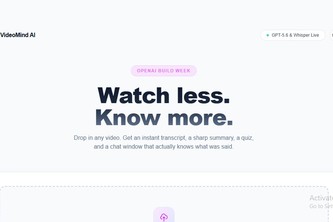
VideoMind AI is a self-reported tool that transforms uploaded videos (MP4/MOV) into searchable knowledge using AI transcription, smart summaries, interactive chat, quizzes, and export features. It was built as a hackathon project during OpenAI Build Week.
What changed
The author reports building this from scratch in a short timeframe, integrating technologies like Whisper for transcription, GPT-5.6 for summarization and Q&A, and Codex for development assistance. The tool supports file upload, transcript generation, chat-based querying of video content, quiz creation, and export to Markdown or PDF.
Single most important open question
Is there any evidence of product-market fit, customer traction, or commercial viability beyond the self-reported hackathon project?
What The Product Actually Is
The description states that VideoMind AI:
- Takes uploaded videos (MP4/MOV)
- Extracts audio using FFmpeg
- Generates timestamped transcripts with OpenAI Whisper
- Produces structured summaries using GPT-5.6
- Allows grounded AI chat based on the transcript
- Automatically generates a 5-question multiple-choice quiz from video content
- Offers one-click export of summary and transcript as Markdown or PDF
- Includes copy transcript functionality
- Has dark/light mode UI built with React/Next.js/Tailwind
Inference The product is an AI-powered video-to-knowledge transformation tool, designed for educational or learning use cases.
Positioning & Claim Evolution
The author claims:
- VideoMind AI turns passive watching into active learning.
- It makes learning faster and easier by transforming videos into searchable knowledge.
- The tool was built to solve the problem of rewatching videos to find specific information.
Inference Positioning is centered on educational content consumption, with a focus on making video-based learning more efficient through AI. However, no evidence exists that this positioning has been validated in the market or tested with users beyond the author’s own experience.
Target Customer & ICP
The description states:
- The tool was built for students and developers who consume educational content, lectures, and tutorials online.
- It addresses the need to quickly locate specific information within long videos.
Inference The initial target customer appears to be learners or professionals in education or tech-related fields. No further segmentation or ICP definition is provided.
Business Model & Pricing Evidence
Not evidenced.
The description does not mention:
- Any pricing model
- Revenue streams
- Monetization strategy
- Subscription tiers or freemium options
Inference No commercial business model is evident from the self-reported project details.
Technical & Delivery Signals
The author reports:
- Built with Next.js (React/TypeScript) frontend and Express (Node.js/TypeScript) backend
- Uses FFmpeg for audio extraction, OpenAI Whisper for transcription, GPT-5.6 for summarization/chat/quiz generation
- Implemented via a REST API pipeline: Video Upload → FFmpeg Audio Extraction → Whisper Transcription → GPT-5.6 Summarization → GPT-5.6 Chat/Quiz Generation
- Used Codex CLI for development assistance
- Deployed and published source code on GitHub
Inference The technical stack is standard for full-stack web apps with AI integrations, and the author demonstrates familiarity with key tools and workflows. However, no evidence of production-grade infrastructure or scalability.
Traction & Maturity Signals
Not evidenced.
The description does not include:
- Any user base
- Customer acquisition metrics
- Usage data
- Product adoption rates
- Revenue figures
- Product roadmap beyond the hackathon version
Inference There is no evidence of traction or maturity beyond a single-person hackathon project.
Competitive Context
Not evidenced.
The description does not:
- Identify competitors
- Describe competitive advantages
- Mention market size or positioning relative to existing tools
Inference No competitive analysis or differentiation strategy is evident from the self-reported information.
Open Questions & Risks
- Unverified claims: All statements are self-reported and unverified.
- No commercial traction: No evidence of revenue, customers, or adoption beyond a hackathon project.
- Limited scope: The tool only supports file uploads; YouTube import was deprioritized due to technical issues.
- Dependency on APIs: Heavy reliance on OpenAI services (Whisper, GPT-5.6) introduces risk of cost, access, and availability.
- Single-person team: The project is built by one individual, raising questions about scalability and long-term maintenance.
Questions the description leaves open
- What specific user problems are you solving, and how did you validate those needs?
- Have you conducted any user testing or feedback sessions beyond your own experience?
- Are there plans to monetize the product? If so, what is your pricing model?
- How do you plan to scale beyond a single developer’s capacity?
- What are the technical limitations or bottlenecks in processing large volumes of videos?
- Do you have any data on how users interact with the tool once they start using it?
Overall Assessment
Not evidenced.
There is no evidence of:
- Revenue
- Customers
- Product-market fit
- Commercial traction
- Financials or funding history
Inference This is a self-reported hackathon project with no demonstrated commercial viability or market validation. It cannot be evaluated as an investment or partnership opportunity without additional data.
User Stories BotA demo video on every pull request
Get a demo video on every new feature
GitHub App that watches your pull requests and records a narrated, captioned demo.
Save time on demo prep and make informed decisions faster with a video walkthrough of every new feature.
Source
Submitted to the OpenAI 2026 hackathon on Devpost. Project home on Devpost. Back to the full gallery on Devpost.
This competitive analysis was produced by top-founders.com (opens in a new tab)
Generated by a language model from this project's public Devpost page — its tagline, the author's own write-up and any built-with tags listed there — as captured in August 2026. Short quotations are the author's words. It is an opinion on the idea as a business, not on the people behind it, and it reflects the description as published then. If the project has moved on, request a correction below. The analysis is not independent research and contains no verified traction, revenue or customer data.
An independent guide by KFG International LLC — not affiliated with, endorsed by, or connected to Devpost or OpenAI.