

Archive position — measured, not model output
1 like on Devpost
505 of the 7,850 archived projects have more likes, and 1,758 share exactly 1 — so this project's #1,663 place in the like-ranked listing is a tie-break inside that group, not a ranking.
Projects (log scale)
Likes on Devpost. ▲ marks this project's group.
Show the figures
| Likes | Projects | Share of archive |
|---|---|---|
| 0 | 5,587 | 71.2% |
| 1 | 1,758 | 22.4% |
| 2 | 284 | 3.6% |
| 3–4 | 132 | 1.7% |
| 5–9 | 75 | 1.0% |
| 10+ | 14 | 0.2% |
 User Stories BotA demo video on every pull request
Get a demo video on every new feature
GitHub App that watches your pull requests and records a narrated, captioned demo.
Save time on demo prep and make informed decisions faster with a video walkthrough of every new feature.
Executive Summary
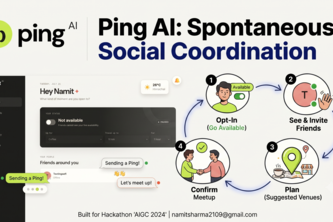
What the company appears to be: Ping AI is a self-reported social coordination tool built as a hackathon project. The author describes it as an "AI Social Coordination Agent" that helps friends meet spontaneously without constant texting or checking each other’s location. It enables users to signal availability, send Pings, and receive AI-generated meetup suggestions.
What changed: This is a prototype submitted for the OpenAI 2026 hackathon. There is no evidence of prior development, funding, or commercial traction beyond its creation as a demonstration project.
Single most important open question: Is there any evidence that users are actively engaging with Ping AI beyond the initial prototype build? The description contains no data on usage, adoption, or customer behavior — only claims about functionality and design decisions.
What The Product Actually Is
The description states that Ping AI is a web application built with React, Vite, Firebase, and Node.js/Express. It allows users to:
- Sign in via Google.
- Add friends using email or a custom handle.
- Set availability for a specific time and activity.
- Send a "Ping" to available friends.
- Receive AI-generated venue recommendations based on location, travel distance, and activity.
- Confirm meetups and share them through WhatsApp or clipboard.
It includes features such as:
- Real-time friend availability status
- Location sharing only upon explicit opt-in
- Notification handling
- Plan history and saved meetups
The system integrates with Groq for AI recommendations, uses Firestore for data storage, and deploys on Vercel and Firebase. It supports a core loop: Available → Ping → Respond → Choose a place → Confirm → Meet.
Note: The author describes this as a prototype built in a hackathon context. No evidence of production deployment or user base exists beyond the self-reported build process.
Positioning & Claim Evolution
The author positions Ping AI as an AI-powered social coordination agent that removes friction from casual meetups by automating planning steps.
Key claims:
- It turns long conversations into lightweight actions.
- It finds the best meeting spot without constant communication.
- It is designed to be consent-based and privacy-conscious.
There is no indication of prior positioning or evolution in messaging beyond this single submission. The project appears to have emerged from a personal frustration — not from an evolving market need or strategic pivot.
Inference: The product’s positioning reflects a niche use case (casual friend meetups) rather than a broader platform strategy. It lacks evidence of scaling ambitions or brand positioning beyond its hackathon prototype.
Target Customer & ICP
The description states that Ping AI is intended for friends who want to coordinate spontaneous meetups.
It targets:
- Individuals looking to reduce friction in casual social planning.
- Users who prefer not to text constantly when arranging meetups.
- People concerned about privacy and location sharing.
There is no evidence of segmentation beyond "friends." No indication of demographics, geographic focus, or user personas beyond the author’s own experience.
Not evidenced: No data on actual users, their behaviors, or whether they are actively using the tool. The only customer reference is the author's personal motivation ("a friend I lost").
Business Model & Pricing Evidence
The description does not contain any information about:
- Revenue streams
- Monetization strategy
- Pricing model
- Subscription plans or freemium tiers
It also does not mention whether the product will be offered as a paid service, supported by ads, or monetized in any way.
Not evidenced: No business model or pricing structure is described. The project is presented as a prototype with no commercial intent beyond demonstration.
Technical & Delivery Signals
The author reports:
- Built using React + Vite frontend
- Firebase Authentication and Firestore backend
- Node.js/Express API for AI recommendations via Groq
- Fallback dataset to ensure functionality during AI outages
- Deployment on Vercel, Firebase, and separate Express server
- Use of Codex and GPT-5.6 during development
Technical decisions include:
- Opt-in location sharing
- Expiry times for availability records
- Local fallbacks for unreliable external services
- Prototype-level security (e.g., no token verification yet)
Inference: The technical stack is standard for a modern web app, but the prototype lacks production-grade features like robust authentication, rate limiting, or offline handling.
Traction & Maturity Signals
The description makes no mention of:
- User adoption
- Active usage metrics
- Customer feedback
- Product iterations
- Revenue or monetization attempts
It is explicitly described as a hackathon prototype and not yet in production. The author notes that the next steps involve improving security, adding push notifications, and supporting group planning — all signs of an early-stage product.
Not evidenced: No traction data, user engagement, or market validation exists beyond the initial build.
Competitive Context
The description does not reference any competitors or existing solutions in the space of social coordination tools or AI-powered meetup apps.
It does not describe how Ping AI compares to other platforms (e.g., Meetup, Facebook Events, WhatsApp groups, etc.) or what unique value it brings to the market.
Not evidenced: No competitive analysis or differentiation strategy is provided. The project appears unanchored in a competitive landscape.
Open Questions & Risks
- No commercial traction: The product is described as a hackathon prototype with no evidence of users, adoption, or monetization.
- Unproven market demand: There is no indication that the target audience actually wants this solution or would pay for it.
- Limited scalability assumptions: The author notes challenges around scope and reliability — suggesting early-stage limitations.
- Privacy concerns: While location sharing is opt-in, there are no clear policies or mechanisms described for data retention or user control beyond basic design choices.
- AI dependency risk: The product relies heavily on AI for venue suggestions, which may fail or be inconsistent without robust fallbacks.
Inference: Without real-world usage or feedback, the risk of misalignment with actual user needs is high. The project lacks evidence of viability or market fit.
Questions the description leaves open
- What inspired you to build this tool? Was there a specific pain point you observed in your own life?
- How many people have used the prototype so far, and what was their feedback?
- Are you planning to launch a beta version or test with real users before going full production?
- Do you have any plans for monetization or revenue generation?
- What are the biggest technical challenges you expect to face in scaling this product?
- How do you plan to handle privacy and data governance as the user base grows?
- Have you considered how this would work across different regions or cultures where social coordination norms vary?
Overall Assessment
Not evidenced: There is no evidence of a viable business, traction, or investment-ready product beyond the hackathon prototype.
The project is presented as a conceptual tool with strong design thinking, but lacks any commercial due-diligence signals such as:
- Revenue
- Customers
- Market validation
- Product-market fit
- Scalability
Confidence level: Low. This is a self-reported, unverified prototype with no external corroboration or evidence of traction.
User Stories BotA demo video on every pull request
Get a demo video on every new feature
GitHub App that watches your pull requests and records a narrated, captioned demo.
Save time on demo prep and make informed decisions faster with a video walkthrough of every new feature.
Source
Submitted to the OpenAI 2026 hackathon on Devpost. Project home on Devpost. Back to the full gallery on Devpost.
This competitive analysis was produced by top-founders.com (opens in a new tab)
Generated by a language model from this project's public Devpost page — its tagline, the author's own write-up and any built-with tags listed there — as captured in August 2026. Short quotations are the author's words. It is an opinion on the idea as a business, not on the people behind it, and it reflects the description as published then. If the project has moved on, request a correction below. The analysis is not independent research and contains no verified traction, revenue or customer data.
An independent guide by KFG International LLC — not affiliated with, endorsed by, or connected to Devpost or OpenAI.