

Archive position — measured, not model output
0 likes on Devpost
2,263 of the 7,850 archived projects have more likes, and 5,587 share exactly 0 — so this project's #5,589 place in the like-ranked listing is a tie-break inside that group, not a ranking.
Projects (log scale)
Likes on Devpost. ▲ marks this project's group.
Show the figures
| Likes | Projects | Share of archive |
|---|---|---|
| 0 | 5,587 | 71.2% |
| 1 | 1,758 | 22.4% |
| 2 | 284 | 3.6% |
| 3–4 | 132 | 1.7% |
| 5–9 | 75 | 1.0% |
| 10+ | 14 | 0.2% |
 User Stories BotA demo video on every pull request
Get a demo video on every new feature
GitHub App that watches your pull requests and records a narrated, captioned demo.
Save time on demo prep and make informed decisions faster with a video walkthrough of every new feature.
Executive Summary
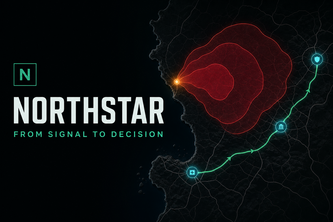
Northstar is a self-reported operational intelligence command center for wildfire response, built as a hackathon project by one person (Kateryna Ivashchenko). The system ingests real-time public hazard, weather, population, infrastructure, and routing data to produce time-based impact projections and a GPT-5.6-powered decision board for emergency teams.
The author states that Northstar combines multiple open-source and public datasets into an "Incident Graph" and uses deterministic geospatial logic for projections, with GPT-5.6 investigating evidence and producing structured action boards for human review. It supports both live and replay modes using real upstream data captures.
Key commercial signals:
- Not evidenced: revenue, customers, or adoption
- Not evidenced: pricing model or business model details beyond the author's description
- Not evidenced: team size beyond one person
- Not evidenced: funding rounds, valuation, or headcount
The single most important open question is whether Northstar can scale from a functional prototype to an operational system that emergency teams actually use in real incidents.
What The Product Actually Is
The description states that Northstar is:
- An operational intelligence command center for wildfire response
- A system that combines public hazard, weather, population, infrastructure, and routing data into a provenance-rich Incident Graph
- A deterministic geospatial engine that projects exposure, affected assets, route status, and destination access across time
- A workflow with four stages: Signal, Evidence, Projection, and Decision
- A system that uses GPT-5.6 to investigate evidence and produce structured action boards for human review
- Not a system that dispatches responders or mutates external systems
The author claims it reports:
- Projected population exposure
- Affected schools, hospitals, shelters, and response assets
- Route impact and destination reachability
- Cross-border and jurisdiction-policy exclusions
- Shelter and resource assumptions
- Intervention deltas and scenario scores
- A priority decision
- Operational objectives with metrics and deadlines
- Owner-assigned actions
- Decision triggers
- Intelligence gaps
- Alternatives and trade-offs
Positioning & Claim Evolution
The description states that Northstar was built to address a gap in emergency response:
- Emergency teams suffer from time and reasoning required to turn fragmented signals into defendable decisions
- The system aims to close the gap "from a real-world signal to an evidence-backed decision a response team can inspect, challenge, and approve"
The author's claim evolution shows:
- Initial positioning: "Emergency teams do not suffer from a lack of data. They suffer from the time and reasoning required..."
- Core value proposition: Operational intelligence command center that turns fragmented signals into defendable decisions
- Specific functionality: Combines multiple data sources into Incident Graph, projects impact across time, uses GPT-5.6 for decision support
The positioning is described as addressing a specific operational pain point rather than being a general-purpose platform.
Target Customer & ICP
The description states that Northstar is designed for:
- Emergency teams
- Wildfire response operations
- Operational intelligence command centers
The author describes the target user as "emergency teams" who need to make decisions based on fragmented signals. The system appears to be built for first responders or incident commanders who must evaluate multiple data sources and make operational decisions.
Not evidenced: specific customer segments, roles, or use cases beyond emergency response teams.
Business Model & Pricing Evidence
The description states:
- Northstar is a hackathon project
- It does not perform numerical geometry or invent impact values
- GPT-5.6 calls typed tools to inspect source health, Incident Graph, routing coverage, and deterministic scenarios
- The system never closes roads, dispatches responders, sends alerts, or mutates external systems
Not evidenced: pricing model, revenue streams, business model details, or monetization strategy.
Technical & Delivery Signals
The description states that Northstar is built with:
- Frontend: Next.js, React, TypeScript, Leaflet
- Backend: FastAPI, Python, Pydantic, Shapely, PyProj, NetworkX, SQLite
- Data sources: NASA EONET, WFIGS, GDACS, Open-Meteo, WorldPop, OpenStreetMap, Overpass, OSRM, Nominatim
- Agent runtime: OpenAI Agents SDK with GPT-5.6 Sol
- Deployment: Separate Vercel projects for frontend and API
The system supports:
- Live mode that refreshes available public sources
- Replay mode that loads checked-in captures of real upstream responses
- Deterministic temporal exposure and route-impact calculations
- Map-driven scenarios for roads, shelters, wind, and resources
- Jurisdiction-aware routing
- Validation that prevents unsupported evidence references and numerical claims
Traction & Maturity Signals
The description states:
- A deployed, functional product rather than a static prototype
- Real captured upstream data with verifiable provenance
- Automated backend, API, routing, simulation, grounding, and frontend tests
- A clear human-approval boundary throughout the product
- The deployed demo contains analysis-ready wildfire scenarios in San Diego, Oregon, and France
Not evidenced: revenue, customers, user adoption, or market traction beyond the author's own account.
Competitive Context
The description does not provide any information about:
- Direct competitors
- Indirect substitutes
- Market positioning relative to existing emergency response systems
- Competitive advantages or differentiators
Not evidenced: competitive landscape, market positioning, or competitive analysis.
Open Questions & Risks
Inferences from the description:
- Single-person team may limit scalability and development velocity
- GPT-5.6 is described as a "Sol" model, which may not be a real product (as of 2024)
- The system is described as a hackathon project, suggesting it's not yet mature for production use
- The system does not actually dispatch responders or mutate external systems, which may limit its utility in real-world operations
- The system requires manual configuration and human review at every step, which may slow decision-making in fast-moving incidents
Questions the description leaves open
- What is the actual timeline for development from this prototype to a production-ready system?
- How does Northstar handle data quality issues or missing data from upstream sources?
- What are the specific operational workflows that emergency teams will use with this system?
- How does the system handle real-time updates and synchronization with external systems?
- What is the plan for integrating with existing emergency response platforms or systems?
- How does Northstar ensure data privacy and security in emergency operations?
- What are the specific requirements for training emergency personnel on using this system?
- How will the system scale to handle multiple concurrent incidents?
- What are the plans for monetization or commercial deployment?
- How does the validation layer prevent false positives or misleading recommendations?
Overall Assessment
The description states that Northstar is a hackathon project built by one person (Kateryna Ivashchenko). The system appears to be a functional prototype with real data integration and deterministic projections, but it has not demonstrated any commercial traction, revenue, or customer adoption.
The author describes the system as:
- A deployed, functional product rather than a static prototype
- Using real captured upstream data with verifiable provenance
- Supporting both live and replay modes
- Incorporating automated testing and validation
However, there is no evidence of:
- Revenue generation
- Customer base or adoption
- Funding rounds or valuation
- Team expansion beyond one person
- Commercial deployment or partnerships
The system's positioning as an operational intelligence command center for emergency response suggests potential market interest, but the lack of any commercial evidence makes it difficult to assess its viability as a business opportunity.
Given the self-reported nature of all information and the absence of any traction data, this represents a very early-stage project with significant uncertainty around commercial viability. The system appears technically sophisticated but lacks demonstrated market validation or commercial momentum.
The author's own description indicates that Northstar is still in development, with future enhancements planned including multi-user incident rooms, authentication, audit history, and notification integrations. This suggests the current version is not yet ready for production use in emergency operations.
Confidence: Low - Based entirely on self-reported evidence with no independent verification or traction data available.
User Stories BotA demo video on every pull request
Get a demo video on every new feature
GitHub App that watches your pull requests and records a narrated, captioned demo.
Save time on demo prep and make informed decisions faster with a video walkthrough of every new feature.
Source
Submitted to the OpenAI 2026 hackathon on Devpost. Project home on Devpost. Back to the full gallery on Devpost.
This competitive analysis was produced by top-founders.com (opens in a new tab)
Generated by a language model from this project's public Devpost page — its tagline, the author's own write-up and any built-with tags listed there — as captured in August 2026. Short quotations are the author's words. It is an opinion on the idea as a business, not on the people behind it, and it reflects the description as published then. If the project has moved on, request a correction below. The analysis is not independent research and contains no verified traction, revenue or customer data.
An independent guide by KFG International LLC — not affiliated with, endorsed by, or connected to Devpost or OpenAI.