

Archive position — measured, not model output
0 likes on Devpost
2,263 of the 7,850 archived projects have more likes, and 5,587 share exactly 0 — so this project's #5,926 place in the like-ranked listing is a tie-break inside that group, not a ranking.
Projects (log scale)
Likes on Devpost. ▲ marks this project's group.
Show the figures
| Likes | Projects | Share of archive |
|---|---|---|
| 0 | 5,587 | 71.2% |
| 1 | 1,758 | 22.4% |
| 2 | 284 | 3.6% |
| 3–4 | 132 | 1.7% |
| 5–9 | 75 | 1.0% |
| 10+ | 14 | 0.2% |
 User Stories BotA demo video on every pull request
Get a demo video on every new feature
GitHub App that watches your pull requests and records a narrated, captioned demo.
Save time on demo prep and make informed decisions faster with a video walkthrough of every new feature.
Executive Summary
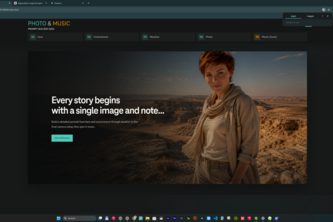
The description states that Photo & Music Prompt Builder is a bilingual AI creative studio that turns one idea into a coherent photography prompt and an environment-driven instrumental music plan. The author, Árpád Puskás, built it as a single-person project using Codex and GPT-5.6, with HTML, CSS, JavaScript, and OpenAI tools. It is described as a browser-based tool for non-technical creators to build detailed visual and musical concepts through a five-stage workflow.
The product appears to be an experimental creative tool that combines AI-assisted prompt engineering with music composition logic. It is not evidenced to have any revenue, customers or traction beyond the author’s own development effort.
Key open question: Is there evidence of a viable market need for this type of integrated visual-music creation tool, or is it a personal experiment?
What The Product Actually Is
The description states that Photo & Music Prompt Builder is:
- A bilingual (Hungarian–English) creative studio
- Designed to generate detailed photography prompts and matching instrumental music concepts
- Built as a browser-based application using HTML, CSS, JavaScript
- Utilizes Codex and GPT-5.6 for development
- Operates through five interconnected stages: Face, Environment, Weather and light, Photo, Music
The author describes it as a "lightweight" tool with local state persistence, bilingual UI dictionaries, dependency-aware controls, and structured prompt composition.
Not evidenced: What the actual output looks like, whether it generates real prompts or just templates, or how the music generation works beyond the stated logic.
Positioning & Claim Evolution
The description states that the product:
- Aims to be a "coherent workspace" where creators can develop visual stories step-by-step
- Is designed for both experienced prompt writers and non-technical creators
- Focuses on turning one idea into a complete creative output (photography + music)
- Uses "environment-driven" rather than identity-based musical direction
The author positions it as solving the problem of needing multiple disconnected tools and specialist knowledge to create cohesive visual and musical content.
Inferred: The positioning suggests a niche market for integrated creative tooling, but no evidence of market research or competitive analysis is provided.
Target Customer & ICP
The description states:
- Designed for "non-technical creators"
- Intended for "experienced prompt writers" as well
- Targets users who begin with a single mental image and want to develop it into a visual story
Not evidenced: Specific customer segments, personas, or use cases beyond the author's own experience.
Business Model & Pricing Evidence
The description states:
- No pricing information is provided
- The project was built as a personal hackathon submission
- No evidence of monetization strategy or revenue streams
Inferred: If this were to become a product, it would likely be sold through subscription or one-time purchase models, but no such evidence exists.
Technical & Delivery Signals
The description states:
- Built with HTML5, CSS3, JavaScript
- Uses Codex and GPT-5.6 for development
- Implements local state persistence
- Features dependency-aware filtering
- Includes responsive design and visual reference cards
- Has bilingual UI support
Not evidenced: Whether the tool is production-ready, scalable, or has any performance metrics.
Traction & Maturity Signals
The description states:
- Built by a single developer (Árpád Puskás)
- Submitted to OpenAI 2026 hackathon
- No evidence of users, customers, revenue, or adoption beyond the author's own development
Not evidenced: Any traction data, user feedback, or market validation.
Competitive Context
The description states:
- The product addresses a gap in tools that require multiple disconnected applications
- It is positioned as solving the need for "specialist knowledge" in prompt creation and music composition
Not evidenced: Competitor analysis, existing solutions in this space, or differentiation from other creative tools.
Open Questions & Risks
The description states:
- Single-person development effort
- No evidence of market demand or user feedback
- The author is the only team member
- No revenue, customers, or traction data
- The tool is described as a "personal experiment"
Inferred risks include:
- Lack of product-market fit validation
- Limited scalability due to single developer
- Unclear monetization strategy
- Potential over-reliance on AI tools without clear value proposition
Questions the description leaves open
- What specific problem are you solving, and how do you know there is a market need?
- How did you validate the concept with potential users?
- What is your plan for scaling beyond single-person development?
- Are you planning to monetize this tool, and if so, what model?
- How will you ensure quality control in AI-assisted development?
- What are the key assumptions about user behavior that drive your design decisions?
Overall Assessment
The description states:
- This is a single-person hackathon project
- No evidence of traction, revenue, or customers
- The author has not demonstrated any prior business experience or team structure
Not evidenced: Any commercial viability, market opportunity, or investment potential.
Inferred: Given the lack of evidence for traction, revenue, or customer validation, and the single-person development model, this does not appear to be a viable investment target at this stage. It may represent an interesting concept with potential but lacks the commercial due-diligence signals required for evaluation.
User Stories BotA demo video on every pull request
Get a demo video on every new feature
GitHub App that watches your pull requests and records a narrated, captioned demo.
Save time on demo prep and make informed decisions faster with a video walkthrough of every new feature.
Source
Submitted to the OpenAI 2026 hackathon on Devpost. Project home on Devpost. Back to the full gallery on Devpost.
This competitive analysis was produced by top-founders.com (opens in a new tab)
Generated by a language model from this project's public Devpost page — its tagline, the author's own write-up and any built-with tags listed there — as captured in August 2026. Short quotations are the author's words. It is an opinion on the idea as a business, not on the people behind it, and it reflects the description as published then. If the project has moved on, request a correction below. The analysis is not independent research and contains no verified traction, revenue or customer data.
An independent guide by KFG International LLC — not affiliated with, endorsed by, or connected to Devpost or OpenAI.