

Archive position — measured, not model output
1 like on Devpost
505 of the 7,850 archived projects have more likes, and 1,758 share exactly 1 — so this project's #1,654 place in the like-ranked listing is a tie-break inside that group, not a ranking.
Projects (log scale)
Likes on Devpost. ▲ marks this project's group.
Show the figures
| Likes | Projects | Share of archive |
|---|---|---|
| 0 | 5,587 | 71.2% |
| 1 | 1,758 | 22.4% |
| 2 | 284 | 3.6% |
| 3–4 | 132 | 1.7% |
| 5–9 | 75 | 1.0% |
| 10+ | 14 | 0.2% |
 User Stories BotA demo video on every pull request
Get a demo video on every new feature
GitHub App that watches your pull requests and records a narrated, captioned demo.
Save time on demo prep and make informed decisions faster with a video walkthrough of every new feature.
Executive Summary
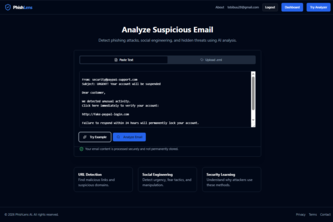
What the company appears to be: PhishLens AI is a self-reported cybersecurity SaaS platform designed to detect phishing threats in emails and explain the risks to users. The author states it is an AI-powered phishing detection tool that analyzes suspicious emails, provides risk scores, and offers security recommendations.
What changed: The project was submitted as a hackathon entry (OpenAI 2026) and represents an early-stage prototype built by one developer (Tebibu Solomon). It includes basic functionality for email analysis, user authentication, and dashboard features but lacks evidence of production deployment or commercial traction.
The single most important open question: Is there any evidence that PhishLens AI has moved beyond the prototype stage into actual use by users or organizations?
What The Product Actually Is
- The description states PhishLens AI is an "AI-powered phishing detection platform"
- It analyzes suspicious emails and identifies common phishing indicators such as:
- Urgency and fear-based manipulation
- Credential theft attempts
- Suspicious sender domains
- Malicious links
- Social engineering patterns
- The platform generates a risk score, explains detected threats, and provides security recommendations
- It includes a personal dashboard for saving analysis history
Evidence: This is self-reported by the author. No independent verification or demonstration of actual product functionality beyond prototype stage.
Positioning & Claim Evolution
- The author claims PhishLens AI makes phishing detection "easier and more understandable"
- It aims to help users identify warning signs they might miss
- The platform positions itself as explainable — not just flagging threats but explaining why an email is dangerous and what actions to take
- It is described as a tool that combines automation with clear explanations to make cybersecurity more accessible
Evidence: These are claims made by the author. No evidence of market positioning, customer feedback, or competitive differentiation beyond self-description.
Target Customer & ICP
- The description states PhishLens AI targets people who "receive suspicious emails but do not know how to identify the warning signs"
- It is positioned for individuals rather than enterprises
- The platform includes user authentication and personal dashboard features suggesting individual end-users as primary audience
Evidence: This is inferred from the author’s self-description. No evidence of actual customers, user personas, or segmentation data.
Business Model & Pricing Evidence
- Not evidenced. The description does not mention pricing models, monetization strategies, or business model details.
- There is no indication whether this will be offered as a freemium service, subscription, or enterprise solution.
Evidence: No information provided about how the platform intends to generate revenue or what its commercial structure might look like.
Technical & Delivery Signals
- Built as a full-stack SaaS application using:
- Frontend: React + TypeScript, Vite, Tailwind CSS
- Backend: Supabase Authentication, PostgreSQL with Row Level Security
- Deployment: Vercel
- Includes secure authentication flows, database integration, user-specific data protection, and real-time dashboard updates
- The detection engine analyzes email content, extracts signals, calculates risk score, and generates explainable results
Evidence: These are self-reported technical details from the author. No evidence of performance metrics, scalability, or production usage.
Traction & Maturity Signals
- Not evidenced. There is no mention of:
- Users
- Customers
- Revenue
- Product adoption
- Usage statistics
- Market feedback
- Product iteration history
Evidence: The project was submitted to a hackathon and described as a working prototype, but no signs of traction or maturity beyond that.
Competitive Context
- Not evidenced. No mention of:
- Competitors
- Market size
- Competitive advantages
- Industry positioning
Evidence: The description does not reference existing phishing detection tools or their market dynamics.
Open Questions & Risks
- Single-founder team: Only one member listed (Tebibu Solomon), which may limit execution capacity and scalability.
- Prototype stage only: No evidence of production deployment, user base, or commercial viability.
- No revenue or customer data: The platform has no demonstrated traction or monetization strategy.
- Unproven AI capabilities: While described as AI-powered, there is no evidence of machine learning models in use or performance metrics.
- Limited scope: The current version focuses on email analysis; future plans include browser extensions and integrations, but these are not yet implemented.
Evidence: These are inferences based on the lack of any commercial or technical validation beyond a hackathon submission.
Questions the description leaves open
- Has PhishLens AI been deployed in production? If so, what is the current user base?
- What specific machine learning models or algorithms are used for phishing detection?
- How does the platform handle false positives and negatives in its risk scoring?
- Are there any partnerships or integrations with email providers or cybersecurity vendors?
- What is the intended pricing model and target market segment (individual vs enterprise)?
- What are the key metrics that indicate product success or user engagement?
Overall Assessment
- Not evidenced. There is no evidence of revenue, customers, traction, or commercial viability.
- The platform appears to be an early-stage prototype built during a hackathon.
- No indication of whether it has moved beyond the proof-of-concept stage or has any real-world application.
Confidence level: Low — this analysis is based entirely on self-reported claims with no external validation.
User Stories BotA demo video on every pull request
Get a demo video on every new feature
GitHub App that watches your pull requests and records a narrated, captioned demo.
Save time on demo prep and make informed decisions faster with a video walkthrough of every new feature.
Source
Submitted to the OpenAI 2026 hackathon on Devpost. Project home on Devpost. Back to the full gallery on Devpost.
This competitive analysis was produced by top-founders.com (opens in a new tab)
Generated by a language model from this project's public Devpost page — its tagline, the author's own write-up and any built-with tags listed there — as captured in August 2026. Short quotations are the author's words. It is an opinion on the idea as a business, not on the people behind it, and it reflects the description as published then. If the project has moved on, request a correction below. The analysis is not independent research and contains no verified traction, revenue or customer data.
An independent guide by KFG International LLC — not affiliated with, endorsed by, or connected to Devpost or OpenAI.