

Archive position — measured, not model output
1 like on Devpost
505 of the 7,850 archived projects have more likes, and 1,758 share exactly 1 — so this project's #1,656 place in the like-ranked listing is a tie-break inside that group, not a ranking.
Projects (log scale)
Likes on Devpost. ▲ marks this project's group.
Show the figures
| Likes | Projects | Share of archive |
|---|---|---|
| 0 | 5,587 | 71.2% |
| 1 | 1,758 | 22.4% |
| 2 | 284 | 3.6% |
| 3–4 | 132 | 1.7% |
| 5–9 | 75 | 1.0% |
| 10+ | 14 | 0.2% |
 User Stories BotA demo video on every pull request
Get a demo video on every new feature
GitHub App that watches your pull requests and records a narrated, captioned demo.
Save time on demo prep and make informed decisions faster with a video walkthrough of every new feature.
Executive Summary
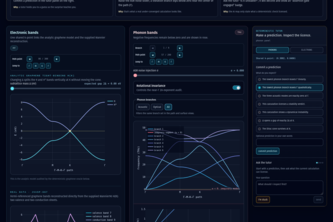
What the company appears to be: Phonon & Fermion visualization is a self-reported educational tool that visualizes electronic band structure and phonon dispersion side-by-side for materials scientists, using an AI tutor that is structurally constrained not to lie. The system is built around a deterministic physics oracle that validates calculations before allowing the AI to respond.
What changed: The project description states this was built as part of an OpenAI 2026 hackathon submission. It represents a novel approach to teaching solid-state physics concepts by combining computational materials science with AI tutoring, where the AI's responses are gated by a physics validation layer.
Single most important open question: Is there evidence that this tool has been adopted or tested beyond its initial hackathon prototype? The description makes no claims about usage, customers, revenue, or traction beyond the author's own account.
The analysis is based entirely on self-reported information from the project description. No independent verification or third-party sources are available. All claims in the description are treated as stated by the author, not proven facts.
What The Product Actually Is
The description states that Phonon & Fermion visualization:
- Puts electrons and phonons side by side on the same $\Gamma!-!M!-!K!-!\Gamma$ path for graphene
- Uses a tight-binding Hamiltonian for electronic bands and a dynamical matrix from force constants for phonon bands
- Includes sliders that represent lessons (e.g., sublattice mass term, ASR violation, rotational invariance)
- Features an AI tutor based on GPT-5.6 that runs physics checks before responding
- Has a deterministic physics oracle that validates calculations through hand-written numerical checks
- Operates with a "Assessment schema" that licenses or revokes specific physics claims
The product is described as being built around a "deterministic physics oracle" that prevents the AI tutor from making false claims, even when prompted.
Positioning & Claim Evolution
The description states:
- The tool was built to address a gap in computational materials science education
- It aims to show that electronic band structure and phonon dispersion are fundamentally the same problem (both eigenvalue problems solved twice with different matrices)
- It positions itself as an "AI tutor for band structure that runs the physics before it answers"
- The core innovation is described as making the AI structurally incapable of lying through a deterministic oracle
- It claims to be a tool the author "wish[ed] I'd had"
The positioning evolved from addressing personal frustration with computational materials science calculations to creating an educational tool that teaches physics concepts while preventing false conclusions.
Target Customer & ICP
The description states:
- The target audience is computational materials scientists
- Specifically mentioned are those who run phonon calculations and encounter issues like negative frequencies near $\Gamma$
- The tool aims to help users understand why their calculations fail or produce unexpected results
- It's positioned as a teaching tool for solid-state physics concepts
The ICP appears to be computational materials scientists working with electronic structure calculations, particularly those dealing with phonon dispersion and band structure analysis.
Business Model & Pricing Evidence
Not evidenced. The description does not contain any information about pricing, monetization, or business model.
Technical & Delivery Signals
The description states:
- Built with Python 3.11, NumPy, phonopy, spglib, ASE for physics core
- Uses FastAPI, Pydantic, Next.js 15, TypeScript, Tailwind, Plotly for API and frontend
- Agents include Codex CLI, GPT-5.6
- Implements a "Assessment schema" with licenses and revokes that gates AI responses
- Has deliberately broken test fixtures as ground truth
- Uses explicit tests to preserve negative frequency signs through JSON round trips
- Includes a taxonomy of misconceptions written by a practising computational materials scientist
The technical architecture shows deliberate design choices around preventing false claims, including:
- Hard prohibitions in AGENTS.md that prevent sanitizing imaginary frequencies
- A deterministic oracle that must validate calculations before AI responses
- Explicit handling of sign conventions for imaginary modes
- Testing with deliberately broken fixtures
Traction & Maturity Signals
Not evidenced. The description makes no claims about customers, revenue, usage metrics, or adoption beyond the author's own account.
The project is described as a hackathon submission from the OpenAI 2026 hackathon, suggesting it may be early-stage development.
Competitive Context
Not evidenced. The description does not contain any information about competitors, market positioning, or competitive landscape.
Open Questions & Risks
- Unproven adoption: No evidence of usage beyond the author's account
- Limited scope: Currently focused only on graphene with no indication of broader materials support
- Unclear scalability: The description suggests it's a teaching tool but doesn't indicate if it can be scaled for commercial use
- Dependency on specific technology stack: Heavy reliance on GPT-5.6 and specific Python libraries that may not be available or stable in production environments
- Unverified claims: All claims are self-reported without independent verification
Questions the description leaves open
- What is the actual adoption rate of this tool beyond the hackathon prototype?
- How does the deterministic oracle handle edge cases not covered in current implementation?
- What is the plan for expanding to other materials beyond graphene?
- How will the system scale from a teaching tool to a diagnostic tool for commercial use?
- What are the specific technical limitations of the current approach that might prevent broader adoption?
- How does the team plan to monetize or commercialize this product?
- What is the long-term vision for the misconception taxonomy and how would it be maintained?
Overall Assessment
Not evidenced. The description contains no information about funding rounds, valuations, revenue, or any commercial metrics that would inform investment or partnership decisions.
The project appears to be an early-stage hackathon prototype with no demonstrated traction or commercial viability. The technical approach is novel but unproven in real-world applications. Without evidence of adoption, customers, or revenue, there is insufficient basis for any investment or partnership assessment.
User Stories BotA demo video on every pull request
Get a demo video on every new feature
GitHub App that watches your pull requests and records a narrated, captioned demo.
Save time on demo prep and make informed decisions faster with a video walkthrough of every new feature.
Source
Submitted to the OpenAI 2026 hackathon on Devpost. Project home on Devpost. Back to the full gallery on Devpost.
This competitive analysis was produced by top-founders.com (opens in a new tab)
Generated by a language model from this project's public Devpost page — its tagline, the author's own write-up and any built-with tags listed there — as captured in August 2026. Short quotations are the author's words. It is an opinion on the idea as a business, not on the people behind it, and it reflects the description as published then. If the project has moved on, request a correction below. The analysis is not independent research and contains no verified traction, revenue or customer data.
An independent guide by KFG International LLC — not affiliated with, endorsed by, or connected to Devpost or OpenAI.