

Archive position — measured, not model output
0 likes on Devpost
2,263 of the 7,850 archived projects have more likes, and 5,587 share exactly 0 — so this project's #5,915 place in the like-ranked listing is a tie-break inside that group, not a ranking.
Projects (log scale)
Likes on Devpost. ▲ marks this project's group.
Show the figures
| Likes | Projects | Share of archive |
|---|---|---|
| 0 | 5,587 | 71.2% |
| 1 | 1,758 | 22.4% |
| 2 | 284 | 3.6% |
| 3–4 | 132 | 1.7% |
| 5–9 | 75 | 1.0% |
| 10+ | 14 | 0.2% |
 User Stories BotA demo video on every pull request
Get a demo video on every new feature
GitHub App that watches your pull requests and records a narrated, captioned demo.
Save time on demo prep and make informed decisions faster with a video walkthrough of every new feature.
Executive Summary
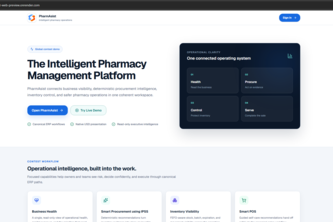
The company appears to be a solo developer project named PharmAsist, self-described as an intelligent pharmacy operations platform. The author, Arie Nugroho, states that the project was built over 14 years of experience in pharmacy and aims to connect fragmented workflows through dashboards, inventory tracking, procurement planning, POS, finance, HR, and clinical decision support.
What changed: The project is presented as a hackathon submission (Devpost entry for OpenAI 2026), with no evidence of prior development or commercial traction. It includes a public demo environment that is intentionally read-only to protect data integrity and security.
The single most important open question: Is there any indication that this software will be deployed in real-world pharmacy operations, and if so, what is the path from prototype to commercial adoption?
This analysis is based entirely on self-reported information. There is no evidence of revenue, customers, funding rounds, headcount, or product-market fit beyond the author's own description.
What The Product Actually Is
The description states that PharmAsist is an intelligent pharmacy operations platform that connects:
- Business health and operational dashboards
- Inventory, batches, expiration dates, and stock movement
- Deterministic procurement planning and supplier recommendations
- Purchase orders, goods receiving, returns, and supplier payables
- POS, sales history, customers, prescriptions, and receipts
- Finance, accounting, expenses, journals, and reporting
- Human resources, attendance, and payroll
- Pharmacy knowledge and clinical-safety decision support
The system is described as having an "explanatory AI layer" that helps users understand information and recommendations but does not execute transactions or replace pharmacist judgment.
Inference: The product appears to be a comprehensive pharmacy management system built with modern web technologies (Laravel, Next.js, TypeScript, PostgreSQL) and integrated with AI tools like GPT-5.6 and Codex for development assistance.
Positioning & Claim Evolution
The author positions PharmAsist as:
- An intelligent pharmacy software designed to optimize inventory, procurement, and operations
- A system that connects fragmented workflows in pharmacy management
- A platform that reduces repetitive work and supports safer decision-making
- A solution built from 14 years of pharmacist experience
Claim evolution: The positioning evolves from a personal problem-solving effort (based on 14 years of pharmacy work) to a comprehensive software platform covering multiple domains of pharmacy operations.
Inference: The author's positioning is rooted in personal experience rather than market research or customer feedback, and the claims are framed as solutions to operational inefficiencies rather than validated market needs.
Target Customer & ICP
The description states that PharmAsist is designed for pharmacists and pharmacy operations. It aims to help users make safer and more informed decisions by connecting fragmented workflows.
Inference: The primary target customer appears to be individual pharmacists or small pharmacy owners who face challenges with inventory, procurement, and operational efficiency.
Not evidenced: No specific customer segments, personas, or market size data are provided.
Business Model & Pricing Evidence
The description does not provide any information about pricing, monetization strategy, or business model. It only mentions that the public demo environment is read-only and that the author intends to use the software in their own pharmacy.
Inference: The business model is unclear, though it may involve selling access to the full platform for real-world pharmacy use.
Not evidenced: No pricing structure, subscription tiers, or revenue streams are described.
Technical & Delivery Signals
The project was built using:
- Technologies: Laravel, Next.js, TypeScript, PHP, PostgreSQL, Tailwind, Docker, GitHub Actions
- AI tools: Claude Code, GPT-5.6, OpenAI Codex
- Deployment platform: Render
Key technical features mentioned include:
- Automated backend, frontend, dependency, identity, and security validation
- Deterministic and idempotent fictional data seeding
- Public-demo mutation protection
- Security analysis using Codex (authentication tokens, cookie security, rate limiting)
Inference: The project demonstrates a strong engineering foundation with attention to security, data integrity, and deployment automation.
Traction & Maturity Signals
The description indicates that this is a hackathon submission (Devpost entry for OpenAI 2026). It includes a public demo environment but no evidence of real-world usage or adoption.
Not evidenced: No revenue, customers, user engagement metrics, or product-market fit data are available. The author states they will use the software in their own pharmacy, but this is not yet demonstrated.
Competitive Context
The description does not mention any competitors or market positioning relative to existing pharmacy management systems.
Inference: There is no evidence of competitive analysis or differentiation from other solutions in the market.
Not evidenced: No information about existing players, market share, or competitive advantages.
Open Questions & Risks
- Solo developer risk: The project is built by a single individual (Arie Nugroho), which raises concerns about scalability and long-term maintenance.
- Unproven commercial viability: There is no evidence of real-world adoption or revenue generation beyond the author's intention to use it in their own pharmacy.
- Public demo limitations: The read-only nature of the public demo may limit understanding of actual functionality and user experience.
- AI dependency: Heavy reliance on AI tools (Codex, GPT-5.6) for development suggests potential risks if these tools change or become unavailable.
Questions the description leaves open
- What specific problems in pharmacy operations are you solving, and how do you know they exist?
- How will you transition from a prototype to a commercial product that can be adopted by other pharmacies?
- What is your plan for addressing regulatory compliance requirements for pharmacy software?
- Can you provide evidence of any real-world testing or pilot programs beyond personal use?
- How do you intend to monetize this platform, and what pricing model are you considering?
Overall Assessment
Not evidenced: No financial data, valuation, funding history, or partnership opportunities are available.
Inference: At this stage, the project appears to be a proof-of-concept or prototype with potential for further development. It lacks commercial traction and market validation, making it premature for investment or partnership consideration without additional evidence of product-market fit or real-world usage.
User Stories BotA demo video on every pull request
Get a demo video on every new feature
GitHub App that watches your pull requests and records a narrated, captioned demo.
Save time on demo prep and make informed decisions faster with a video walkthrough of every new feature.
Source
Submitted to the OpenAI 2026 hackathon on Devpost. Project home on Devpost. Back to the full gallery on Devpost.
This competitive analysis was produced by top-founders.com (opens in a new tab)
Generated by a language model from this project's public Devpost page — its tagline, the author's own write-up and any built-with tags listed there — as captured in August 2026. Short quotations are the author's words. It is an opinion on the idea as a business, not on the people behind it, and it reflects the description as published then. If the project has moved on, request a correction below. The analysis is not independent research and contains no verified traction, revenue or customer data.
An independent guide by KFG International LLC — not affiliated with, endorsed by, or connected to Devpost or OpenAI.