

Archive position — measured, not model output
1 like on Devpost
505 of the 7,850 archived projects have more likes, and 1,758 share exactly 1 — so this project's #1,651 place in the like-ranked listing is a tie-break inside that group, not a ranking.
Projects (log scale)
Likes on Devpost. ▲ marks this project's group.
Show the figures
| Likes | Projects | Share of archive |
|---|---|---|
| 0 | 5,587 | 71.2% |
| 1 | 1,758 | 22.4% |
| 2 | 284 | 3.6% |
| 3–4 | 132 | 1.7% |
| 5–9 | 75 | 1.0% |
| 10+ | 14 | 0.2% |
 User Stories BotA demo video on every pull request
Get a demo video on every new feature
GitHub App that watches your pull requests and records a narrated, captioned demo.
Save time on demo prep and make informed decisions faster with a video walkthrough of every new feature.
Executive Summary
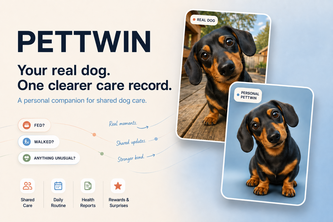
What the company appears to be: PetTwin is a self-reported iOS application that creates a digital twin of a dog from a photo, using AI for image generation and structured care logging. It is described as a local-first app with two modes: Normal Mode (personalized, authenticated) and Deterministic offline Demo Mode (sample data). The app is built around a structured, append-only local care ledger and includes features like task assignment, daily recap, vet reports, and reward systems.
What changed: This is a hackathon submission. The author states it was built in a short timeframe using Swift, SwiftUI, and AI tools including OpenAI GPT-5.6 and gpt-image-2. It has no revenue, customers or traction beyond the author’s own testing and submission to a hackathon.
The single most important open question: Is there any evidence of real-world adoption or user feedback from caregivers who would use this product in practice? The description makes no claims about actual users or usage beyond the author's manual testing and demo mode.
What The Product Actually Is
- The description states PetTwin is a native iOS application built with SwiftUI and SwiftData.
- It creates a "personalised soft-3D digital twin" of a dog from a photo.
- The twin is generated using AI tools including gpt-image-2, GPT-5.6 Terra (for analysis), and GPT-5.6 Luna (for language).
- Care records are stored locally on-device with SwiftData.
- It supports two modes:
- Normal Mode: Uses owner-selected photos, authenticated AI analysis, and personalized twin generation.
- Deterministic offline Demo Mode: Bundled sample data for judges to experience the full care loop without network access or new generation requests.
- The app includes features such as:
- Today’s care plan
- Task assignment
- Recording walks, feeding, medication, grooming, observations
- Daily Recap
- Seven-day Vet Report
- Treat jar and reward system
Inference: The product is described as a local-first iOS app with no cloud sync or multi-user collaboration in its current form.
Positioning & Claim Evolution
- The description states PetTwin aims to be “a living digital twin for your real dog—bringing family and caregivers together around calmer, safer, coordinated care.”
- It positions itself as warmer than traditional pet trackers.
- The author emphasizes emotional engagement through the twin’s personality and rewards while maintaining factual care records.
- It is described as not certifying breed or diagnosing health but helping organize structured facts.
- The app uses AI to personalize summaries and language but does not let AI decide what is true; owners confirm facts.
Inference: The positioning evolved from a personal idea (caring for a dog across households) into a tool that blends emotional engagement with practical care coordination.
Target Customer & ICP
- The description states PetTwin targets households where multiple people care for a dog.
- It is designed to help families or caregivers coordinate tasks and track care history.
- The app simulates caregiver roles (e.g., “Preview as Grandma”) but does not currently support remote accounts or multi-device collaboration.
Inference: The primary ICP appears to be pet owners who live in households with multiple caregivers, though the current version lacks support for actual shared use.
Business Model & Pricing Evidence
- Not evidenced.
- No mention of pricing, monetization strategy, or revenue model.
- The app is described as a hackathon build and not intended for commercial launch yet.
Inference: There is no evidence of any business model or pricing structure beyond the author’s own use case.
Technical & Delivery Signals
- Built with Swift, SwiftUI, SwiftData, PhotosUI, UIKit, Supabase (for auth and edge functions), Deno, TypeScript.
- Uses OpenAI APIs via server-side Edge Functions; iOS app never calls OpenAI directly.
- AI roles are separated:
- GPT-5.6 Terra analyzes visible traits for Vet Reports
- GPT-5.6 Luna generates optional recap language
- gpt-image-2 creates the soft-3D twin
- Local-first design with SwiftData for persistence.
- Includes offline Demo Mode using bundled sample data.
- Supports accessibility features like Reduce Motion, VoiceOver, and adaptive layouts.
- Unit and UI tests (61 unit tests, 27 UI tests) were run.
- The app was tested manually by the author.
Inference: The technical stack supports a local-first approach with AI integration via secure backend services. No evidence of production infrastructure or scalability beyond the demo.
Traction & Maturity Signals
- Not evidenced.
- No data on users, adoption, retention, or usage metrics.
- The project is described as a hackathon submission and not yet launched for public use.
- Manual testing by the author was conducted, but no external validation or feedback is mentioned.
Inference: There is no evidence of traction or maturity beyond the author’s own development and testing.
Competitive Context
- Not evidenced.
- No mention of competitors or market analysis.
- The description does not reference existing pet care apps or digital twin solutions.
Inference: No competitive context provided in the self-reported description.
Open Questions & Risks
- No commercial traction or user feedback: The app is a hackathon submission with no evidence of real-world adoption.
- Limited functionality: Multi-user collaboration, live sync, notifications, and custom tasks are not supported in current version.
- AI safety constraints: While AI is used for personalization, it does not diagnose health or make decisions; however, this may limit its utility if users expect more advanced features.
- Local-first design limits scalability: The app stores data locally, which may hinder broader adoption or integration with other platforms.
- Unverified claims: All descriptions are self-reported and unverified.
Inference: Risk of misalignment between perceived value and actual product capability due to lack of real-world testing and commercial viability.
Questions the description leaves open
- What specific problems in household pet care did you observe that led to this solution?
- How do you plan to validate the emotional engagement aspect with real users?
- Are there any plans to expand beyond the current local-first, single-user model?
- What is your roadmap for integrating remote caregiver accounts or multi-device sync?
- Have you considered how to handle data privacy and ownership in a multi-user environment?
- How do you intend to monetize this product if at all?
- What are the key assumptions about user behavior that underpin your design choices?
Overall Assessment
- Not evidenced.
- No financials, funding rounds, or valuation data provided.
- The project is described as a hackathon submission with no commercial traction or business model.
Inference: At this stage, there is insufficient evidence to assess investment or partnership potential. The idea shows promise in addressing household pet care coordination but lacks real-world validation and scalability features.
User Stories BotA demo video on every pull request
Get a demo video on every new feature
GitHub App that watches your pull requests and records a narrated, captioned demo.
Save time on demo prep and make informed decisions faster with a video walkthrough of every new feature.
Source
Submitted to the OpenAI 2026 hackathon on Devpost. Project home on Devpost. Back to the full gallery on Devpost.
This competitive analysis was produced by top-founders.com (opens in a new tab)
Generated by a language model from this project's public Devpost page — its tagline, the author's own write-up and any built-with tags listed there — as captured in August 2026. Short quotations are the author's words. It is an opinion on the idea as a business, not on the people behind it, and it reflects the description as published then. If the project has moved on, request a correction below. The analysis is not independent research and contains no verified traction, revenue or customer data.
An independent guide by KFG International LLC — not affiliated with, endorsed by, or connected to Devpost or OpenAI.