

Archive position — measured, not model output
1 like on Devpost
505 of the 7,850 archived projects have more likes, and 1,758 share exactly 1 — so this project's #1,652 place in the like-ranked listing is a tie-break inside that group, not a ranking.
Projects (log scale)
Likes on Devpost. ▲ marks this project's group.
Show the figures
| Likes | Projects | Share of archive |
|---|---|---|
| 0 | 5,587 | 71.2% |
| 1 | 1,758 | 22.4% |
| 2 | 284 | 3.6% |
| 3–4 | 132 | 1.7% |
| 5–9 | 75 | 1.0% |
| 10+ | 14 | 0.2% |
 User Stories BotA demo video on every pull request
Get a demo video on every new feature
GitHub App that watches your pull requests and records a narrated, captioned demo.
Save time on demo prep and make informed decisions faster with a video walkthrough of every new feature.
Executive Summary
What the company appears to be
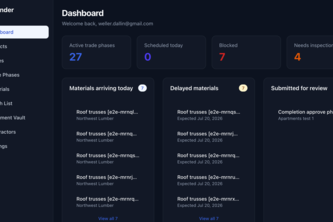
PhaseBinder is a self-reported construction project management tool built as a web application by one developer (Dallin Weller). The author states it is intended for general contractors managing multiple construction projects, with features focused on tracking trades, materials, inspections, punch work, documents, and access control.
What changed
This appears to be an early-stage prototype or MVP submitted to the OpenAI 2026 hackathon. There is no evidence of prior development, funding, or commercial traction beyond the author’s own description.
Single most important open question
Is there any evidence that this product will be adopted by general contractors in real-world use, or whether it addresses a genuine need in the field?
Note: This analysis is based entirely on self-reported information provided by the author. No third-party verification, revenue data, customer feedback, or traction metrics are available.
What The Product Actually Is
The description states that PhaseBinder is a responsive web application built using Next.js, React, TypeScript, Tailwind CSS, and Firebase, designed to help general contractors manage construction projects in one place. It includes functionality for:
- Project workspaces with sections like Overview, Trade Phases, Materials, Punch List, and Documents.
- Secure material delivery tracking via photo uploads and one-time receipt links.
- User access control and permission management.
- Integration with Firebase Authentication, Cloud Firestore, and Cloud Storage.
The author claims the tool was built to support a real-world use case — managing five major construction projects involving forty apartments. It is described as a complete product experience rather than a collection of separate screens.
Inference: The tool appears to be a minimal viable product (MVP) developed in a short timeframe, likely for demonstration purposes at a hackathon.
Positioning & Claim Evolution
The author positions PhaseBinder as a practical solution for general contractors dealing with scattered information across multiple tools and formats. It is described as addressing issues such as delayed material orders, missing inspection photos, and outdated plans that cause rework.
Key claims:
- The tool aims to keep jobs organized and moving.
- It supports real-world workflows on job sites.
- It reduces uncertainty by providing clear visibility into what is ready, blocked, arrived, or needs approval.
There are no stated competitors or market positioning beyond the author’s personal experience with a family member who uses construction tools. No branding, messaging, or differentiation strategy is evident in the description.
Claim vs Fact: The author claims that PhaseBinder solves real problems but does not provide evidence of adoption, user feedback, or validation from actual users outside the developer's circle.
Target Customer & ICP
The target customer is described as a general contractor preparing to start major construction projects, specifically mentioned as someone managing five large-scale apartment developments.
The author notes that the tool was built for his brother-in-law, who is about to begin these projects. The intended user base seems limited to individuals or small teams managing construction workflows, with no indication of broader market targeting.
Not evidenced: No evidence of customer personas, segmentation, or buyer intent beyond one person’s experience.
Business Model & Pricing Evidence
There is no mention of pricing, monetization strategy, or business model in the description. The author does not state whether PhaseBinder will be sold as a SaaS product, offered free to users, or supported through another mechanism.
Not evidenced: No information on how the company intends to generate revenue or sustain operations.
Technical & Delivery Signals
The application is built using modern web technologies:
- Framework: Next.js, React
- Language: TypeScript
- Styling: Tailwind CSS
- Backend: Firebase (Authentication, Firestore, Storage)
- Testing: Playwright browser tests covering workflows and permissions
Security features include:
- Firestore security rules enforcing access control.
- One-time receipt links with expiration and upload limits.
- Interface-level filtering based on user permissions.
Inference: The technical stack suggests a scalable, secure MVP built for performance and usability. However, no evidence of production deployment or scalability testing is provided.
Traction & Maturity Signals
The project was submitted to the OpenAI 2026 hackathon and has no known traction beyond that context. There are no references to:
- Customers
- Revenue
- Usage metrics
- Product adoption
- User feedback or reviews
Not evidenced: No signs of product-market fit, user engagement, or growth indicators.
Competitive Context
There is no mention of existing competitors or market analysis in the description. The author does not reference other construction project management tools or platforms.
Not evidenced: No competitive landscape or positioning against existing solutions.
Open Questions & Risks
- Single-person development team: Only one developer (Dallin Weller) is involved, which raises concerns about scalability and long-term maintenance.
- No commercial traction: The tool has not been tested in real-world conditions beyond the author’s family member.
- Unverified claims: All features and benefits are self-reported without external validation.
- Limited scope: No indication of integration capabilities, reporting tools, or advanced functionality beyond basic tracking.
- Hackathon origin: The product was built for a hackathon, suggesting it may be incomplete or experimental.
Inference: The lack of independent verification, user testing, and commercial viability raises significant risk for investment or partnership.
Questions the description leaves open
- Has the tool been tested with actual general contractors on real job sites?
- What is the expected timeline for full product release and adoption?
- Are there any plans to monetize the platform, and how?
- How does the team plan to scale beyond a single developer?
- What specific feedback has been received from the intended users (e.g., your brother-in-law)?
- Is there any interest from construction firms or contractors in using this tool?
Overall Assessment
At this stage, PhaseBinder appears to be an early-stage MVP developed for a hackathon with no known commercial traction or evidence of market demand.
Assessment: Not suitable for investment or partnership at this time. The product lacks validation, scalability, and clear monetization strategy. It requires further development, real-world testing, and user feedback before any strategic consideration can be made.
Confidence Level: Low — based on minimal self-reported evidence and no external corroboration.
User Stories BotA demo video on every pull request
Get a demo video on every new feature
GitHub App that watches your pull requests and records a narrated, captioned demo.
Save time on demo prep and make informed decisions faster with a video walkthrough of every new feature.
Source
Submitted to the OpenAI 2026 hackathon on Devpost. Project home on Devpost. Back to the full gallery on Devpost.
This competitive analysis was produced by top-founders.com (opens in a new tab)
Generated by a language model from this project's public Devpost page — its tagline, the author's own write-up and any built-with tags listed there — as captured in August 2026. Short quotations are the author's words. It is an opinion on the idea as a business, not on the people behind it, and it reflects the description as published then. If the project has moved on, request a correction below. The analysis is not independent research and contains no verified traction, revenue or customer data.
An independent guide by KFG International LLC — not affiliated with, endorsed by, or connected to Devpost or OpenAI.