

Archive position — measured, not model output
1 like on Devpost
505 of the 7,850 archived projects have more likes, and 1,758 share exactly 1 — so this project's #1,646 place in the like-ranked listing is a tie-break inside that group, not a ranking.
Projects (log scale)
Likes on Devpost. ▲ marks this project's group.
Show the figures
| Likes | Projects | Share of archive |
|---|---|---|
| 0 | 5,587 | 71.2% |
| 1 | 1,758 | 22.4% |
| 2 | 284 | 3.6% |
| 3–4 | 132 | 1.7% |
| 5–9 | 75 | 1.0% |
| 10+ | 14 | 0.2% |
 User Stories BotA demo video on every pull request
Get a demo video on every new feature
GitHub App that watches your pull requests and records a narrated, captioned demo.
Save time on demo prep and make informed decisions faster with a video walkthrough of every new feature.
Executive Summary
What the company appears to be
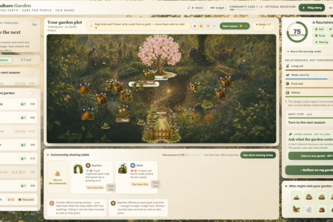
Permaculture Garden — A living systems learning game is a self-reported educational browser-based game designed for young people and community groups to explore permaculture through interactive gameplay and AI-assisted feedback. It is built as a local desktop experience using React, Vercel, and GPT-5.6 Luna, with no account required.
What changed
The project was submitted to the OpenAI 2026 hackathon on Devpost. The author describes it as an experimental prototype that began from personal inspiration rooted in real-world volunteering in France. It is not evidenced to have launched or scaled beyond this initial submission.
Single most important open question
Is there any evidence of external validation, user testing, or traction beyond the author’s own description?
What The Product Actually Is
The description states that Permaculture Garden is a local desktop browser experience, built with React, and runs on Vercel. It uses GPT-5.6 Luna via a Vercel AI Gateway to provide feedback in the form of a “Living Lesson” that connects player actions to real-world ecological outcomes.
The game is described as:
- A first-person narrative-driven experience set in a permaculture garden.
- Involving four seasons, eleven learning challenges, and minigames focused on system thinking.
- Using GPT-5.6 Luna to explain relationships, but not to control gameplay or reward outcomes.
- Designed for offline fallback when AI is unavailable.
It is not a commercial product, nor does it appear to have monetization or user accounts.
Claim: The game is a browser-based experience with AI integration and educational goals.
Evidence: Author's own description.
Inference: It is not a scalable or production-ready product, but an experimental prototype.
Positioning & Claim Evolution
The author positions Permaculture Garden as:
- A hands-on learning tool for permaculture that avoids textbook-style instruction.
- An experience where players can make mistakes, observe outcomes, and learn through feedback.
- A system-thinking game that connects ecological principles with real-world experimentation.
It is described as:
- Not a generic chatbot or AI assistant.
- A living lesson embedded within gameplay, not a standalone AI tool.
- Designed for youth, schools, and community projects, but not yet launched for those audiences.
Claim: The game is positioned to teach system thinking through ecological interaction.
Evidence: Author’s own description.
Inference: It is an experimental prototype with no evidence of adoption or commercial traction.
Target Customer & ICP
The author states that the longer-term vision includes:
- Schools
- Youth programmes
- Environmental organisations
- Community projects exploring ecology and social cooperation
It is also intended for young people and facilitators involved in community gardening, including those connected to the real Menet garden project.
However, there is no evidence of:
- Actual users
- Customer segments or personas
- Market research or feedback loops
Claim: The target audience includes educators, youth, and environmental groups.
Evidence: Author’s own description.
Inference: No validated customer data or ICP.
Business Model & Pricing Evidence
The project is described as:
- A non-commercial prototype.
- Not monetized or sold.
- Designed to be free to play, with no account required.
- No pricing, subscription, or revenue model is mentioned.
Claim: The product is not commercial.
Evidence: Author’s own description.
Inference: No business model or pricing structure is evident.
Technical & Delivery Signals
The project is built using:
- React
- Vercel AI Gateway
- GPT-5.6 Luna
- Codex (as a development tool)
- ElevenLabs for audio
- Vercel Functions
It uses:
- Local storage for progress
- Server boundary only for GPT-5.6 Luna
- Offline fallback when AI is unavailable
- OIDC authentication for security
Claim: The product is technically feasible and uses modern tools.
Evidence: Author’s own description.
Inference: No evidence of production deployment or scalability.
Traction & Maturity Signals
The project is described as:
- A prototype submitted to a hackathon
- Not yet launched for real users
- A self-contained experience with no external metrics or user data
- A personal project by one developer (Martin Pazderník)
There is no evidence of:
- Users, customers, or adoption
- Revenue or monetization
- Product-market fit or feedback loops
- Scaling beyond the initial prototype
Claim: The product is an early-stage prototype.
Evidence: Author’s own description.
Inference: No traction or maturity signals.
Competitive Context
The author does not reference:
- Competitors
- Similar products in the educational or permaculture space
- Market positioning or differentiation
Claim: No competitive context is provided.
Evidence: Author’s own description.
Inference: No evidence of market analysis or competitive awareness.
Open Questions & Risks
Key risks and open questions include:
- The project is not commercial or monetized.
- It is a single-person prototype, with no team or external validation.
- There is no evidence of user testing, feedback, or real-world impact.
- The AI integration is described as limited in scope (not controlling gameplay).
- No data on performance, scalability, or long-term viability.
Claim: The project lacks commercial traction and external validation.
Evidence: Author’s own description.
Inference: Risk of failure to scale or gain adoption.
Questions the description leaves open
- What is the actual user feedback from the Menet garden volunteers or facilitators?
- How does the AI integration actually work in practice, and what are its limitations?
- Is there any plan for monetization or commercialization beyond the prototype?
- What are the technical constraints of the current architecture that might limit scalability?
- Are there any plans to expand beyond the current scope (e.g., mobile, language support)?
- How is the narrative and educational content validated or tested?
Claim: These questions are needed to assess real-world applicability and viability.
Evidence: Author’s own description.
Inference: No evidence of answers to these questions.
Overall Assessment
The project is described as a personal prototype submitted to a hackathon, with no evidence of traction, revenue, or commercialization. It is an experimental educational tool that uses AI in a limited way and is not yet ready for investment or partnership.
Claim: Not suitable for investment or partnership at this stage.
Evidence: Author’s own description.
Inference: No evidence of product-market fit or scalability.
User Stories BotA demo video on every pull request
Get a demo video on every new feature
GitHub App that watches your pull requests and records a narrated, captioned demo.
Save time on demo prep and make informed decisions faster with a video walkthrough of every new feature.
Source
Submitted to the OpenAI 2026 hackathon on Devpost. Project home on Devpost. Back to the full gallery on Devpost.
This competitive analysis was produced by top-founders.com (opens in a new tab)
Generated by a language model from this project's public Devpost page — its tagline, the author's own write-up and any built-with tags listed there — as captured in August 2026. Short quotations are the author's words. It is an opinion on the idea as a business, not on the people behind it, and it reflects the description as published then. If the project has moved on, request a correction below. The analysis is not independent research and contains no verified traction, revenue or customer data.
An independent guide by KFG International LLC — not affiliated with, endorsed by, or connected to Devpost or OpenAI.