

Archive position — measured, not model output
0 likes on Devpost
2,263 of the 7,850 archived projects have more likes, and 5,587 share exactly 0 — so this project's #3,609 place in the like-ranked listing is a tie-break inside that group, not a ranking.
Projects (log scale)
Likes on Devpost. ▲ marks this project's group.
Show the figures
| Likes | Projects | Share of archive |
|---|---|---|
| 0 | 5,587 | 71.2% |
| 1 | 1,758 | 22.4% |
| 2 | 284 | 3.6% |
| 3–4 | 132 | 1.7% |
| 5–9 | 75 | 1.0% |
| 10+ | 14 | 0.2% |
 User Stories BotA demo video on every pull request
Get a demo video on every new feature
GitHub App that watches your pull requests and records a narrated, captioned demo.
Save time on demo prep and make informed decisions faster with a video walkthrough of every new feature.
Executive Summary
What the company appears to be
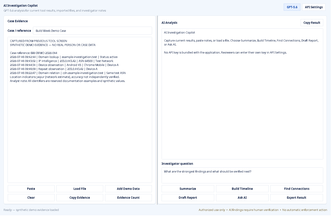
Cyber Search For Lea Work is a self-reported Java desktop application designed for law enforcement and cybersecurity professionals to conduct cyber investigations. It integrates multiple tools into one interface and adds an AI Copilot to assist in summarizing, organizing, and analyzing technical evidence.
What changed
The project evolved from a multi-tool desktop workspace into an AI-assisted investigation tool during the OpenAI Build Week hackathon. The AI component was added as a separate layer that reads visible results from existing modules and sends them to OpenAI APIs for analysis.
Single most important open question — the commercial due-diligence read
Is there any evidence of real-world usage, traction or customer validation beyond this self-reported hackathon submission? The description does not indicate whether the tool has been adopted by any law enforcement or cybersecurity teams, nor does it show any revenue, user data, or market feedback.
What The Product Actually Is
The description states that Cyber Search For Lea Work is a Java desktop application built for lawful cyber investigation, cybersecurity research, and authorized training. It includes:
- IP and network-intelligence tools
- Domain and website analysis
- Device and technical-information searches
- API-based investigation utilities
- Local database-backed search modules
- External web investigation tools
- Structured result and reporting screens
It also features a new AI Copilot, which reads information from the current screen and sends it to OpenAI APIs for tasks such as:
- Summarizing results
- Generating timelines
- Identifying connections between indicators
- Drafting structured reports
- Answering natural-language questions
The AI does not make final decisions but acts as an assistant, with outputs intended to provide leads that must be independently reviewed by a human investigator.
Evidence Self-reported by author. No independent verification or demonstration of actual functionality beyond the project submission.
Positioning & Claim Evolution
The author claims the product is:
- A single desktop workspace for authorized investigators
- An AI-assisted desktop workspace designed for lawful cyber investigation, cybersecurity research, and authorized training
It started as a collection of tools and evolved into an AI-enhanced version during OpenAI Build Week. The author emphasizes that the AI is meant to assist analysis, not replace human judgment.
Inference The evolution from tool aggregation to AI integration suggests intent to improve workflow efficiency, but no evidence indicates whether this change was successful or adopted in practice.
Target Customer & ICP
The description states that the product is intended for:
- Law enforcement agencies (LEA)
- Cybersecurity professionals
- Authorized training environments
It is described as a tool for authorized personnel, implying access control and compliance requirements. The application is built for cyber investigations, suggesting use in digital forensics or incident response contexts.
Evidence Self-reported. No indication of specific customers, user types, or market segmentation beyond the stated audience.
Business Model & Pricing Evidence
There is no evidence provided about:
- Revenue streams
- Pricing models
- Monetization strategy
- Subscription plans or licensing
The description focuses on the technical architecture and functionality, not commercial aspects.
Evidence Not evidenced. No claims or data regarding business model or pricing.
Technical & Delivery Signals
The application is built using:
- Java, with a NetBeans-based codebase
- Codex for navigating and modifying the existing codebase
- OpenAI API integration via REST calls
- Swing UI framework
- Integration of multiple APIs, local databases, and web tools
Key technical features include:
- AI Copilot button in main interface
- Evidence capture from different screen formats (tables, labels, text areas)
- Structured context sent to OpenAI API with task-specific instructions
- API key kept outside source code for credential protection
- Removal of non-working modules and sensitive data for submission
Evidence Self-reported. No independent verification of technical performance or delivery.
Traction & Maturity Signals
There is no evidence of:
- Customers or users
- Revenue or monetization
- Product adoption or usage metrics
- Market traction or feedback
The project was submitted as a hackathon entry, and the author notes that it was cleaned for submission, removing real investigation data and non-working tools.
Evidence Not evidenced. The product is described only as a prototype or demo.
Competitive Context
No mention of competitors or market positioning in the description. The author does not reference similar tools or platforms in the cyber investigation or digital forensics space.
Evidence Not evidenced. No competitive analysis or market comparison provided.
Open Questions & Risks
- Unverified claims: All statements are self-reported and unverified.
- No traction or adoption: The product is described only as a hackathon submission with no evidence of real-world usage.
- Limited commercial viability: No pricing, revenue, or customer data provided.
- AI integration risk: AI output is described as assistive but not final — this may be a limitation for adoption in high-stakes environments.
- Security and privacy concerns: While the author mentions credential protection, no details are given about how sensitive data is handled or stored.
Inference The product appears to be a proof-of-concept rather than a commercial offering. Its lack of real-world validation raises questions about scalability and utility.
Questions the description leaves open
- Has the tool been tested or used by any law enforcement or cybersecurity teams?
- What is the current status of the product — is it still under development, or has it moved beyond the prototype stage?
- Are there plans to monetize this tool? If so, what is the business model?
- How does the AI integration handle edge cases or ambiguous data?
- What are the technical limitations of the current implementation?
- Is there any internal testing or feedback from users in the field?
Overall Assessment
Not evidenced.
There is no evidence to support a commercial investment or partnership opportunity at this time. The project is described as a hackathon submission with no indication of traction, revenue, or customer validation.
The author states that the tool was built for authorized training, law enforcement, and cybersecurity research, but does not provide any data on actual usage or market demand.
Confidence level Low. The description is self-reported and unverified, with no third-party corroboration of claims or evidence of real-world application.
User Stories BotA demo video on every pull request
Get a demo video on every new feature
GitHub App that watches your pull requests and records a narrated, captioned demo.
Save time on demo prep and make informed decisions faster with a video walkthrough of every new feature.
Source
Submitted to the OpenAI 2026 hackathon on Devpost. Project home on Devpost. Back to the full gallery on Devpost.
This competitive analysis was produced by top-founders.com (opens in a new tab)
Generated by a language model from this project's public Devpost page — its tagline, the author's own write-up and any built-with tags listed there — as captured in August 2026. Short quotations are the author's words. It is an opinion on the idea as a business, not on the people behind it, and it reflects the description as published then. If the project has moved on, request a correction below. The analysis is not independent research and contains no verified traction, revenue or customer data.
An independent guide by KFG International LLC — not affiliated with, endorsed by, or connected to Devpost or OpenAI.