

Archive position — measured, not model output
0 likes on Devpost
2,263 of the 7,850 archived projects have more likes, and 5,587 share exactly 0 — so this project's #5,572 place in the like-ranked listing is a tie-break inside that group, not a ranking.
Projects (log scale)
Likes on Devpost. ▲ marks this project's group.
Show the figures
| Likes | Projects | Share of archive |
|---|---|---|
| 0 | 5,587 | 71.2% |
| 1 | 1,758 | 22.4% |
| 2 | 284 | 3.6% |
| 3–4 | 132 | 1.7% |
| 5–9 | 75 | 1.0% |
| 10+ | 14 | 0.2% |
 User Stories BotA demo video on every pull request
Get a demo video on every new feature
GitHub App that watches your pull requests and records a narrated, captioned demo.
Save time on demo prep and make informed decisions faster with a video walkthrough of every new feature.
Executive Summary
What the company appears to be
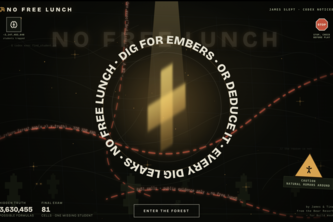
The project described by the caller is a two-player logic game named No Free Lunch, built as part of the OpenAI 2026 hackathon. It uses an AI opponent (the Assayer) that operates with integrity, based on a symbolic solver rather than bluffing or hallucinating. The game is rooted in the No Free Lunch theorem and draws inspiration from Inscryption. It includes online play, narrative elements, and multiple difficulty modes.
What changed
The project is presented as an experimental prototype, not yet commercialized or deployed for public use beyond the hackathon submission. There is no evidence of prior versions, funding, or product-market fit beyond its self-reported development.
Single most important open question — the commercial due-diligence read
Is there a viable path to monetization or strategic value from this concept, and does it have any traction or user engagement that would justify further investment or partnership?
What The Product Actually Is
The description states that No Free Lunch is a two-player logic game played on a 9x9 board. Players attempt to uncover a hidden boolean formula using five maps (AND, OR, XOR). The game features:
- A public information system where clues are shared between players.
- An AI opponent called “The Assayer” that uses an exact solver and cannot bluff.
- A narrative twist involving GPT-generated taunts grounded in logical truth.
- Online play enabled via Convex and GitHub Pages.
- A technical stack including React, Tailwind, shadcn, Node.js, OpenAI APIs, and Codex.
Inference The game is a hybrid of logic puzzle mechanics and AI integrity design. It uses symbolic computation to ensure factual accuracy in its AI opponent, distinguishing it from typical generative AI games.
Positioning & Claim Evolution
The description claims the project:
- Is inspired by the No Free Lunch theorem.
- Turns the scientific method into a tense and quirky game.
- Uses an AI opponent that is demonstrably honest due to a symbolic solver.
- Grounds AI responses in symbolic computation rather than prompt engineering.
Inference The positioning centers on integrity, logic, and educational value. It positions itself as a thought experiment or proof-of-concept for how AI can be used responsibly in interactive experiences.
Not evidenced There is no claim of market readiness, scalability, or commercial viability beyond the hackathon submission.
Target Customer & ICP
The description does not specify:
- Who the target customer is.
- Whether the game targets educators, puzzle enthusiasts, gamers, or developers.
- Any explicit ICP (Ideal Customer Profile) or persona definition.
Inference The game may appeal to fans of logic puzzles, AI enthusiasts, and those interested in educational or experimental games. However, no clear segment is defined.
Business Model & Pricing Evidence
The description does not contain any information about:
- Revenue model.
- Pricing strategy.
- Monetization plans.
- Paid features or subscriptions.
Inference The project appears to be a prototype with no commercial business model evident.
Technical & Delivery Signals
The description states:
- The game uses a dedicated engine and exact solver.
- Boards are represented as bitboards ($b\in{0,1}^{81}$).
- The solver systematically enumerates configurations consistent with publicly available evidence.
- AI opponent uses GPT-4o-mini for phrasing but not for generating facts.
- API keys are handled server-side via Convex to maintain security.
- Online play is supported through Convex and GitHub Pages.
Inference The technical architecture shows a clear separation of logic (solver), presentation (React), and AI (GPT with grounding). It reflects a deliberate approach to AI integrity and secure delivery.
Traction & Maturity Signals
The description states:
- This was submitted to the OpenAI 2026 hackathon.
- The team size is two.
- The project includes an introduction, multiple endings, two difficulty levels, online play, sound, and a narrative twist.
- Future plans include daily puzzles, classroom mode, spectator replays, and narrator updates.
Not evidenced
- No revenue or monetization data.
- No user base or engagement metrics.
- No evidence of prior versions or product-market fit.
- No indication of any commercial deployment or distribution.
Competitive Context
The description does not mention:
- Direct competitors.
- Similar games or platforms in the logic puzzle or AI-integrated gaming space.
- Market positioning relative to existing tools or products.
Inference The game appears to be unique in its use of a symbolic solver for AI integrity, but there is no evidence of competitive analysis or market presence.
Open Questions & Risks
- Unproven commercial viability: No evidence of revenue, customers, or monetization.
- Limited team size: Only two members, which may constrain execution and scalability.
- Prototype-only status: The project is described as a hackathon submission with no indication of further development or deployment.
- No market traction: No data on adoption, usage, or user feedback.
- Narrative-driven design: While unique, the focus on narrative and integrity may not translate into broad appeal or commercial success.
Questions the description leaves open
- What is your plan for monetization or commercialization?
- Have you tested the game with users beyond the hackathon?
- How do you intend to scale beyond a prototype?
- Are there any existing partnerships or distribution channels?
- What are the key assumptions about user behavior and engagement?
- How do you plan to handle potential scalability issues in online play?
Overall Assessment
Not evidenced: There is no evidence of revenue, traction, or commercial readiness.
Inference: This project is a hackathon prototype with strong technical design around AI integrity and logic puzzles. It does not appear to be a viable investment or partnership opportunity at this stage, as there is no indication of product-market fit, monetization, or user engagement beyond the initial submission.
User Stories BotA demo video on every pull request
Get a demo video on every new feature
GitHub App that watches your pull requests and records a narrated, captioned demo.
Save time on demo prep and make informed decisions faster with a video walkthrough of every new feature.
Source
Submitted to the OpenAI 2026 hackathon on Devpost. Project home on Devpost. Back to the full gallery on Devpost.
This competitive analysis was produced by top-founders.com (opens in a new tab)
Generated by a language model from this project's public Devpost page — its tagline, the author's own write-up and any built-with tags listed there — as captured in August 2026. Short quotations are the author's words. It is an opinion on the idea as a business, not on the people behind it, and it reflects the description as published then. If the project has moved on, request a correction below. The analysis is not independent research and contains no verified traction, revenue or customer data.
An independent guide by KFG International LLC — not affiliated with, endorsed by, or connected to Devpost or OpenAI.