

Archive position — measured, not model output
0 likes on Devpost
2,263 of the 7,850 archived projects have more likes, and 5,587 share exactly 0 — so this project's #3,611 place in the like-ranked listing is a tie-break inside that group, not a ranking.
Projects (log scale)
Likes on Devpost. ▲ marks this project's group.
Show the figures
| Likes | Projects | Share of archive |
|---|---|---|
| 0 | 5,587 | 71.2% |
| 1 | 1,758 | 22.4% |
| 2 | 284 | 3.6% |
| 3–4 | 132 | 1.7% |
| 5–9 | 75 | 1.0% |
| 10+ | 14 | 0.2% |
 User Stories BotA demo video on every pull request
Get a demo video on every new feature
GitHub App that watches your pull requests and records a narrated, captioned demo.
Save time on demo prep and make informed decisions faster with a video walkthrough of every new feature.
Executive Summary
Company: CyberSafe Defender Studio
Self-reported basis: The description is entirely self-reported and unverified; it contains no evidence of revenue, customers, traction, or funding.
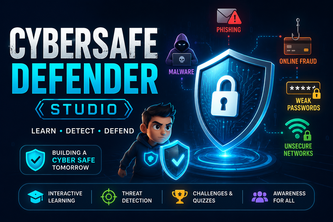
What the company appears to be: A local-first, offline-capable cybersecurity awareness app designed for general public education, with simulated phishing scenarios and response planning tools.
What changed: The project was adapted from an institution-specific cybersecurity manual into a global, public-facing product with a focus on safe learning and privacy.
Single most important open question: Is there any evidence of user engagement or adoption beyond the single developer's claim?
What The Product Actually Is
The description states that CyberSafe Defender Studio is:
- A global cyber-safety learning app
- Built as a static, local-first PWA
- Uses HTML, CSS, JavaScript, browser local storage, and service workers for offline functionality
- Includes guided cybersecurity modules, fictional phishing simulations, safety checklists, incident-note drafting, and an awareness-report workspace
- Operates without cloud sync or account requirements
- Designed to preserve learning progress on-device
Inferred: It is a browser-based, offline-capable educational tool for cyber awareness.
Positioning & Claim Evolution
The description states:
- The app aims to bridge the gap between technical and generic cyber education
- It seeks to create a calmer learning space where users can understand risks, practice safe responses, and know when to escalate
- It was built to be safe for broad audiences, removing institutional framing and logos
Inferred: The positioning evolved from an institution-specific manual to a public-facing, privacy-conscious, defensive learning tool.
Target Customer & ICP
The description states:
- Intended for students, volunteers, educators, or small organisations
- Designed for everyday people, not just technical users
- Aims to support low-connectivity environments
Inferred: The target customer is a non-technical public audience with limited access to online tools, who benefit from offline-first learning.
Business Model & Pricing Evidence
The description states:
- No account or cloud sync required
- No mention of pricing or monetisation strategy
- No evidence of revenue streams or business model
Not evidenced: There is no indication of how the product will be monetised or whether it has a business model beyond its current development stage.
Technical & Delivery Signals
The description states:
- Built as a local-first PWA
- Uses HTML, CSS, JavaScript, and browser local storage
- Employs service workers for offline use
- Utilises Codex and GPT-5.6 for content conversion and documentation
- Includes interactive client-side modules
Inferred: The technical approach is client-side, privacy-focused, and offline-capable, with minimal backend dependencies.
Traction & Maturity Signals
The description states:
- Built by a single developer
- Submitted to the OpenAI 2026 hackathon
- No mention of users, downloads, or adoption
- No evidence of product usage or engagement metrics
Not evidenced: There is no evidence of traction, user base, or product maturity beyond its development stage.
Competitive Context
The description states:
- Cybercrime awareness education is often too technical or too generic
- The app aims to offer a calmer, practical learning experience
Inferred: It competes in the cybersecurity education space, aiming to differentiate through practicality, calmness, and accessibility.
Not evidenced: No information on existing competitors or market positioning beyond the self-reported narrative.
Open Questions & Risks
- The app is single-developer, which raises concerns about scalability and long-term maintenance
- It is not verified as a product in use; it’s a hackathon submission with no evidence of adoption
- No pricing or monetisation strategy is evident, raising questions about sustainability
- The local-first approach may limit reach or functionality for users who need cloud-based tools
Inferred: Risks include lack of traction, unclear business model, and limited development capacity.
Questions the description leaves open
- What is the intended user base beyond the initial public audience?
- How will the app be distributed or promoted to users?
- Are there any plans for monetisation or revenue generation?
- Has the app been tested with real users, and what feedback was received?
- What are the long-term maintenance and scalability plans?
Overall Assessment
The description states:
- The project is a single-developer hackathon submission
- No evidence of traction, revenue, or customer adoption
- No indication of business model or funding
Not evidenced: There is no basis for investment or partnership consideration at this stage. The product is in early development and lacks any verified commercial signals.
User Stories BotA demo video on every pull request
Get a demo video on every new feature
GitHub App that watches your pull requests and records a narrated, captioned demo.
Save time on demo prep and make informed decisions faster with a video walkthrough of every new feature.
Source
Submitted to the OpenAI 2026 hackathon on Devpost. Project home on Devpost. Back to the full gallery on Devpost.
This competitive analysis was produced by top-founders.com (opens in a new tab)
Generated by a language model from this project's public Devpost page — its tagline, the author's own write-up and any built-with tags listed there — as captured in August 2026. Short quotations are the author's words. It is an opinion on the idea as a business, not on the people behind it, and it reflects the description as published then. If the project has moved on, request a correction below. The analysis is not independent research and contains no verified traction, revenue or customer data.
An independent guide by KFG International LLC — not affiliated with, endorsed by, or connected to Devpost or OpenAI.