

Archive position — measured, not model output
0 likes on Devpost
2,263 of the 7,850 archived projects have more likes, and 5,587 share exactly 0 — so this project's #5,867 place in the like-ranked listing is a tie-break inside that group, not a ranking.
Projects (log scale)
Likes on Devpost. ▲ marks this project's group.
Show the figures
| Likes | Projects | Share of archive |
|---|---|---|
| 0 | 5,587 | 71.2% |
| 1 | 1,758 | 22.4% |
| 2 | 284 | 3.6% |
| 3–4 | 132 | 1.7% |
| 5–9 | 75 | 1.0% |
| 10+ | 14 | 0.2% |
 User Stories BotA demo video on every pull request
Get a demo video on every new feature
GitHub App that watches your pull requests and records a narrated, captioned demo.
Save time on demo prep and make informed decisions faster with a video walkthrough of every new feature.
Executive Summary
What the company appears to be
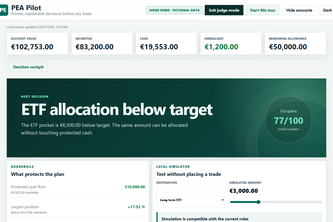
PEA Pilot is a self-reported personal finance decision cockpit designed to make disciplined investing visible and repeatable. It reads a local portfolio and generates an explainable decision brief based on user-defined rules, without executing trades or accessing external data sources.
What changed
The project was built during a hackathon (OpenAI 2026) as an extension of a pre-existing personal PEA tracker. It introduces new features such as rule-aware simulation, evidence gates, and decision memory — all within a privacy-safe, local-first framework.
Single most important open question
Is there any evidence that the author has built or tested this product with real users beyond the fictional demo? The description states no revenue, customers, or traction data exist; it is unclear whether PEA Pilot has moved past prototype stage in practice.
What The Product Actually Is
The description states that PEA Pilot:
- Reads a local portfolio and turns it into one prioritized, explainable decision brief.
- Surfaces a protected cash floor, concentration risk, and critical alerts.
- Lets the user simulate an allocation without placing an order.
- Reveals the maximum rule-compatible amount when a scenario fails.
- Includes an Evidence Gate that asks where a signal came from, validates source freshness, requires a counter-case, and adds a deliberate pause for emotionally loaded or social signals.
- Allows exporting a timestamped JSON decision receipt with a
noExecutionflag. - Tracks verified evidence, slowed decisions, and respected guardrails without rewarding trading frequency.
- Supports English Judge Mode and a five-step guided tour.
- Offers privacy switches, dark mode, keyboard navigation, reduced motion, responsive layouts, offline PWA behavior, and local-first storage.
- Uses fictional data in its public build.
Inference: The product is described as a local-first, privacy-preserving tool that emphasizes explainability and behavioral discipline over execution or engagement. It does not appear to connect to external APIs or financial institutions.
Positioning & Claim Evolution
The author states:
- PEA Pilot optimizes for understanding the next decision, testing it against personal rules, and recording why it was made.
- It makes disciplined investing visible and repeatable without encouraging more trading.
- Investment tools often optimize for data, alerts, and execution speed — PEA Pilot focuses on behavioral control.
Inference: The positioning is that of a behavioral finance assistant, not a financial advisor or trading platform. It aims to help users slow down and reflect before acting, rather than to automate or optimize trades.
Target Customer & ICP
The description states:
- PEA Pilot works without a bank login, cloud account, paid API, or private dataset.
- It is designed for individuals who want to apply personal investing rules in a disciplined way.
- The interface supports local-first storage and offline behavior, suggesting use by people who value privacy.
Inference: The target customer appears to be individuals with personal investment portfolios (e.g., PEA holders) who are interested in behavioral discipline and privacy. It is not described as targeting institutional or professional users.
Business Model & Pricing Evidence
The description states:
- No bank login, cloud account, paid API, or private dataset is required.
- The product never places an order.
- It is a discipline aid, not financial advice.
- The public build contains only fictional data.
- There is no mention of pricing, monetization, or revenue streams.
Inference: No evidence of a business model or pricing structure is provided. The project is described as a prototype or demo tool with no commercial intent stated.
Technical & Delivery Signals
The description states:
- Built using Codex powered by GPT-5.6.
- Uses Python, JavaScript, HTML5, CSS3, JSON, and progressive web app (PWA) technologies.
- Supports offline behavior, local-first storage, dark mode, keyboard navigation, reduced motion, responsive layouts.
- Includes automated tests, browser tour, public-package privacy scans, and GitHub Pages deployment.
- The build runs through a local Python rules engine or a privacy-safe static snapshot.
Inference: The technical stack is consistent with a local-first, web-based prototype. It uses modern accessibility and PWA features, suggesting attention to usability and offline capability. However, no evidence of production-grade infrastructure or scalability is provided.
Traction & Maturity Signals
The description states:
- The project works without external data sources.
- Ten automated tests pass.
- A complete browser tour, public-package privacy scans, and real GitHub Pages deployment all pass.
- It makes its limits explicit: it is a discipline aid, not financial advice, and never places an order.
- The public build contains only fictional data.
Inference: There is no evidence of user adoption, revenue, or traction beyond the author’s own testing and demo. No customers, usage metrics, or product-market fit data are reported.
Competitive Context
The description states:
- Investment tools often optimize for more data, alerts, and faster execution.
- PEA Pilot focuses on behavioral discipline and explainability instead of engagement or transaction frequency.
- It is a privacy-safe tool that does not connect to external APIs or financial institutions.
Inference: The competitive context is behavioral finance tools or discipline aids, not traditional trading platforms or robo-advisors. It positions itself as an alternative to tools that prioritize execution over reflection.
Open Questions & Risks
- The product is described as a prototype built during a hackathon, with no evidence of real-world use.
- No revenue, customers, or traction data are provided.
- The public build uses only fictional data.
- It does not connect to external financial systems or APIs — this may limit its utility for real users.
- No business model or monetization strategy is described.
Inference: The biggest risk is that PEA Pilot remains a conceptual or demo tool, with no demonstrated path to commercial viability or user adoption.
Questions the description leaves open
- What is the actual user feedback from anyone who has tested this beyond the fictional demo?
- Has the product been tested with real users, or is it purely a prototype?
- Are there any plans to integrate with real financial data sources or APIs?
- How does the author intend to monetize or scale this tool if at all?
- What are the limitations of the current rule engine and how would it be expanded?
- Is there any evidence of user retention or engagement beyond the initial 90-second tour?
Overall Assessment
Not evidenced.
The description provides no information about:
- Revenue, customers, or traction.
- Business model or monetization strategy.
- Product-market fit or user feedback.
- Team experience or prior success.
- Market size or competitive positioning beyond self-description.
Inference: The project is described as a self-contained prototype built during a hackathon. There is no evidence of commercial readiness, market traction, or scalability. It appears to be an idea or proof-of-concept rather than a product in development or with a clear path to investment or partnership.
User Stories BotA demo video on every pull request
Get a demo video on every new feature
GitHub App that watches your pull requests and records a narrated, captioned demo.
Save time on demo prep and make informed decisions faster with a video walkthrough of every new feature.
Source
Submitted to the OpenAI 2026 hackathon on Devpost. Project home on Devpost. Back to the full gallery on Devpost.
This competitive analysis was produced by top-founders.com (opens in a new tab)
Generated by a language model from this project's public Devpost page — its tagline, the author's own write-up and any built-with tags listed there — as captured in August 2026. Short quotations are the author's words. It is an opinion on the idea as a business, not on the people behind it, and it reflects the description as published then. If the project has moved on, request a correction below. The analysis is not independent research and contains no verified traction, revenue or customer data.
An independent guide by KFG International LLC — not affiliated with, endorsed by, or connected to Devpost or OpenAI.