

Archive position — measured, not model output
0 likes on Devpost
2,263 of the 7,850 archived projects have more likes, and 5,587 share exactly 0 — so this project's #5,866 place in the like-ranked listing is a tie-break inside that group, not a ranking.
Projects (log scale)
Likes on Devpost. ▲ marks this project's group.
Show the figures
| Likes | Projects | Share of archive |
|---|---|---|
| 0 | 5,587 | 71.2% |
| 1 | 1,758 | 22.4% |
| 2 | 284 | 3.6% |
| 3–4 | 132 | 1.7% |
| 5–9 | 75 | 1.0% |
| 10+ | 14 | 0.2% |
 User Stories BotA demo video on every pull request
Get a demo video on every new feature
GitHub App that watches your pull requests and records a narrated, captioned demo.
Save time on demo prep and make informed decisions faster with a video walkthrough of every new feature.
Executive Summary
What the company appears to be
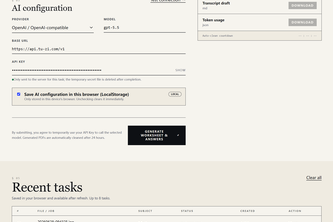
pdf-exercise-web is a self-hosted, single-server web application built as a lightweight tool for transforming scanned or photographed worksheet images (or PDFs) into two downloadable files: one clean student worksheet without answers and another with full answers and explanations. It supports multiple subjects including math, physics, and English, and includes features like diagram handling strategies, optional image preprocessing, and language switching between English and Chinese.
What changed
The project was submitted to the OpenAI 2026 hackathon by a solo developer (Yi Lu), indicating an early-stage development effort focused on solving a specific workflow problem for educators and parents. The description shows intent to build a practical tool rather than a commercial product, with open-source documentation and self-hosting support.
The single most important open question
Is there any evidence of real-world usage or adoption beyond the author’s own deployment? The project is described as deployed but lacks any data on customer base, revenue, or traction.
What The Product Actually Is
The description states that pdf-exercise-web is a lightweight single-server web app designed to convert worksheet images or PDFs into two downloadable files:
- A clean student worksheet PDF without answers
- A complete worksheet PDF with answers and explanations
It also generates structured transcription data and Markdown drafts. The tool supports math, physics, English, and other subjects, and includes diagram handling strategies such as source-image crops for complex diagrams.
The system uses FastAPI for backend logic, Jinja2 templates with vanilla JavaScript for frontend, SQLite for job tracking and logs, local filesystem storage, and OpenCV/Pillow for image preprocessing. PDF generation is handled via XeLaTeX and ReportLab. It can be deployed on a small VPS using Nginx and systemd.
Inference The tool appears to be built for personal or small-scale educational use rather than enterprise-level adoption.
Positioning & Claim Evolution
The author claims that pdf-exercise-web was inspired by the tedious process of preparing printable worksheets from scanned images with answers already marked. It positions itself as a solution to reduce manual editing and streamline workflow for parents, teachers, and tutors.
It is described as:
- A practical tool, not just a demo
- Deployed in production
- Open-source and self-hostable
- Designed for small VPS environments
Inference The positioning evolved from solving an internal problem (author’s own use case) to a general-purpose educational document processing tool that could be used by others.
Target Customer & ICP
The description states that pdf-exercise-web targets:
- Parents
- Teachers
- Tutors
- Small learning communities
It is intended for users who need fast, printable practice materials from imperfect scans and photos.
Inference The target customer segment is likely small-scale educators or individuals working in informal educational settings. No explicit segmentation beyond subject areas (math, physics, English) is provided.
Business Model & Pricing Evidence
There is no evidence of a business model or pricing structure in the description. The app is described as:
- Self-hosted
- Open source
- Deployed on a small VPS
- Supports trial access tokens and visitor stats
The author mentions users can provide their own OpenAI-compatible API key, or use a site-provided trial/shared access link.
Inference There is no indication of monetization or paid features. The app seems to be offered as a free tool with optional self-hosting support.
Technical & Delivery Signals
The technical stack includes:
- Backend: FastAPI
- Frontend: Jinja2 templates + vanilla JS
- Database: SQLite
- Storage: Local filesystem
- Image processing: OpenCV, Pillow
- PDF generation: XeLaTeX, ReportLab
- Deployment: Nginx, systemd, Cloudflare
The system is designed to run on a small VPS without Docker or heavy frameworks. It uses a single background worker process for queued jobs and implements security measures like temporary API key handling and hashed trial tokens.
Inference The architecture reflects a minimal viable product (MVP) approach with careful resource management, suitable for solo developers or small teams.
Traction & Maturity Signals
The description indicates that:
- The app is deployed in production
- Users can upload actual worksheet photos or PDFs
- Generated files are downloadable and automatically cleaned up
- Trial tokens can be created, limited, revoked, or bound on first use
- Visitor statistics help track usage without storing content
- The interface supports English and Chinese
However, there is no evidence of:
- Revenue
- Customer base
- User engagement metrics
- Adoption beyond the author’s own use
Inference While the app appears functional and deployed, it lacks any measurable traction or user feedback.
Competitive Context
No direct competitors are mentioned in the description. The tool addresses a niche problem — converting messy worksheet images into clean printable versions — which may not have a large market presence yet.
The author notes that educational document processing is less about OCR and more about preserving intent and layout, suggesting a hybrid approach combining AI understanding, image preprocessing, and PDF generation.
Inference There is no clear competitive landscape described. The tool fills a gap in the current ecosystem of educational tools for parents and teachers.
Open Questions & Risks
- No revenue or monetization strategy: The app appears to be open-source and self-hosted with no commercial model.
- Single-person development: With only one team member, scalability and long-term maintenance are concerns.
- Limited deployment options: Designed for small VPS environments; not scalable for enterprise use.
- No user data or feedback: No evidence of real-world usage or customer insights.
- Unclear long-term vision: The next steps listed suggest continued development but no clear roadmap toward commercial viability.
Inference The project is in early stages with limited commercial potential unless it evolves into a hosted SaaS offering or gains significant traction among educators.
Questions the description leaves open
- What is the actual usage volume of the tool? How many users are there?
- Are there any plans to monetize the service, or will it remain open-source/self-hosted?
- Has the tool been adopted by any schools, tutoring centers, or educational institutions?
- What are the main challenges in scaling this beyond a single-server setup?
- Is there interest from users in additional features like batch processing or visual editors?
- How is the quality of generated outputs being validated or improved over time?
Overall Assessment
Not evidenced.
There is no evidence of revenue, customers, or traction to assess commercial viability. The project is described as a solo developer’s effort with an open-source, self-hosted tool that solves a specific workflow problem for educators.
It does not appear to be a mature business model or scalable platform at this stage. Any investment or partnership would require further evidence of adoption, growth potential, or monetization strategy.
Confidence Level: Low
The description is self-reported and unverified, with no external validation or data points on performance, users, or market fit.
User Stories BotA demo video on every pull request
Get a demo video on every new feature
GitHub App that watches your pull requests and records a narrated, captioned demo.
Save time on demo prep and make informed decisions faster with a video walkthrough of every new feature.
Source
Submitted to the OpenAI 2026 hackathon on Devpost. Project home on Devpost. Back to the full gallery on Devpost.
This competitive analysis was produced by top-founders.com (opens in a new tab)
Generated by a language model from this project's public Devpost page — its tagline, the author's own write-up and any built-with tags listed there — as captured in August 2026. Short quotations are the author's words. It is an opinion on the idea as a business, not on the people behind it, and it reflects the description as published then. If the project has moved on, request a correction below. The analysis is not independent research and contains no verified traction, revenue or customer data.
An independent guide by KFG International LLC — not affiliated with, endorsed by, or connected to Devpost or OpenAI.