

Archive position — measured, not model output
0 likes on Devpost
2,263 of the 7,850 archived projects have more likes, and 5,587 share exactly 0 — so this project's #3,553 place in the like-ranked listing is a tie-break inside that group, not a ranking.
Projects (log scale)
Likes on Devpost. ▲ marks this project's group.
Show the figures
| Likes | Projects | Share of archive |
|---|---|---|
| 0 | 5,587 | 71.2% |
| 1 | 1,758 | 22.4% |
| 2 | 284 | 3.6% |
| 3–4 | 132 | 1.7% |
| 5–9 | 75 | 1.0% |
| 10+ | 14 | 0.2% |
 User Stories BotA demo video on every pull request
Get a demo video on every new feature
GitHub App that watches your pull requests and records a narrated, captioned demo.
Save time on demo prep and make informed decisions faster with a video walkthrough of every new feature.
Executive Summary
Company: Course Crafter
Self-reported basis: The analysis is based entirely on the project description provided by the caller — its name, tagline, the author's own write-up, and technology stack. No external verification or historical data are available.
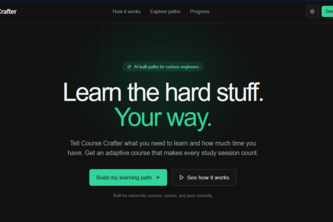
What it appears to be: A student-focused learning platform that uses AI to help users create structured, personalized learning paths from any topic.
What changed: The project was submitted as part of a hackathon (OpenAI 2026), indicating an early-stage prototype or proof-of-concept.
Single most important open question: Is there evidence of user adoption or traction beyond the author’s own use case?
What The Product Actually Is
The description states that Course Crafter is a student-focused learning platform that helps users create personalized learning journeys around any topic. It breaks broad subjects into structured modules, lessons, and milestones to provide clear direction.
- The product is described as a tool for generating, organizing, and following courses.
- It combines course-planning workflows with AI-powered content suggestions.
- It aims to transform a topic into a practical learning roadmap.
- The platform is built using Next.js, React, TypeScript, PostgreSQL, Supabase, OpenAI SDK, and Groq.
Inference: Based on the tech stack and description, it appears to be a web-based SaaS product with AI integration for content structuring.
Not evidenced: No information about actual functionality, UI/UX, or how the AI generates learning paths.
Positioning & Claim Evolution
The author states that Course Crafter was inspired by the need to turn an overwhelming stream of online learning resources into a clear, focused study plan.
- The tagline: “Course Crafter helps students learn better with clear, engaging, personalized courses that turn complex subjects into confident progress.”
- The platform is positioned as helping students stay consistent, make real progress, and follow an organized course.
- It emphasizes simplicity, student-centered design, and reducing stress rather than adding complexity.
Claim: The product aims to reduce the overwhelm of online learning by offering structured, personalized paths.
Not evidenced: No evidence of how this positioning has been tested or validated with users beyond the author’s own experience.
Target Customer & ICP
The description states that Course Crafter is aimed at students who are looking for a way to organize their learning and make progress in complex subjects.
- The target is described as students with different starting points, goals, and ways of learning.
- It is designed to be simple enough for students to use quickly, while still providing meaningful structure.
Inference: The ICP appears to be self-directed learners or students who struggle with navigating online content.
Not evidenced: No data on actual student segments, personas, or user interviews.
Business Model & Pricing Evidence
The description does not contain any information about pricing, monetization, or business model.
Not evidenced: No mention of revenue streams, subscription tiers, or commercial strategy.
Technical & Delivery Signals
The project is built with the following technologies:
- Frontend: React, Next.js
- Backend: TypeScript, PostgreSQL, Supabase
- AI Integration: OpenAI SDK, Groq
Inference: The use of AI tools suggests that content generation or structuring is a core part of the platform.
Not evidenced: No information on how these technologies are integrated into the user experience or whether they are used in production.
Traction & Maturity Signals
The project was submitted to the OpenAI 2026 hackathon, indicating it is likely an early-stage prototype or proof-of-concept.
- The team size is listed as 1.
- No mention of users, customers, or adoption beyond the author’s own use case.
- No evidence of product-market fit, retention, or usage metrics.
Not evidenced: No data on traction, user engagement, or product maturity beyond the hackathon submission.
Competitive Context
The description does not provide any information about competitors or market positioning.
Not evidenced: No mention of existing platforms in the learning or course creation space.
Open Questions & Risks
- The project is a single-person hackathon submission, with no evidence of team, traction, or product-market fit.
- The lack of revenue, customers, or usage data raises questions about viability.
- The AI integration is described only in general terms — no clarity on how it works or whether it’s effective.
- The platform is positioned for students but lacks any indication of how it will scale beyond one user or use case.
Inference: Risk of over-engineering or misalignment with actual student needs due to lack of real-world testing.
Not evidenced: No evidence of competitive analysis, user feedback, or market validation.
Questions the description leaves open
- What specific problem are you solving for students, and how do you know it exists?
- How does your AI-powered course generation work in practice? Can you show an example?
- Have you tested this with real students or users beyond yourself?
- What is your plan to scale beyond a single-user prototype?
- Are there any existing competitors you are aware of, and how do you differentiate?
Overall Assessment
Not evidenced: No information on financials, traction, or commercial viability.
Inference: At this stage, the project appears to be an early-stage idea or prototype with no demonstrated commercial potential.
Confidence level: Low — based entirely on a self-reported hackathon submission with no external validation.
User Stories BotA demo video on every pull request
Get a demo video on every new feature
GitHub App that watches your pull requests and records a narrated, captioned demo.
Save time on demo prep and make informed decisions faster with a video walkthrough of every new feature.
Source
Submitted to the OpenAI 2026 hackathon on Devpost. Project home on Devpost. Back to the full gallery on Devpost.
This competitive analysis was produced by top-founders.com (opens in a new tab)
Generated by a language model from this project's public Devpost page — its tagline, the author's own write-up and any built-with tags listed there — as captured in August 2026. Short quotations are the author's words. It is an opinion on the idea as a business, not on the people behind it, and it reflects the description as published then. If the project has moved on, request a correction below. The analysis is not independent research and contains no verified traction, revenue or customer data.
An independent guide by KFG International LLC — not affiliated with, endorsed by, or connected to Devpost or OpenAI.