

Archive position — measured, not model output
0 likes on Devpost
2,263 of the 7,850 archived projects have more likes, and 5,587 share exactly 0 — so this project's #3,554 place in the like-ranked listing is a tie-break inside that group, not a ranking.
Projects (log scale)
Likes on Devpost. ▲ marks this project's group.
Show the figures
| Likes | Projects | Share of archive |
|---|---|---|
| 0 | 5,587 | 71.2% |
| 1 | 1,758 | 22.4% |
| 2 | 284 | 3.6% |
| 3–4 | 132 | 1.7% |
| 5–9 | 75 | 1.0% |
| 10+ | 14 | 0.2% |
 User Stories BotA demo video on every pull request
Get a demo video on every new feature
GitHub App that watches your pull requests and records a narrated, captioned demo.
Save time on demo prep and make informed decisions faster with a video walkthrough of every new feature.
Executive Summary
What the company appears to be
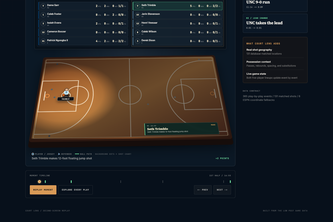
Court Lens is a self-reported interactive 3D second screen for college basketball, built as a hackathon project. The author states it allows fans to replay possessions spatially with shot locations, player identities, lineups, and live context. It uses Next.js, React, TypeScript, Three.js/WebGL, Supabase, and Cloudflare.
What changed
The project was submitted to the OpenAI 2026 hackathon. The author describes it as a new surface built during Build Week, using Codex and GPT-5.6 for data inspection, model design, and implementation.
Single most important open question
Is there any evidence of traction, revenue, or customer adoption beyond the self-reported project description?
What The Product Actually Is
The description states that Court Lens is an interactive 3D second screen for college basketball. It allows users to replay possessions from a scrubber instead of waiting for broadcast highlights. It shows shot locations, ball states, player identities, lineups, and live context.
It builds on play-by-play data, shot-chart anchors, and a seed fixture to create keyframes for 3D replays. The system validates player identity, possession, ball ownership, court bounds, shot anchors, and camera cuts before rendering.
The product is described as a deterministic reconstruction builder that combines multiple data sources into replay keyframes. It uses WebGL for presentation and includes animated ball flight, substitution handoffs, and a broadcast-style scoreboard.
Evidence
- The author states Court Lens "turns a Duke–UNC game sequence into a three-minute interactive replay on a 3D court."
- It is built with Next.js, React, TypeScript, Three.js/WebGL, Supabase, and Cloudflare.
- It uses a "deterministic reconstruction builder" that combines play-by-play, shot-chart anchors, and a seed fixture.
Inference The product is a visualization tool for basketball fans, not a commercial platform or SaaS offering.
Positioning & Claim Evolution
The author states that watching a game live is visceral but understanding it afterward is flat. The broadcast picks one camera angle and a box score gives the outcome, but neither allows fans to revisit how a possession developed.
Court Lens is positioned as an explorable second screen that rebuilds a basketball replay spatially, with honesty about what the data knows and what it does not.
The author claims that earlier prototypes could make players teleport or let balls float without owners. They used Codex and GPT-5.6 to replace that with immutable identities and explicit reviewed/inferred/unobserved states.
Evidence
- The tagline: “An interactive 3D second screen for college basketball—replaying every possession with shot locations, player identities, lineups, and live context.”
- The author says the product "does not pretend uncertain data is precise."
- It was built during Build Week as a new surface for an existing product (Low Post).
Inference The positioning evolved from a simple replay tool to one that emphasizes transparency in data handling.
Target Customer & ICP
The description states that Court Lens targets hardcore fans who want to understand how a possession developed, including shot locations, player identities, lineups, and game state changes.
It is built for fans of college basketball, particularly those who watch Duke–UNC games and want more context than traditional broadcasts provide.
Evidence
- The author says it's for fans who "want to revisit how a possession developed: where the shot came from, who had the ball, what lineup was on the floor, and how the game state changed."
- It is described as an explorable second screen for college basketball.
Inference The target customer is likely niche — hardcore sports fans, not general consumers or teams.
Business Model & Pricing Evidence
Not evidenced. The description does not mention any pricing model, monetization strategy, or business model.
Evidence
- No mention of revenue, customers, or pricing.
- The project was submitted to a hackathon and is described as a prototype.
Technical & Delivery Signals
The author states that Court Lens was built with Next.js, React, TypeScript, Three.js/WebGL, Supabase, and Cloudflare. It uses a deterministic reconstruction builder combining play-by-play data, shot-chart anchors, and a seed fixture.
Codex and GPT-5.6 were used for inspecting data, designing the semantic replay model, implementing the pipeline, writing tests, and running QA.
The system validates player identity, possession, ball ownership, court bounds, shot anchors, and camera cuts before rendering.
Evidence
- Built with Next.js, React, TypeScript, Three.js/WebGL, Supabase, Cloudflare.
- Uses Codex and GPT-5.6 for data inspection, model design, implementation, testing, and QA.
- Validates player identity, possession, ball ownership, court bounds, shot anchors, and camera cuts.
Inference The technical stack suggests a modern web-based visualization tool with AI-assisted development.
Traction & Maturity Signals
Not evidenced. The description does not mention any traction, customers, revenue, or adoption beyond the hackathon submission.
Evidence
- Submitted to OpenAI 2026 hackathon.
- No mention of users, customers, or revenue.
- Described as a prototype built during Build Week.
Competitive Context
Not evidenced. The description does not mention any competitors or market positioning in relation to existing tools.
Evidence
- No reference to other basketball visualization tools or platforms.
- No mention of how Court Lens compares to existing second-screen or replay technologies.
Open Questions & Risks
- No commercial traction or revenue: The project is described as a hackathon submission with no evidence of monetization or customer adoption.
- Single founder team: The team size is listed as 1, which may limit execution capacity.
- Unproven market demand: No evidence of user feedback or market validation beyond the author’s own claims.
- Limited scope: The product is described as a prototype for college basketball and not scalable to other sports or use cases.
Evidence
- Team size: 1.
- Submitted to hackathon.
- No mention of revenue, customers, or adoption.
Questions the description leaves open
- What is the source of the basketball data used in Court Lens?
- How does the product plan to scale beyond college basketball?
- Are there any plans for monetization or customer acquisition?
- Has the product been tested with real users or fans?
- What are the technical limitations of the current 3D visualization approach?
Overall Assessment
Not evidenced. The description does not provide sufficient information to assess whether Court Lens is a viable investment or partnership opportunity.
Evidence
- No revenue, customers, or traction data.
- No business model or monetization strategy described.
- Project is a prototype submitted to a hackathon.
Inference At this stage, the project appears to be an experimental tool with no commercial viability or market traction. It lacks evidence of a scalable business model or customer base.
User Stories BotA demo video on every pull request
Get a demo video on every new feature
GitHub App that watches your pull requests and records a narrated, captioned demo.
Save time on demo prep and make informed decisions faster with a video walkthrough of every new feature.
Source
Submitted to the OpenAI 2026 hackathon on Devpost. Project home on Devpost. Back to the full gallery on Devpost.
This competitive analysis was produced by top-founders.com (opens in a new tab)
Generated by a language model from this project's public Devpost page — its tagline, the author's own write-up and any built-with tags listed there — as captured in August 2026. Short quotations are the author's words. It is an opinion on the idea as a business, not on the people behind it, and it reflects the description as published then. If the project has moved on, request a correction below. The analysis is not independent research and contains no verified traction, revenue or customer data.
An independent guide by KFG International LLC — not affiliated with, endorsed by, or connected to Devpost or OpenAI.