

Archive position — measured, not model output
0 likes on Devpost
2,263 of the 7,850 archived projects have more likes, and 5,587 share exactly 0 — so this project's #7,479 place in the like-ranked listing is a tie-break inside that group, not a ranking.
Projects (log scale)
Likes on Devpost. ▲ marks this project's group.
Show the figures
| Likes | Projects | Share of archive |
|---|---|---|
| 0 | 5,587 | 71.2% |
| 1 | 1,758 | 22.4% |
| 2 | 284 | 3.6% |
| 3–4 | 132 | 1.7% |
| 5–9 | 75 | 1.0% |
| 10+ | 14 | 0.2% |
 User Stories BotA demo video on every pull request
Get a demo video on every new feature
GitHub App that watches your pull requests and records a narrated, captioned demo.
Save time on demo prep and make informed decisions faster with a video walkthrough of every new feature.
Executive Summary
Company: User Ease
Self-reported basis: The description is entirely from the author’s own submission to a hackathon — no third-party verification, no archived history, no traction data.
What it appears to be: A self-described AI-powered assistant that integrates with user subscriptions and computer activity to automate tasks and guide users through workflows.
What changed: No evidence of prior version or evolution; this is a single project submission.
Single most important open question: Is there any evidence of actual user adoption, revenue, or product-market fit beyond the author’s own claims?
What The Product Actually Is
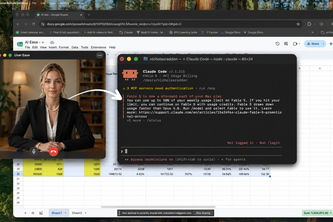
The description states that User Ease is “an avatar that pops up in the screen of your computer” and “connects to any of your subscriptions via terminal coding.” It creates “agentic loops for projects,” and can “see what you are doing on your computer at all times and direct you to what you need to do.”
Inference: The product is described as a desktop-based AI assistant that monitors user activity, integrates with software tools, and automates or guides tasks.
Not evidenced: No details about how it connects to subscriptions, what “agentic loops” means in practice, or whether it actually works as described.
Positioning & Claim Evolution
The tagline states: “Everyone is being bottlenecked with their tech when using Ai. With User Ease, you can help the non technical understand what they need to do BUT also help the technical scale more rapidly.”
Claim: The product aims to reduce friction for both non-technical and technical users by simplifying AI use and scaling workflows.
Inference: The positioning is broad — targeting both end-users and developers, with a focus on AI adoption and productivity.
Not evidenced: No evidence of prior positioning or evolution; this is the only claim made in the description.
Target Customer & ICP
The author states: “How to create this to work for normal working class people and to make sure it can also work with those who don't know how to set up google chrome on their mac computer.”
Claim: The target is average users, including those unfamiliar with technical setup.
Inference: The ICP appears to be non-technical users and developers seeking productivity tools.
Not evidenced: No segmentation, personas, or customer data beyond the author’s own description.
Business Model & Pricing Evidence
The description states: “It works and it doesn't cost you anything more than what you are already paying for.”
Claim: The product is free or included in existing subscriptions.
Not evidenced: No pricing model, monetization strategy, or revenue path described beyond this statement.
Technical & Delivery Signals
The author states: “Built with (author-declared): codex, github, python” and “Used codex to brainstorm, plan, then execute the build.”
Claim: The product was built using AI tools (Codex), version control (GitHub), and Python.
Inference: The tech stack suggests a prototype or early-stage tool, likely built in a short timeframe.
Not evidenced: No evidence of scalability, architecture, or delivery mechanism beyond the author’s own account.
Traction & Maturity Signals
The description states: “It works and it doesn't cost you anything more than what you are already paying for.” and “Road to a billion. Disruption for Ai agencies that specifically do consulting.”
Claim: The product is functional, and the author envisions massive scale and disruption.
Inference: No evidence of traction, user base, or adoption beyond the author’s own claims.
Not evidenced: No data on users, usage, or product maturity.
Competitive Context
The description states: “Disruption for Ai agencies that specifically do consulting.”
Claim: The product is positioned to disrupt AI consulting agencies.
Inference: The competitive landscape includes AI consultants and agencies.
Not evidenced: No mention of competitors, market size, or competitive positioning beyond this single claim.
Open Questions & Risks
- No evidence of traction or adoption: The project is described as a hackathon submission with no user data.
- Unverifiable claims: The author states the product “works,” but provides no proof or metrics.
- Vague functionality: The description lacks clarity on how the avatar works, what it monitors, or how it integrates.
- No monetization path: The only pricing claim is that it costs nothing beyond existing subscriptions — not a business model.
- Single founder, single project: No team or prior product history to validate execution capability.
Questions the description leaves open
- What specific workflows does the avatar automate or guide?
- How does it connect to user subscriptions and applications?
- Can you demonstrate how it monitors and interacts with computer activity?
- What is the actual technical architecture, and how scalable is it?
- Have you tested it with real users beyond yourself?
- What is your plan for monetization or revenue generation?
- How does it differ from existing AI productivity tools?
Overall Assessment
Not evidenced: No data to support commercial viability, traction, or scalability.
Inference: This is a self-contained hackathon project with no demonstrated product-market fit, revenue, or user engagement. The author’s claims are unverified and lack supporting evidence.
Confidence level: Very low — based entirely on the author’s own description, which is not independently verified.
User Stories BotA demo video on every pull request
Get a demo video on every new feature
GitHub App that watches your pull requests and records a narrated, captioned demo.
Save time on demo prep and make informed decisions faster with a video walkthrough of every new feature.
Source
Submitted to the OpenAI 2026 hackathon on Devpost. Project home on Devpost. Back to the full gallery on Devpost.
This competitive analysis was produced by top-founders.com (opens in a new tab)
Generated by a language model from this project's public Devpost page — its tagline, the author's own write-up and any built-with tags listed there — as captured in August 2026. Short quotations are the author's words. It is an opinion on the idea as a business, not on the people behind it, and it reflects the description as published then. If the project has moved on, request a correction below. The analysis is not independent research and contains no verified traction, revenue or customer data.
An independent guide by KFG International LLC — not affiliated with, endorsed by, or connected to Devpost or OpenAI.