

Archive position — measured, not model output
0 likes on Devpost
2,263 of the 7,850 archived projects have more likes, and 5,587 share exactly 0 — so this project's #5,833 place in the like-ranked listing is a tie-break inside that group, not a ranking.
Projects (log scale)
Likes on Devpost. ▲ marks this project's group.
Show the figures
| Likes | Projects | Share of archive |
|---|---|---|
| 0 | 5,587 | 71.2% |
| 1 | 1,758 | 22.4% |
| 2 | 284 | 3.6% |
| 3–4 | 132 | 1.7% |
| 5–9 | 75 | 1.0% |
| 10+ | 14 | 0.2% |
 User Stories BotA demo video on every pull request
Get a demo video on every new feature
GitHub App that watches your pull requests and records a narrated, captioned demo.
Save time on demo prep and make informed decisions faster with a video walkthrough of every new feature.
Executive Summary
What the company appears to be
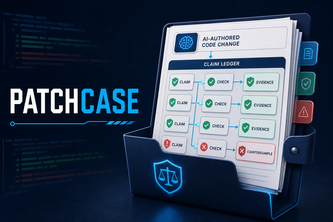
PatchCase is a self-reported developer tool designed to validate AI-generated code changes by creating a "case file" that challenges and scrutinizes agent-made modifications. It operates as a local Python program with a plugin component, using Codex for development and integrating with Git/GitHub workflows.
What changed
The project was submitted to the OpenAI 2026 hackathon by a solo developer (Joe Straight) who describes it as a personal tool that evolved into something potentially useful for others. No evidence of prior version or evolution is provided beyond this submission.
The single most important open question
Is there actual utility beyond the author's personal use case, and can the tool be scaled to validate changes in broader development environments?
What The Product Actually Is
The description states that PatchCase is:
- A plugin and local Python program
- Built entirely with Codex
- Designed to challenge AI-generated code changes
- Capable of generating reports that scrutinize changes
- Uses Python to calculate final assessments deterministically
- Runs on every project without requiring additional prompting from the user
The author describes it as a "Codex skill that anyone can use" and claims it is self-testing, running on projects automatically.
Evidence strength Self-reported. No independent verification of functionality or technical implementation details.
Positioning & Claim Evolution
The author states:
- The tool was built to address personal frustration with AI-generated code changes
- It aims to create "case files" where agents state their beliefs, what could disprove them, and how they were checked
- The tool is positioned as a way to ensure truth/validity of AI claims
- It's described as something the author would "ACTUALLY use"
- The author claims it found a packaging defect in itself during release
Inference This appears to be an early-stage personal project that evolved from a developer's own workflow challenge, rather than a commercial product with market validation.
Evidence strength Self-reported. No evidence of positioning evolution or market feedback.
Target Customer & ICP
The description states:
- The tool is designed for developers who use AI tools like Codex
- It targets users who want to validate AI-generated code changes
- It's described as a "Codex skill that anyone can use"
- The author mentions it helps with their own game development project
Inference The target customer appears to be individual developers or small teams using AI-assisted coding tools, particularly those working with Codex.
Evidence strength Self-reported. No evidence of actual customers, user personas, or market segmentation.
Business Model & Pricing Evidence
The description states:
- The tool is made accessible on GitHub
- It's described as "a Codex skill that anyone can use"
- No pricing information, licensing model, or monetization strategy is mentioned
Evidence strength Not evidenced. No indication of how the tool would be monetized or whether it has a business model.
Technical & Delivery Signals
The description states:
- Built entirely with Codex
- Uses Python for deterministic assessment calculation
- Integrates with Git/GitHub workflows
- Runs automatically on every project without additional prompting
- Designed to be self-testing and self-validating
- Developed using ai-agents, codex, developer-tools, devops, git, github, gpt-5.6, html, json, openai, python
Inference The tool appears to be a lightweight, local utility that integrates with existing development workflows.
Evidence strength Self-reported. No evidence of technical architecture, scalability, or delivery mechanisms beyond the author's description.
Traction & Maturity Signals
The description states:
- The project was submitted to the OpenAI 2026 hackathon
- It has real project evidence from what the author tested it on
- It helped with the author's own game development
- It found a packaging defect in itself during release
- The author mentions getting a team onboard as a next step
Evidence strength Not evidenced. No revenue, customer adoption, or usage metrics are provided.
Competitive Context
The description states:
- The tool is built for developers using AI tools like Codex
- It's positioned to validate AI-generated code changes
- It integrates with Git/GitHub workflows
Inference The competitive context likely includes other AI-assisted development tools, code review platforms, and automated testing solutions.
Evidence strength Not evidenced. No information about existing competitors or market positioning.
Open Questions & Risks
- Solo developer project: Only one team member (Joe Straight) is mentioned
- No traction evidence: No customers, revenue, or usage data provided
- Unproven utility: The tool's value beyond the author's personal use case is unverified
- Limited scope: The description suggests it's primarily a personal tool with uncertain scalability
- Hackathon submission: This indicates early-stage development rather than a mature product
Evidence strength Self-reported. No independent validation of risks or market viability.
Questions the description leaves open
- What specific problems does PatchCase solve that existing tools don't?
- How many developers have actually used this beyond the author?
- What is the actual technical architecture and how does it integrate with different development environments?
- Are there any plans for monetization or commercialization?
- What are the key assumptions about developer workflows that this tool relies on?
- How does it handle edge cases or complex code changes?
- What feedback have you received from other developers who tried it?
Overall Assessment
Assessment Not evidenced.
The description provides no information about revenue, customers, traction, or commercial viability. It's a self-reported personal project submitted to a hackathon with no evidence of market validation or product-market fit.
Confidence level Low. This is a solo developer project with no demonstrated traction or business model.
Inference The tool may have potential as a proof-of-concept but lacks evidence of commercial viability or scalability.
User Stories BotA demo video on every pull request
Get a demo video on every new feature
GitHub App that watches your pull requests and records a narrated, captioned demo.
Save time on demo prep and make informed decisions faster with a video walkthrough of every new feature.
Source
Submitted to the OpenAI 2026 hackathon on Devpost. Project home on Devpost. Back to the full gallery on Devpost.
This competitive analysis was produced by top-founders.com (opens in a new tab)
Generated by a language model from this project's public Devpost page — its tagline, the author's own write-up and any built-with tags listed there — as captured in August 2026. Short quotations are the author's words. It is an opinion on the idea as a business, not on the people behind it, and it reflects the description as published then. If the project has moved on, request a correction below. The analysis is not independent research and contains no verified traction, revenue or customer data.
An independent guide by KFG International LLC — not affiliated with, endorsed by, or connected to Devpost or OpenAI.