

Archive position — measured, not model output
0 likes on Devpost
2,263 of the 7,850 archived projects have more likes, and 5,587 share exactly 0 — so this project's #5,828 place in the like-ranked listing is a tie-break inside that group, not a ranking.
Projects (log scale)
Likes on Devpost. ▲ marks this project's group.
Show the figures
| Likes | Projects | Share of archive |
|---|---|---|
| 0 | 5,587 | 71.2% |
| 1 | 1,758 | 22.4% |
| 2 | 284 | 3.6% |
| 3–4 | 132 | 1.7% |
| 5–9 | 75 | 1.0% |
| 10+ | 14 | 0.2% |
 User Stories BotA demo video on every pull request
Get a demo video on every new feature
GitHub App that watches your pull requests and records a narrated, captioned demo.
Save time on demo prep and make informed decisions faster with a video walkthrough of every new feature.
Executive Summary
What the company appears to be: PartyHost is a self-reported web application built by one developer (Cindy B.) as a personal solution for managing kids' birthday parties and family events. It claims to centralize scattered planning tools into one platform, using AI to generate party ideas, timelines, and invitations while integrating with calendars and tracking budgets.
What changed: The author states that PartyHost was developed during a hackathon sprint, with no prior version or product history mentioned. It is described as an end-to-end tool launched live in a short timeframe, built from scratch by someone with zero coding experience at the start.
Single most important open question: Is there any evidence of actual user adoption, revenue, or traction beyond the author’s personal use and sharing with family and friends?
Analysis basis: This report is based entirely on the self-reported description provided by the project author. No third-party verification, archived data, or independent sources are available. All claims in this document are labeled as “the description states…” and should be treated accordingly.
What The Product Actually Is
- The description states that PartyHost is a web-based application designed to centralize party planning for kids' birthdays and family events.
- It includes features such as:
- Central workspace with a master print plan (timeline, rain backup, shopping list)
- AI-generated activity ideas matched to themes
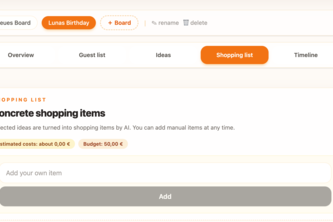
- Budget tracking and shopping list management
- Live RSVPs and instant invitations
- Calendar sync for hosts and guests
- Weather forecasting integration
- Bilingual support (English/German)
- The product is described as having been built using:
- Frontend: React, TypeScript, Vite, Tailwind CSS
- Backend: Neon Postgres database, deployed on Vercel
- AI engine powered by OpenAI gpt-5.6
- Integrations with Open-Meteo API and react-i18next
Note: The description does not clarify whether PartyHost is a SaaS product, an MVP, or a prototype. It also lacks information about monetization or distribution beyond the author’s own use.
Positioning & Claim Evolution
- The description states that PartyHost aims to eliminate scattered party planning by offering one central hub.
- It positions itself as solving a common pain point for busy parents who juggle multiple tools (Pinterest, WhatsApp, Google Sheets).
- The product is framed as bringing structure, speed, and peace of mind to family event operations.
Inference: The positioning reflects a niche B2C use case focused on parental convenience. There is no indication that PartyHost targets businesses or enterprise users.
Target Customer & ICP
- The description states that PartyHost is intended for “busy people,” particularly parents organizing kids' birthdays and family events.
- It explicitly mentions moms of young children who help friends plan events as part of its target audience.
- No explicit segmentation beyond this demographic is described.
Note: There is no evidence of customer personas, market research, or user feedback from actual users outside the founder’s circle.
Business Model & Pricing Evidence
- The description does not mention any pricing model, subscription plans, or monetization strategy.
- It implies that PartyHost is a personal tool built by one person and shared with family and friends.
- No indication of paid features, freemium tiers, or enterprise offerings is present.
Inference: If PartyHost has any commercial aspect, it is not evident from the description. It may be a hobby project or a prototype without a defined business model.
Technical & Delivery Signals
- The product was built in a hackathon setting using:
- Frontend: React, TypeScript, Vite, Tailwind CSS
- Backend: Neon Postgres database, deployed on Vercel
- AI engine: OpenAI gpt-5.6
- Integrations: Open-Meteo API, react-i18next
- The author notes that the app was built by someone with no prior coding experience.
- Features include:
- Live database tracking (RSVPs)
- Calendar export functionality (.ics files)
- AI-generated content (timelines, ideas, invitations)
Inference: The technical stack suggests a modern full-stack web application. However, there is no evidence of scalability, performance metrics, or long-term architecture planning.
Traction & Maturity Signals
- The description states that PartyHost was built during a hackathon and launched live within days.
- It has been shared with family and friends who are reportedly excited about it.
- No mention of:
- Users beyond the founder’s circle
- Revenue or monetization
- Customer acquisition metrics
- Retention data
- Product usage analytics
Absence of evidence: There is no indication that PartyHost has achieved any measurable traction or user base beyond the author’s personal network.
Competitive Context
- The description does not name specific competitors.
- It implies that current solutions involve switching between multiple tools (e.g., Pinterest, ChatGPT, Google Sheets, WhatsApp).
- No competitive analysis is provided.
Inference: PartyHost appears to be positioned against fragmented digital workflows for event planning. However, no clear comparison with existing platforms or market positioning is made.
Open Questions & Risks
- The author describes building the app from scratch with zero prior coding experience.
- There is no evidence of:
- Product-market fit validation
- User testing or feedback loops
- Long-term sustainability or scalability plans
- Team structure beyond one person
- The product is described as a hackathon prototype, not a mature offering.
- No mention of legal, privacy, or data governance considerations.
Open question: Lack of evidence for traction, revenue, or user validation raises concerns about viability as a scalable business.
Questions the description leaves open
- What is the actual scope of your user base beyond family and friends?
- Have you validated demand through surveys, interviews, or early adopters?
- Are there any plans to monetize PartyHost? If so, what model are you considering?
- How do you plan to scale beyond a single developer?
- What is the roadmap for future features, and how will they be prioritized?
- Do you have any data on user retention or engagement with core features?
- Are there any legal or compliance issues related to handling personal data (e.g., RSVPs, calendars)?
- How do you intend to compete with existing tools that already solve parts of this problem?
Overall Assessment
- The description states that PartyHost is a personal project built during a hackathon.
- There is no evidence of:
- Revenue generation
- Customer traction or adoption
- Product-market fit validation
- Team expansion or funding history
- Scalability or long-term business strategy
Assessment: Based on the self-reported description alone, PartyHost appears to be an early-stage prototype with limited commercial evidence. It does not yet demonstrate a viable business model or traction. Further diligence would require independent verification of user adoption, monetization plans, and team capability.
User Stories BotA demo video on every pull request
Get a demo video on every new feature
GitHub App that watches your pull requests and records a narrated, captioned demo.
Save time on demo prep and make informed decisions faster with a video walkthrough of every new feature.
Source
Submitted to the OpenAI 2026 hackathon on Devpost. Project home on Devpost. Back to the full gallery on Devpost.
This competitive analysis was produced by top-founders.com (opens in a new tab)
Generated by a language model from this project's public Devpost page — its tagline, the author's own write-up and any built-with tags listed there — as captured in August 2026. Short quotations are the author's words. It is an opinion on the idea as a business, not on the people behind it, and it reflects the description as published then. If the project has moved on, request a correction below. The analysis is not independent research and contains no verified traction, revenue or customer data.
An independent guide by KFG International LLC — not affiliated with, endorsed by, or connected to Devpost or OpenAI.