

Archive position — measured, not model output
0 likes on Devpost
2,263 of the 7,850 archived projects have more likes, and 5,587 share exactly 0 — so this project's #5,829 place in the like-ranked listing is a tie-break inside that group, not a ranking.
Projects (log scale)
Likes on Devpost. ▲ marks this project's group.
Show the figures
| Likes | Projects | Share of archive |
|---|---|---|
| 0 | 5,587 | 71.2% |
| 1 | 1,758 | 22.4% |
| 2 | 284 | 3.6% |
| 3–4 | 132 | 1.7% |
| 5–9 | 75 | 1.0% |
| 10+ | 14 | 0.2% |
 User Stories BotA demo video on every pull request
Get a demo video on every new feature
GitHub App that watches your pull requests and records a narrated, captioned demo.
Save time on demo prep and make informed decisions faster with a video walkthrough of every new feature.
Executive Summary
Company: PasoClaro AI
Self-reported basis: The analysis is based entirely on the author's own description of the project, submitted as part of a Devpost entry for the OpenAI 2026 hackathon. No external verification or independent data is available.
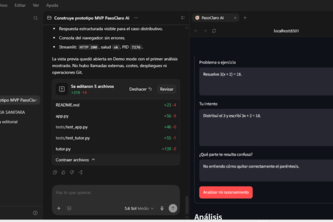
What it appears to be: A prototype educational AI tool designed to identify where learners lose understanding in problem-solving and provide step-by-step explanations tailored to that specific point of confusion. It is described as a web-based prototype built during OpenAI Build Week, using Codex and GPT-5.6.
What changed: The project was submitted to the OpenAI 2026 hackathon, indicating it is in an early development stage, likely a proof-of-concept or prototype.
Single most important open question: Is there evidence of any functional prototype or user testing that demonstrates the system's ability to correctly identify confusion points and deliver adaptive explanations?
What The Product Actually Is
The description states that PasoClaro AI is a step-by-step learning assistant. It receives:
- A problem
- The learner’s attempted solution
- An explanation of what they find confusing
It is designed to:
- Identify the first unsupported or misunderstood step
- Explain only that step in clear language
- Avoid unnecessary transformations or hidden assumptions
- Ask a short question to verify understanding
- Continue only when the learner is ready
The system aims to preserve learner agency and reduce cognitive overload.
Inference: The product is described as a web prototype, not a production tool. It is built using Codex and GPT-5.6, with Python and Streamlit mentioned in the tech stack.
Positioning & Claim Evolution
The author states that PasoClaro AI was inspired by the idea that learners often struggle not due to lack of ability, but because explanations skip the exact step where understanding breaks.
Claim: The system is designed to slow down explanations, identify the first point of confusion, and rebuild understanding without overwhelming the learner.
Inference: It positions itself as a cognitive accessibility tool for education, focusing on learner confusion rather than just correctness.
The project description indicates it was built during OpenAI Build Week, suggesting an early-stage, hackathon-style development. The author notes that the technical architecture and tools used will be updated before submission — implying the current version is incomplete or experimental.
Target Customer & ICP
The description states that PasoClaro AI targets learners who struggle with explanations that are technically correct but cognitively inaccessible.
Claim: It is aimed at users who find standard educational content difficult to follow due to skipped steps, assumptions, or unclear transitions.
Inference: The target customer appears to be students or learners, possibly in STEM subjects, who benefit from personalized, adaptive instruction.
There is no evidence of a defined ICP beyond this general description. No specific grade level, subject focus, or learner segment is named.
Business Model & Pricing Evidence
The description does not include any information about pricing, monetization, or business model.
Not evidenced: No claims or details are provided regarding how the product would be sold, who pays, or what revenue model is envisioned.
Technical & Delivery Signals
The project is described as a web prototype, built during OpenAI Build Week. The author states:
- It uses Codex for development assistance
- It uses GPT-5.6 for reasoning and explanation generation
- It was built using Python and Streamlit
The author notes that the technical architecture will be updated before submission, indicating the current version is incomplete.
Inference: The system is likely a proof-of-concept, not a production-ready product. It may be hosted on a web platform but lacks evidence of deployment or scalability.
Traction & Maturity Signals
The description states that this is a prototype built during a hackathon, and no user testing or functional implementation has been completed yet.
Not evidenced: No data on users, adoption, usage metrics, or product maturity is provided. The author notes that final accomplishments will be documented after the prototype is tested.
Competitive Context
The description does not mention any competitors or existing solutions in the educational AI space.
Not evidenced: No competitive analysis, market positioning, or comparison to other tools is included.
Open Questions & Risks
- Prototype only: The system is described as a prototype and has not been tested or deployed.
- No user feedback: There is no evidence of any real-world testing or learner interaction.
- Unverified claims: The author’s claims about cognitive accessibility and adaptive learning are self-reported, not validated.
- Unclear technical execution: The tools used (e.g., GPT-5.6) are not confirmed to be available or functional in the described context.
- No business model: No indication of how the product would generate revenue or scale.
Questions the description leaves open
- What is the current functional state of the prototype? Is it usable by learners?
- Have you conducted any user testing with real learners? If so, what were the results?
- How does the system distinguish between a wrong answer and a point where understanding breaks down?
- What are the technical limitations of using GPT-5.6 for this purpose?
- Are there plans to expand beyond STEM subjects or support additional languages?
- What is the long-term vision for product development, and how will it scale?
Overall Assessment
Not evidenced: No financials, traction, or commercial viability data are available.
Inference: At this stage, PasoClaro AI appears to be a conceptual prototype with strong potential in the educational AI space. However, without evidence of functionality, testing, or market validation, it is not ready for investment or partnership consideration.
The project is in an early phase and may evolve significantly before becoming a viable product. The author’s claims about cognitive accessibility are compelling but unproven.
User Stories BotA demo video on every pull request
Get a demo video on every new feature
GitHub App that watches your pull requests and records a narrated, captioned demo.
Save time on demo prep and make informed decisions faster with a video walkthrough of every new feature.
Source
Submitted to the OpenAI 2026 hackathon on Devpost. Project home on Devpost. Back to the full gallery on Devpost.
This competitive analysis was produced by top-founders.com (opens in a new tab)
Generated by a language model from this project's public Devpost page — its tagline, the author's own write-up and any built-with tags listed there — as captured in August 2026. Short quotations are the author's words. It is an opinion on the idea as a business, not on the people behind it, and it reflects the description as published then. If the project has moved on, request a correction below. The analysis is not independent research and contains no verified traction, revenue or customer data.
An independent guide by KFG International LLC — not affiliated with, endorsed by, or connected to Devpost or OpenAI.