

Archive position — measured, not model output
0 likes on Devpost
2,263 of the 7,850 archived projects have more likes, and 5,587 share exactly 0 — so this project's #5,821 place in the like-ranked listing is a tie-break inside that group, not a ranking.
Projects (log scale)
Likes on Devpost. ▲ marks this project's group.
Show the figures
| Likes | Projects | Share of archive |
|---|---|---|
| 0 | 5,587 | 71.2% |
| 1 | 1,758 | 22.4% |
| 2 | 284 | 3.6% |
| 3–4 | 132 | 1.7% |
| 5–9 | 75 | 1.0% |
| 10+ | 14 | 0.2% |
 User Stories BotA demo video on every pull request
Get a demo video on every new feature
GitHub App that watches your pull requests and records a narrated, captioned demo.
Save time on demo prep and make informed decisions faster with a video walkthrough of every new feature.
Executive Summary
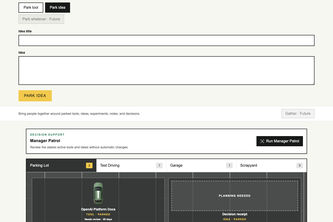
The company appears to be a single-person project named "Parking Anything", submitted as a hackathon entry to the OpenAI 2026 hackathon. The author describes it as a local-first web application that allows users to "park" tools, ideas, and content for later evaluation, with a lifecycle that includes testing, adoption (garage), or rejection (scrapyard).
The core innovation is a unified lifecycle for saved items — tools and ideas — that supports AI-assisted analysis but keeps deterministic state management in conventional code. The author emphasizes that the system treats rejection as a valuable outcome and uses a "parking" metaphor to guide user experience.
The most important open question is: Is there any evidence of traction, revenue, or customer adoption beyond the single developer's own account?
Note: This analysis is based entirely on the self-reported project description provided by the author. No external verification, archived data, or third-party sources are available.
What The Product Actually Is
The description states that Parking Anything is a local-first web application built with:
- Next.js
- React
- TypeScript
- Tailwind CSS
- Zod
- OpenAI Responses API
It supports the following core functions:
- Park tool: Submit a public URL and receive an AI-generated summary, effort estimate, usefulness hypothesis, and first test task.
- Park idea: Capture an idea manually without AI or network request.
- Test Drive: Turn a saved item into a concrete experiment.
- Garage: Keep something that proved useful, supported by notes or a result URL.
- Scrapyard: Deliberately reject something and record the reason.
- Manager Patrol: Review stale items while keeping deterministic facts separate from AI recommendations.
The system is described as having one unified lifecycle for tools and ideas, with AI used only where judgment adds value (e.g., analyzing submitted tools), while conventional code owns IDs, timestamps, lifecycle transitions, evidence requirements, and persistence.
Inference: The product is a prototype or MVP built in a hackathon context. It is not described as having any commercial revenue, customers, or ongoing user base.
Positioning & Claim Evolution
The author states:
- The project was inspired by the difficulty of returning to evaluate saved tools and ideas.
- Traditional bookmark managers help people collect more but rarely help them decide what deserves attention.
- Parking Anything turns passive collecting into deliberate action.
Key claims:
- It is a visual workspace that supports AI-assisted analysis.
- It treats rejection as a valuable outcome, not just an afterthought.
- The system uses a "parking" metaphor to guide user experience.
- AI is used only where judgment adds value; deterministic code owns state and validation.
Claim: The product positions itself as a tool for deliberate decision-making around saved content, using AI to support judgment without replacing it.
Inference: This positioning implies a niche in personal productivity or research workflows, but no evidence of market traction or user feedback is provided.
Target Customer & ICP
The author states:
- The inspiration came from a postdoctoral researcher focused on AI workflows.
- The product is designed for people who save tools, ideas, repositories, articles, and research materials but struggle to return to evaluate them.
Inference: The target customer appears to be researchers, developers, or knowledge workers who manage large volumes of content and need structured ways to revisit it.
Not evidenced: No specific customer segments, personas, or user data are provided.
Business Model & Pricing Evidence
The description does not mention:
- Any pricing model
- Revenue streams
- Monetization strategy
- Customer acquisition costs
- Subscription tiers or usage-based models
Not evidenced: There is no evidence of any business model or pricing structure. The project is described as a hackathon submission.
Technical & Delivery Signals
The author states:
- Built with Next.js, React, TypeScript, Tailwind CSS, Zod, OpenAI Responses API
- Uses Codex throughout the development process
- Follows a specification-first and test-driven workflow
- Implements safe local persistence and versioned migration
- Uses structured outputs for AI analysis
Inference: The technical stack suggests a modern, frontend-heavy web application with strong TypeScript and AI integration.
Not evidenced: No evidence of scalability, infrastructure, or performance metrics.
Traction & Maturity Signals
The description states:
- It is a hackathon submission
- Built by one developer (Jui-ming Chang)
- The author emphasizes that it is a prototype, not a production product
- No mention of users, customers, or adoption
Not evidenced: There is no evidence of traction, user engagement, or product maturity beyond the single developer’s own account.
Competitive Context
The description does not mention:
- Competitors
- Market size
- Competitive advantages
- Differentiation from existing tools like Notion, Roam Research, or bookmarking tools
Not evidenced: No competitive analysis or positioning relative to other tools is provided.
Open Questions & Risks
- Single-person development: The project is described as built by one person, raising questions about scalability and long-term maintenance.
- No commercial traction: There is no evidence of users, customers, or revenue.
- Hackathon prototype: The product is a hackathon submission, not a mature product.
- Unproven market demand: No evidence that the target audience actually needs this solution.
- AI dependency without clear value chain: While AI is used for analysis, it’s unclear how this adds value beyond what could be done manually.
Inference: The project is in early-stage development and lacks commercial validation or product-market fit.
Questions the description leaves open
- What specific user problems are you solving, and how do you know?
- Have you tested the product with actual users beyond yourself?
- How do you plan to scale beyond a single developer?
- What is your vision for monetization or commercial viability?
- Are there any existing tools that already solve this problem, and how does Parking Anything differ?
- How do you plan to handle data persistence and migration at scale?
Overall Assessment
Not evidenced: There is no evidence of revenue, customers, or traction to support an investment or partnership decision.
Inference: Based on the self-reported description alone, this appears to be a hackathon prototype with no commercial viability or market validation. It may be a proof-of-concept or early-stage idea, but not a product ready for investment or partnership.
User Stories BotA demo video on every pull request
Get a demo video on every new feature
GitHub App that watches your pull requests and records a narrated, captioned demo.
Save time on demo prep and make informed decisions faster with a video walkthrough of every new feature.
Source
Submitted to the OpenAI 2026 hackathon on Devpost. Project home on Devpost. Back to the full gallery on Devpost.
This competitive analysis was produced by top-founders.com (opens in a new tab)
Generated by a language model from this project's public Devpost page — its tagline, the author's own write-up and any built-with tags listed there — as captured in August 2026. Short quotations are the author's words. It is an opinion on the idea as a business, not on the people behind it, and it reflects the description as published then. If the project has moved on, request a correction below. The analysis is not independent research and contains no verified traction, revenue or customer data.
An independent guide by KFG International LLC — not affiliated with, endorsed by, or connected to Devpost or OpenAI.