

Archive position — measured, not model output
0 likes on Devpost
2,263 of the 7,850 archived projects have more likes, and 5,587 share exactly 0 — so this project's #7,784 place in the like-ranked listing is a tie-break inside that group, not a ranking.
Projects (log scale)
Likes on Devpost. ▲ marks this project's group.
Show the figures
| Likes | Projects | Share of archive |
|---|---|---|
| 0 | 5,587 | 71.2% |
| 1 | 1,758 | 22.4% |
| 2 | 284 | 3.6% |
| 3–4 | 132 | 1.7% |
| 5–9 | 75 | 1.0% |
| 10+ | 14 | 0.2% |
 User Stories BotA demo video on every pull request
Get a demo video on every new feature
GitHub App that watches your pull requests and records a narrated, captioned demo.
Save time on demo prep and make informed decisions faster with a video walkthrough of every new feature.
Executive Summary
Project: yQueue — Smart Virtual Queue via Telegram
Self-reported basis: The description is entirely from the author’s own submission to a hackathon, unverified and without independent corroboration.
Commercial due-diligence read: The project appears to be an MVP for a virtual queue system targeting solo doctors or small clinics, built using Python and Telegram integration. It is not evidenced to have traction, revenue, customers, or product-market fit beyond the author’s own claims. The most important open question is whether this solution addresses a real market need in a way that can scale beyond a hackathon prototype.
What The Product Actually Is
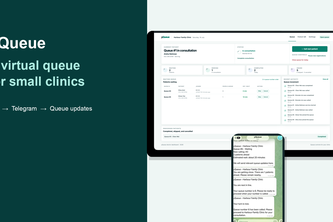
The description states that yQueue is a virtual queue assistant for solo doctors and small clinics. It allows patients to join a queue by scanning a QR code, which opens Telegram and registers them into the clinic’s queue. The system supports queue management from a dashboard, including pausing, closing, calling, and completing consultations. Patients receive updates via Telegram about their queue status.
- Claimed functionality: Patient joins queue via QR → Telegram registration → Dashboard for doctor to manage queue.
- Technology stack: Built with Python, FastAPI, SQLAlchemy 2.x, SQLite, Alembic, Pydantic, Jinja2, lightweight JavaScript, and python-telegram-bot.
- Not evidenced: No actual product, no live users, no production data.
Positioning & Claim Evolution
The author positions yQueue as a solution for small clinics managing busy waiting rooms, aiming to reduce patient anxiety and streamline doctor operations. It is described as an alternative to verbal queue updates or third-party apps, using Telegram as the primary communication channel.
- Claimed positioning: A calm, digital queue assistant for solo doctors.
- Evolution of claims: The project was built in a hackathon context; it does not appear to have evolved beyond MVP stage.
- Not evidenced: No evidence of prior versions, user feedback, or product iteration.
Target Customer & ICP
The description states that yQueue is intended for solo doctors and small clinics. It targets environments where patients want to avoid downloading another app but need queue updates, while doctors want a calm dashboard to manage their day.
- Claimed customer: Solo doctors or small clinics.
- Not evidenced: No evidence of actual customers, market research, or ICP validation.
Business Model & Pricing Evidence
The description does not provide any information about pricing, monetization, or business model. It is implied that the system is built for clinics to use internally, but no commercial structure is described.
- Claimed model: Not stated.
- Not evidenced: No pricing, revenue model, or customer acquisition strategy.
Technical & Delivery Signals
The project was built using Python and FastAPI with a database-backed notification system. It includes automated tests, migrations, demo data, and local setup instructions. The author used Codex and GPT-5.6 for development.
- Technical stack: Python, FastAPI, SQLAlchemy 2.x, SQLite, Alembic, Pydantic, Jinja2, JavaScript, python-telegram-bot.
- Delivery signals: MVP with test suite, migrations, and documentation.
- Not evidenced: No production deployment, scalability data, or performance metrics.
Traction & Maturity Signals
The project is described as a hackathon MVP. It does not include evidence of real users, adoption, or product-market fit. The author explicitly states that features like authentication, public deployment, and payment systems are deferred.
- Claimed maturity: MVP built in one week.
- Not evidenced: No traction, no customers, no usage data, no revenue.
Competitive Context
The description does not mention any competitors or market context. It is unclear whether similar solutions exist in the market or how yQueue would differentiate itself.
- Claimed context: Not described.
- Not evidenced: No competitive analysis, market size, or differentiation strategy.
Open Questions & Risks
- The project is a hackathon MVP with no evidence of real-world use or traction.
- It defers critical features like authentication and regulatory compliance.
- No pricing, monetization, or customer data are provided.
- The author is a single individual (team size: 1), raising questions about scalability and long-term maintenance.
Questions the description leaves open
- What specific pain points in small clinic queue management does yQueue solve?
- Have you validated this with actual clinics or doctors?
- What are the plans for authentication, data privacy, and regulatory compliance?
- How do you intend to monetize this product?
- Are there any existing competitors in this space?
Overall Assessment
Not evidenced: No commercial traction, revenue, or customer validation exists. The project is described as a hackathon MVP with no evidence of product-market fit or scalability.
- Confidence level: Low.
- Assessment: Not ready for investment or partnership at this stage. This is an idea in early development, not a product with demonstrated value.
User Stories BotA demo video on every pull request
Get a demo video on every new feature
GitHub App that watches your pull requests and records a narrated, captioned demo.
Save time on demo prep and make informed decisions faster with a video walkthrough of every new feature.
Source
Submitted to the OpenAI 2026 hackathon on Devpost. Project home on Devpost. Back to the full gallery on Devpost.
This competitive analysis was produced by top-founders.com (opens in a new tab)
Generated by a language model from this project's public Devpost page — its tagline, the author's own write-up and any built-with tags listed there — as captured in August 2026. Short quotations are the author's words. It is an opinion on the idea as a business, not on the people behind it, and it reflects the description as published then. If the project has moved on, request a correction below. The analysis is not independent research and contains no verified traction, revenue or customer data.
An independent guide by KFG International LLC — not affiliated with, endorsed by, or connected to Devpost or OpenAI.