

Archive position — measured, not model output
0 likes on Devpost
2,263 of the 7,850 archived projects have more likes, and 5,587 share exactly 0 — so this project's #3,860 place in the like-ranked listing is a tie-break inside that group, not a ranking.
Projects (log scale)
Likes on Devpost. ▲ marks this project's group.
Show the figures
| Likes | Projects | Share of archive |
|---|---|---|
| 0 | 5,587 | 71.2% |
| 1 | 1,758 | 22.4% |
| 2 | 284 | 3.6% |
| 3–4 | 132 | 1.7% |
| 5–9 | 75 | 1.0% |
| 10+ | 14 | 0.2% |
 User Stories BotA demo video on every pull request
Get a demo video on every new feature
GitHub App that watches your pull requests and records a narrated, captioned demo.
Save time on demo prep and make informed decisions faster with a video walkthrough of every new feature.
Executive Summary
What the company appears to be: EchoCards is a self-reported English learning tool built as a hackathon project that generates structured practice cards from prompts using AI. The author states it is not a general chatbot but a focused tool for reusable English practice material.
What changed: The project was developed over a hackathon period using an iterative human-supervised workflow with GPT-5.6 and Codex, implementing a range of technical controls around AI usage, concurrency, security, and data persistence.
The single most important open question: Is there any evidence of real user adoption or commercial traction beyond the author's own development work?
What The Product Actually Is
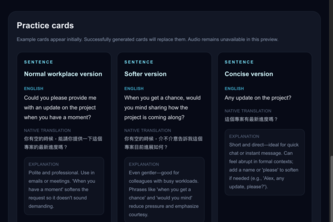
The description states that EchoCards generates structured English practice cards instead of free-form chatbot responses. Each lesson contains three to five cards by default, with each card including:
- learner-facing English;
- Traditional Chinese translation;
- Explanation of usage;
- Optional source context;
- On-demand audio for the persisted English text.
Users can save, hear, revisit, and delete lessons explicitly through a shared access-code gate. The tool supports practical sentences, vocabulary, transition phrases, workplace and interview English, short dialogues, short passages, natural rewrites, and translation-to-practice.
The application uses Next.js, TypeScript, React, Tailwind CSS, OpenAI, Supabase PostgreSQL, and private Supabase Storage.
Evidence: Self-reported by the author. No independent verification or demonstration of actual product functionality beyond the developer's account.
Positioning & Claim Evolution
The author claims EchoCards is intentionally not a general chatbot but a focused tool for reusable English practice material. The inspiration behind it was to turn AI-generated answers into persistent, actionable learning content that learners can save, hear, and revisit.
The product evolved from an idea to a working prototype through an iterative human-supervised workflow involving GPT-5.6 and Codex.
Evidence: Self-reported by the author. No external positioning or market claims are provided.
Target Customer & ICP
The description states that EchoCards targets English learners who want to practice using AI-generated content in a structured way, with reusable practice material rather than one-time chat interactions.
It supports various types of English learning content such as practical sentences, vocabulary, transition phrases, workplace and interview English, short dialogues, and passages.
Evidence: Self-reported by the author. No specific customer segments or personas are defined beyond general English learners.
Business Model & Pricing Evidence
There is no evidence provided about a business model or pricing structure. The description mentions that users unlock the app through a shared access-code gate, but does not describe how this might translate into monetization.
Evidence: Not evidenced.
Technical & Delivery Signals
The application uses:
- Server-only OpenAI text and audio providers;
- Strict structured practice-card output validation;
- Transactional lesson and card persistence;
- Signed, expiring HttpOnly access sessions;
- Durable deployment-wide text and audio quotas;
- Independent generation and audio kill switches;
- Fixed PostgreSQL RPC capabilities;
- Strict fail-closed validation of provider and database responses;
- Server-rendered History and lesson detail pages;
- On-demand private audio with temporary signed playback URLs;
- Concurrency-safe audio admission using claims, leases, and fencing;
- Cached audio replay without another generation quota charge;
- Database-authoritative hard lesson deletion;
- Durable exact-path audio cleanup evidence.
The author also describes how GPT-5.6 and Codex were used in an iterative workflow to define scope, implement features, and validate outcomes.
Evidence: Self-reported by the author. No third-party verification or deployment data is available.
Traction & Maturity Signals
There is no evidence of user traction, revenue, or adoption beyond the author's own development work. The project was submitted as a hackathon entry, and no metrics on usage, retention, or growth are mentioned.
Evidence: Not evidenced.
Competitive Context
No competitive landscape or market positioning is described in the self-report. The author does not mention competitors or similar tools in the English learning space.
Evidence: Not evidenced.
Open Questions & Risks
Key risks include:
- The project is entirely self-reported and unverified;
- No evidence of real users, customers, or revenue;
- The tool appears to be a prototype built for a hackathon;
- Lack of clarity on scalability or long-term viability;
- No mention of monetization strategy or business model.
Evidence: Inferred from lack of external validation and absence of traction data.
Questions the description leaves open
- What is the actual user base or target audience for EchoCards?
- How does the product plan to scale beyond a single developer's hackathon effort?
- Is there any evidence of real-world usage or feedback from English learners?
- What are the plans for monetization and commercial sustainability?
- Are there any technical limitations that prevent broader deployment or adoption?
Evidence: Inferred based on lack of verified data.
Overall Assessment
There is no evidence to support a commercial due-diligence read beyond the author's own description. The project appears to be a hackathon prototype with no demonstrated traction, revenue, or customer base.
Evidence: Self-reported only; no external validation or performance metrics available.
User Stories BotA demo video on every pull request
Get a demo video on every new feature
GitHub App that watches your pull requests and records a narrated, captioned demo.
Save time on demo prep and make informed decisions faster with a video walkthrough of every new feature.
Source
Submitted to the OpenAI 2026 hackathon on Devpost. Project home on Devpost. Back to the full gallery on Devpost.
This competitive analysis was produced by top-founders.com (opens in a new tab)
Generated by a language model from this project's public Devpost page — its tagline, the author's own write-up and any built-with tags listed there — as captured in August 2026. Short quotations are the author's words. It is an opinion on the idea as a business, not on the people behind it, and it reflects the description as published then. If the project has moved on, request a correction below. The analysis is not independent research and contains no verified traction, revenue or customer data.
An independent guide by KFG International LLC — not affiliated with, endorsed by, or connected to Devpost or OpenAI.