

Archive position — measured, not model output
0 likes on Devpost
2,263 of the 7,850 archived projects have more likes, and 5,587 share exactly 0 — so this project's #3,861 place in the like-ranked listing is a tie-break inside that group, not a ranking.
Projects (log scale)
Likes on Devpost. ▲ marks this project's group.
Show the figures
| Likes | Projects | Share of archive |
|---|---|---|
| 0 | 5,587 | 71.2% |
| 1 | 1,758 | 22.4% |
| 2 | 284 | 3.6% |
| 3–4 | 132 | 1.7% |
| 5–9 | 75 | 1.0% |
| 10+ | 14 | 0.2% |
 User Stories BotA demo video on every pull request
Get a demo video on every new feature
GitHub App that watches your pull requests and records a narrated, captioned demo.
Save time on demo prep and make informed decisions faster with a video walkthrough of every new feature.
Executive Summary
What the company appears to be
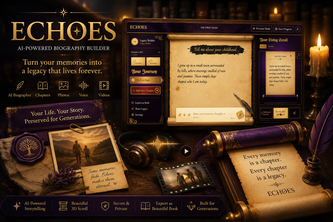
Echoes is a self-reported personal archiving tool that uses Generative AI and 3D web technologies to help users preserve life stories as interactive, immersive digital artifacts. It allows users to input memories via text, voice, images, or video through an AI “Royal Biographer,” which then structures these into narratives visualized on a dynamic 3D scroll.
What changed
The author states they built this during a hackathon with no prior traction or revenue data. There is no evidence of any product launch, user base, or monetization model beyond the self-reported project description.
Single most important open question
Is there any evidence that users have adopted or engaged with Echoes beyond its development phase? The author claims to have built a functional prototype but provides no proof of usage, adoption, or commercial viability.
What The Product Actually Is
The description states that Echoes is an interactive web application acting as a personal archivist. It allows users to share memories via text, voice, images, and videos through a conversational interface with an AI "Royal Biographer." These inputs are processed into structured narratives and visualized on a dynamic 3D Living Scroll — a parchment-like timeline where memories appear as polaroids, stickers, and handwritten notes.
It also includes a Full-Screen Scrapbook Editor, enabling manual arrangement of memories on an infinite canvas. The system supports exporting or sharing these digital heirlooms.
Inference Based on the author's technical stack and implementation details, Echoes appears to be a full-stack application combining AI, 3D visualization, and media storage — but it is not evidenced as having launched or been used beyond its development stage.
Positioning & Claim Evolution
The description states that Echoes aims to "preserve legacies through magical storytelling and immersive visualization." It positions itself at the intersection of oral tradition and digital preservation, blending nostalgia with modern AI and WebGL technologies.
It describes the AI as a “Royal Biographer,” suggesting an aesthetic and emotional framing around personal history. The author emphasizes creating a "Memory Palace" where users don’t just store data but experience their legacy as a living artifact.
Inference This is a positioning statement about the emotional value of the product, not evidence of market demand or adoption. The claim of transforming life stories into an “interactive living scroll” reflects intent and vision rather than traction.
Target Customer & ICP
The description does not clearly define a target customer segment or ideal customer profile (ICP). It implies that Echoes is for individuals who want to preserve personal or family histories, but no specific demographic, persona, or use case is detailed.
Inference The author’s stated inspiration — “fading art of oral storytelling” and “preserving family histories” — suggests a potential audience of older adults or genealogy enthusiasts. However, this remains unproven without evidence of actual users or market research.
Business Model & Pricing Evidence
There is no evidence in the description of any business model or pricing strategy. The author does not mention monetization, subscriptions, sales, or revenue streams.
Inference While the author mentions future plans such as multi-user collaboration and physical book export, these are speculative and not tied to any current or past commercial activity.
Technical & Delivery Signals
The project is described as a full-stack application built using:
- Frontend: Next.js 14, TypeScript, Tailwind CSS, React Three Fiber (R3F), react-rnd
- Backend: FastAPI in Python
- AI Integration: DeepSeek-R1 via Replicate API
- Database & Storage: AWS DynamoDB, AWS S3
- Deployment: Vercel and Render
The author reports solving several technical challenges including:
- 3D texture rendering issues
- Streaming latency with AI models
- State synchronization across components
- Aesthetic consistency in UI/UX design
Inference The technical architecture shows a capable developer with experience in modern web stacks, AI integration, and 3D visualization. However, this does not indicate product-market fit or scalability beyond the prototype stage.
Traction & Maturity Signals
There is no evidence of traction, revenue, customers, or adoption beyond the author’s own development efforts. The project was submitted to a hackathon, indicating it exists only as a prototype or proof-of-concept.
Inference No metrics, user feedback, or product usage data are provided. The lack of any mention of users, downloads, or engagement signals suggests no real-world testing has occurred.
Competitive Context
The description does not reference competitors or the broader market landscape. It focuses solely on the author’s own innovation and technical approach.
Inference While Echoes may be unique in its blend of AI storytelling and 3D visualization, there is no evidence of competitive analysis or positioning within existing markets such as genealogy tools, digital scrapbooking apps, or AI narrative builders.
Open Questions & Risks
- No traction or user data: The product exists only as a self-reported prototype.
- Unproven commercial viability: No evidence of monetization, pricing, or business model execution.
- Highly subjective positioning: The emotional framing ("magical storytelling") lacks measurable impact or validation.
- Technical complexity without real-world testing: The author solved complex problems in development but did not demonstrate their effectiveness with users.
- Speculative roadmap: Future features like AR viewing and print-on-demand are not backed by current product usage or market demand.
Questions the description leaves open
- Has Echoes been tested with real users? What feedback have you received?
- Are there any early adopters or pilot groups using the system?
- How do you plan to monetize this tool, and what pricing model are you considering?
- Have you validated demand for this type of digital legacy preservation?
- What is your strategy for scaling beyond a single developer?
- Do you have any data on how users interact with the 3D scroll or scrapbook editor?
Overall Assessment
There is no evidence that Echoes has reached a stage suitable for investment or partnership. The project is described as a hackathon submission, and there are no signs of traction, revenue, or customer engagement.
Confidence Level Very low — based entirely on self-reported claims with no external corroboration.
Assessment Not ready for commercial due diligence or investment consideration at this time. Any potential value lies in the author’s technical capabilities and creative vision, but not in demonstrated product-market fit or business viability.
User Stories BotA demo video on every pull request
Get a demo video on every new feature
GitHub App that watches your pull requests and records a narrated, captioned demo.
Save time on demo prep and make informed decisions faster with a video walkthrough of every new feature.
Source
Submitted to the OpenAI 2026 hackathon on Devpost. Project home on Devpost. Back to the full gallery on Devpost.
This competitive analysis was produced by top-founders.com (opens in a new tab)
Generated by a language model from this project's public Devpost page — its tagline, the author's own write-up and any built-with tags listed there — as captured in August 2026. Short quotations are the author's words. It is an opinion on the idea as a business, not on the people behind it, and it reflects the description as published then. If the project has moved on, request a correction below. The analysis is not independent research and contains no verified traction, revenue or customer data.
An independent guide by KFG International LLC — not affiliated with, endorsed by, or connected to Devpost or OpenAI.