

Archive position — measured, not model output
0 likes on Devpost
2,263 of the 7,850 archived projects have more likes, and 5,587 share exactly 0 — so this project's #3,862 place in the like-ranked listing is a tie-break inside that group, not a ranking.
Projects (log scale)
Likes on Devpost. ▲ marks this project's group.
Show the figures
| Likes | Projects | Share of archive |
|---|---|---|
| 0 | 5,587 | 71.2% |
| 1 | 1,758 | 22.4% |
| 2 | 284 | 3.6% |
| 3–4 | 132 | 1.7% |
| 5–9 | 75 | 1.0% |
| 10+ | 14 | 0.2% |
 User Stories BotA demo video on every pull request
Get a demo video on every new feature
GitHub App that watches your pull requests and records a narrated, captioned demo.
Save time on demo prep and make informed decisions faster with a video walkthrough of every new feature.
Executive Summary
What the company appears to be
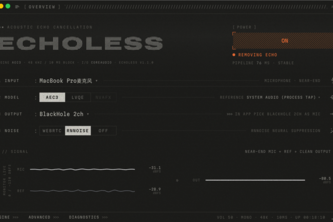
Echoless is a self-reported real-time acoustic echo cancellation app for speaker-based voice chat, built as an open-source desktop tool for Windows and macOS. It uses reference-based audio processing to remove echo from microphone input by capturing system audio and aligning it with the user's voice signal.
What changed
The project was submitted to the OpenAI 2026 hackathon, indicating a transition from personal development to public release. The author describes building a complete end-to-end solution that integrates multiple audio engines (AEC3, LocalVQE, NVIDIA Maxine AEC) with a desktop GUI and CLI interface.
Single most important open question
Does Echoless have any commercial traction or adoption beyond the author's own use case? The description contains no evidence of revenue, customers, or market validation.
Analysis basis
This report is based entirely on the self-reported project description provided by the caller. All claims are unverified and should be treated as stated by the author, not proven facts. No third-party verification, historical data, or external sources were used in this analysis.
What The Product Actually Is
The description states that Echoless is:
- A real-time acoustic echo cancellation app and CLI for Windows and macOS
- Designed to work with speakers + microphone setups during voice chat (e.g., Discord)
- An open-source desktop application built using Rust, Tauri, React, and Swift
- Capable of capturing two live signals:
- Far-end reference: audio currently playing through the computer
- Near-end capture: microphone signal containing user's voice, speaker echo, and room reflections
- Uses three processing engines:
- AEC3 (WebRTC-based)
- LocalVQE (neural model)
- NVIDIA Maxine AEC (RTX-accelerated)
- Provides device checks, delay probing, live health telemetry, optional runtime downloads, diagnostic logs, and a standalone CLI for scripting and offline processing
Evidence strength This is self-reported by the author. No independent verification or external data confirms these technical claims.
Positioning & Claim Evolution
The description states that Echoless was built to solve a specific problem: using speakers during Discord calls without sending system audio back through the microphone.
Key positioning elements:
- Addresses a common pain point in voice chat (speaker echo)
- Positions itself as bringing reference-based acoustic echo cancellation to "common" speaker + microphone setups
- Describes itself as a small, open-source desktop app
- Claims to be a complete solution rather than an offline demo
The author's claim evolution shows:
- Initial problem identification: wanting to use speakers without echo issues
- Solution development: building reference-based cancellation for common setups
- Product maturity: moving from prototype to full end-to-end system with multiple engines
- Future vision: improving setup experience and diagnostics
Evidence strength All claims are self-reported, with no external validation or market positioning data.
Target Customer & ICP
The description states that Echoless targets users who:
- Use speakers during voice chat (e.g., Discord)
- Want to avoid sending system audio through their microphone
- Are comfortable with desktop applications and audio routing concepts
- May be technically inclined enough to understand virtual audio devices
The author notes that the tool is designed for "people who want to use speakers during voice chat without making them understand the audio plumbing underneath."
Evidence strength This is inferred from the problem statement and target use case described by the author. No explicit customer segmentation or persona data is provided.
Business Model & Pricing Evidence
The description states that Echoless:
- Is an open-source desktop app
- Provides a CLI for scripting and offline processing
- Includes optional runtime and model downloads
- Uses established routing tools (VB-CABLE, BlackHole) rather than custom drivers
- Has no mention of pricing or monetization strategy
There is no evidence of:
- Revenue streams
- Pricing models
- Subscription or licensing fees
- Commercial partnerships
- Paid features or tiers
Evidence strength Not evidenced. The description does not contain any information about business model or pricing.
Technical & Delivery Signals
The description states that Echoless:
- Uses Rust for real-time audio pipeline and CLI
- Implements Tauri v2 desktop app with React, TypeScript, and Vite
- Captures system audio through native platform APIs:
- Windows: WASAPI loopback capture
- macOS: Core Audio Process Tap via Swift helper
- Handles clock drift between independently clocked audio devices
- Integrates three different processing engines (AEC3, LocalVQE, NVIDIA Maxine AEC)
- Uses JSONL protocol for GUI-sidecar communication
- Implements startup/shutdown handshakes to prevent unstable states
- Provides diagnostics including setup validation, delay probing, health events, crash logs
Evidence strength These are technical claims made by the author. No independent verification of implementation quality or delivery performance.
Traction & Maturity Signals
The description states:
- The project was submitted to the OpenAI 2026 hackathon
- It has been released as version 1.1.0
- It is open-source
- It includes a complete end-to-end solution with GUI, CLI, and offline processing capabilities
- It handles complex audio engineering challenges like delay tracking, resampling, and clock-skew telemetry
However, there is no evidence of:
- User adoption or customer base
- Revenue generation
- Market traction
- Product usage metrics
- Commercial deployment
- Customer feedback or reviews
Evidence strength Not evidenced. The description shows development maturity but lacks any commercial traction data.
Competitive Context
The description does not provide information about:
- Direct competitors in the acoustic echo cancellation space
- Alternative solutions for speaker-based voice chat
- Market positioning relative to existing tools
- Competitive advantages or differentiators
The author mentions that noise-suppression tools can remove keyboard, fan, and room noise but states that "speaker echo requires a different approach," suggesting this is a niche area of audio processing.
Evidence strength Not evidenced. No competitive landscape information provided.
Open Questions & Risks
Inferences from the description:
- Single-person development: The project has only one team member, which may limit scalability and long-term maintenance
- Limited commercial validation: No evidence of revenue, customers, or market traction beyond personal use
- Technical complexity risk: Audio engineering challenges like clock drift and device alignment are complex and could impact user experience
- Platform dependency: Relies on specific native APIs for Windows and macOS, which may limit portability
- Open-source model risk: While open-source can be beneficial, it may not provide clear monetization paths or commercial control
- Limited diagnostics: The author notes that diagnostics need to distinguish between engine failures and routing issues, suggesting potential complexity in troubleshooting
Evidence strength These are inferences based on the self-reported description. No external validation of these risks.
Questions the description leaves open
- What specific user problems does Echoless solve that existing solutions don't?
- How do you plan to monetize an open-source product?
- What is your long-term roadmap for commercial adoption?
- Have you tested the product with users beyond yourself?
- What are the technical limitations of the current implementation?
- How do you handle edge cases in audio routing and device compatibility?
- What is your strategy for expanding to other platforms or audio ecosystems?
- How do you plan to scale beyond single-person development?
- What metrics do you use to measure product success?
- Are there any commercial partnerships or distribution channels planned?
Overall Assessment
Not evidenced.
The description provides no information about:
- Revenue or financial performance
- Customer base or adoption metrics
- Market size or opportunity
- Competitive advantages or defensible position
- Commercial traction or validation
- Team experience or track record
- Financial projections or capital requirements
This is a self-reported technical project with no evidence of commercial viability, market traction, or investment-ready metrics. The author describes building a functional prototype but provides no data about product-market fit, scalability, or monetization potential.
The project appears to be a personal development effort that may have some technical merit, but there is no evidence that it represents a viable business opportunity or has achieved any commercial milestones.
User Stories BotA demo video on every pull request
Get a demo video on every new feature
GitHub App that watches your pull requests and records a narrated, captioned demo.
Save time on demo prep and make informed decisions faster with a video walkthrough of every new feature.
Source
Submitted to the OpenAI 2026 hackathon on Devpost. Project home on Devpost. Back to the full gallery on Devpost.
This competitive analysis was produced by top-founders.com (opens in a new tab)
Generated by a language model from this project's public Devpost page — its tagline, the author's own write-up and any built-with tags listed there — as captured in August 2026. Short quotations are the author's words. It is an opinion on the idea as a business, not on the people behind it, and it reflects the description as published then. If the project has moved on, request a correction below. The analysis is not independent research and contains no verified traction, revenue or customer data.
An independent guide by KFG International LLC — not affiliated with, endorsed by, or connected to Devpost or OpenAI.