

Archive position — measured, not model output
0 likes on Devpost
2,263 of the 7,850 archived projects have more likes, and 5,587 share exactly 0 — so this project's #5,825 place in the like-ranked listing is a tie-break inside that group, not a ranking.
Projects (log scale)
Likes on Devpost. ▲ marks this project's group.
Show the figures
| Likes | Projects | Share of archive |
|---|---|---|
| 0 | 5,587 | 71.2% |
| 1 | 1,758 | 22.4% |
| 2 | 284 | 3.6% |
| 3–4 | 132 | 1.7% |
| 5–9 | 75 | 1.0% |
| 10+ | 14 | 0.2% |
 User Stories BotA demo video on every pull request
Get a demo video on every new feature
GitHub App that watches your pull requests and records a narrated, captioned demo.
Save time on demo prep and make informed decisions faster with a video walkthrough of every new feature.
Executive Summary
What the company appears to be
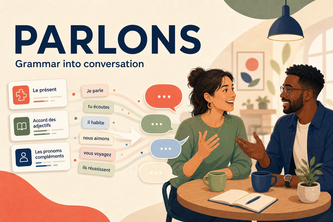
Parlons is an AI-powered French language-learning tool designed for English-speaking A1–A2 learners. It integrates grammar instruction with conversational practice using GPT-5.6, structured curriculum, and a lightweight technical stack.
What changed
The author describes Parlons as a response to the gap between knowing French grammar and using it in real-life situations. The tool was built as part of an OpenAI 2026 hackathon submission, with a focus on minimal dependencies, deterministic structure around generative AI, and responsible content handling.
Single most important open question
Is there evidence that Parlons has traction or adoption beyond the author's own use case, or that it can scale to serve more than one user?
This analysis is based solely on the self-reported project description provided by the author. No third-party verification, revenue data, customer names, or usage metrics are available.
What The Product Actually Is
The description states that Parlons is an AI-powered learning experience for English-speaking A1–A2 learners of French. It includes:
- 24 lessons organized into five progressive stages.
- A continuous loop: Learn → Practice → Converse → Correct → Review.
- Grammar-focused lessons with vocabulary review, exercises, open-ended writing tasks, and conversation simulations.
- AI-powered corrections using GPT-5.6 in role-play scenarios.
- Optional local accounts for tracking progress using SQLite.
It is described as a browser-based application built with Node.js, HTML/CSS/JS, and SQLite, with no external dependencies beyond OpenAI’s API and Codex for development support.
The product is self-described as a lightweight, deterministic system that uses generative AI within structured learning workflows. It does not include any evidence of monetization or user base.
Positioning & Claim Evolution
The author positions Parlons as a solution to the gap between grammar knowledge and conversational fluency for English-speaking learners at A1–A2 levels. The core claim is that traditional grammar instruction fails to translate into real-world usage, and Parlons bridges this by integrating grammar with practice.
Key claims:
- Learners can move from understanding rules to using them naturally.
- The tool uses AI to simulate conversation and provide corrections.
- It avoids exact-string grading for open-ended responses, instead relying on contextual correction during role-play.
These are claims made by the author. There is no evidence of market positioning or competitive differentiation beyond the stated goals.
Target Customer & ICP
The description states that Parlons targets English-speaking A1–A2 learners of French. The scenarios used in lessons include practical situations such as ordering coffee, navigating a city, checking into a hotel, attending university, and job interviews.
No evidence is provided about specific demographics, learner motivations, or segmentation beyond the CEFR level.
Business Model & Pricing Evidence
The description mentions that learners can begin immediately as guests. Optional local accounts store progress using SQLite. There is no mention of pricing, subscriptions, monetization, or paid features.
The business model is not evidenced. No indication of how revenue would be generated.
Technical & Delivery Signals
Parlons uses:
- Node.js 20
- Browser-native HTML/CSS/JavaScript
- SQLite with better-sqlite3
- OpenAI API (GPT-5.6)
- JSON and JSONL for curriculum authoring
- Built-in test runner and cryptography
The system is described as lightweight, deterministic, and secure:
- API keys remain server-side.
- Passwords are hashed using scrypt.
- Session tokens are stored as hashes.
- SQL uses prepared statements.
- Messages are escaped before rendering.
The technical stack is self-reported. No evidence of scalability, performance metrics, or production deployment details.
Traction & Maturity Signals
The project was submitted to the OpenAI 2026 hackathon. It includes:
- A functional prototype with curriculum and AI integration.
- A test suite.
- A responsive browser interface.
- Content extraction pipelines using Codex.
However, there is no evidence of:
- User adoption or retention.
- Revenue or monetization.
- Customer feedback or usage data.
- Public availability or distribution beyond the Devpost submission.
No traction signals are evidenced. The project appears to be a prototype or proof-of-concept.
Competitive Context
The description does not mention any competitors or market context. It is unclear whether Parlons operates in a crowded space of language-learning tools, nor how it differentiates from existing platforms.
No competitive landscape is evidenced.
Open Questions & Risks
- No revenue or monetization model: The tool is described as free to use, with optional local accounts.
- Single-person team: Only one member (Krickt Yueng) is listed.
- Prototype nature: Built for a hackathon; no evidence of long-term product development or user feedback loops.
- Limited scope: Only 24 lessons and five stages; no indication of roadmap or expansion plans.
- AI dependency: Relies heavily on GPT-5.6, which may not be sustainable or scalable without API access control or cost management.
These are inferred risks from the self-reported description. No independent validation exists.
Questions the description leaves open
- What is your plan for scaling beyond a single-person development effort?
- How do you intend to monetize Parlons, if at all?
- Have you tested the AI correction system with real learners or only in simulation?
- What are your plans for curriculum expansion beyond 24 lessons?
- Do you have any feedback from English-speaking A1–A2 learners who tried the tool?
- How do you plan to ensure content quality and avoid copyright issues as the curriculum grows?
These questions aim to probe assumptions and gaps in the self-reported narrative.
Overall Assessment
Not evidenced.
There is no evidence of a business model, traction, or commercial viability beyond the author’s own prototype. No investment or partnership opportunity can be assessed without further data on user adoption, monetization, or scalability.
User Stories BotA demo video on every pull request
Get a demo video on every new feature
GitHub App that watches your pull requests and records a narrated, captioned demo.
Save time on demo prep and make informed decisions faster with a video walkthrough of every new feature.
Source
Submitted to the OpenAI 2026 hackathon on Devpost. Project home on Devpost. Back to the full gallery on Devpost.
This competitive analysis was produced by top-founders.com (opens in a new tab)
Generated by a language model from this project's public Devpost page — its tagline, the author's own write-up and any built-with tags listed there — as captured in August 2026. Short quotations are the author's words. It is an opinion on the idea as a business, not on the people behind it, and it reflects the description as published then. If the project has moved on, request a correction below. The analysis is not independent research and contains no verified traction, revenue or customer data.
An independent guide by KFG International LLC — not affiliated with, endorsed by, or connected to Devpost or OpenAI.