

Archive position — measured, not model output
1 like on Devpost
505 of the 7,850 archived projects have more likes, and 1,758 share exactly 1 — so this project's #1,901 place in the like-ranked listing is a tie-break inside that group, not a ranking.
Projects (log scale)
Likes on Devpost. ▲ marks this project's group.
Show the figures
| Likes | Projects | Share of archive |
|---|---|---|
| 0 | 5,587 | 71.2% |
| 1 | 1,758 | 22.4% |
| 2 | 284 | 3.6% |
| 3–4 | 132 | 1.7% |
| 5–9 | 75 | 1.0% |
| 10+ | 14 | 0.2% |
 User Stories BotA demo video on every pull request
Get a demo video on every new feature
GitHub App that watches your pull requests and records a narrated, captioned demo.
Save time on demo prep and make informed decisions faster with a video walkthrough of every new feature.
Executive Summary
Servent-AI is a self-reported, local, privacy-first Windows OS agent designed to enable hands-free computer control for individuals with motor or physical disabilities. The project uses multimodal inputs (voice and hand gestures) and local AI models (Gemma 4, Moondream) to plan and execute tasks on a Windows machine. It claims to operate entirely offline, without cloud dependencies, and is built using open-source tools and local inference engines.
The author states that Servent-AI was submitted to the OpenAI 2026 hackathon and represents a proof-of-concept for accessible computing using local AI models. No evidence of revenue, customers, or commercial traction is provided. The project is described as a single-person effort with no external funding or team structure evident.
The most important open question
Is there any evidence that Servent-AI has been tested or validated beyond the author's own development environment? The description provides no indication of real-world usage, user feedback, or performance data outside of the developer’s own testing.
What The Product Actually Is
The description states that Servent-AI is a local, privacy-first Windows OS agent. It claims to:
- Accept inputs via voice (Whisper STT) and hand gestures (MediaPipe).
- Use a local Gemma 4 model as the planner ("Aria Brain").
- Execute tasks using PyAutoGUI.
- Verify execution using a local Moondream vision model ("VISTA").
- Operate entirely offline, without cloud APIs or internet connectivity.
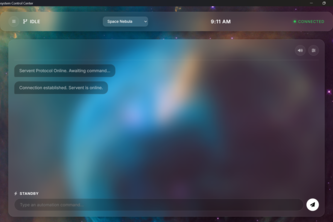
The product is described as a self-contained system built in Python with websockets and PyAutoGUI. It includes a local web dashboard for monitoring real-time state and commands.
Inference The system appears to be a prototype or proof-of-concept, not a production-ready product. It is built using open-source tools and local inference engines, as evidenced by the technology stack listed.
Positioning & Claim Evolution
The author positions Servent-AI as an accessibility tool for people with motor or physical disabilities. The project's inspiration centers on removing barriers to digital access and enabling users to perform tasks like browsing, writing, and coding using only voice and gestures.
Key claims:
- It is a 100% local, privacy-first solution.
- It enables hands-free control of Windows laptops.
- It is designed for digital inclusion and career-building for disabled individuals.
- It uses open-weight models to avoid reliance on expensive cloud APIs.
The positioning has evolved from a hackathon prototype to an accessibility-focused agent, but there is no evidence of further development or commercialization beyond the author’s own testing.
Target Customer & ICP
The description states that Servent-AI is designed for people with motor or physical disabilities, who are hindered by traditional input methods (keyboard and mouse). It aims to enable them to:
- Navigate computers.
- Write and code.
- Access digital careers and financial independence.
Inference The target customer segment is individuals with physical limitations, but the description does not specify:
- Whether the tool targets a specific disability type or severity.
- If there are any commercial or institutional users beyond personal use.
- Whether the tool is intended for home, workplace, or educational settings.
The ICP (Ideal Customer Profile) is implied to be disabled individuals seeking digital access, but no segmentation or user research data is provided.
Business Model & Pricing Evidence
There is no evidence of a business model or pricing structure in the description. The project is described as a single-person hackathon submission, with no indication of monetization, licensing, or customer acquisition plans.
The author states that the system is built using open-source tools and local inference engines, suggesting it may be free to use or self-hosted. However, there is no mention of:
- Subscription models.
- Licensing fees.
- SaaS offerings.
- Revenue streams.
Inference The project appears to be a proof-of-concept, not a commercial offering.
Technical & Delivery Signals
The author reports that Servent-AI was built using:
- Backend: Python, asyncio, websockets, PyAutoGUI.
- Brain Engine: Gemma 4 E4B (quantized to Q4_K_M) via LM Studio.
- Visual Verification: Moondream via Ollama on integrated GPU.
- Frontend: Local web dashboard for real-time monitoring.
The system is described as:
- Offline-first.
- Optimized for performance on consumer hardware (Core Ultra 5 with 16GB RAM).
- Capable of executing complex workflows like opening a browser, writing prompts, copying responses, and sending messages via WhatsApp.
Inference The technical stack suggests a local inference pipeline, but there is no evidence of scalability, robustness, or integration with broader ecosystems. Performance claims are limited to the author’s own testing.
Traction & Maturity Signals
The description provides no traction or maturity signals:
- No revenue data.
- No customer base.
- No user feedback or adoption metrics.
- No production deployment or commercial use cases.
- No evidence of iterative development beyond the hackathon prototype.
The project is described as a single-person effort, and there is no indication of team growth, funding, or product evolution.
Inference The project is at an early stage (proof-of-concept) with no validated traction or market adoption.
Competitive Context
There is no evidence of competitive analysis or awareness of existing solutions in the description. The author does not reference:
- Other accessibility tools.
- Voice-controlled OS agents.
- Gesture-based input systems.
- AI-powered automation platforms.
The project appears to be independent, with no mention of prior work or market positioning relative to competitors.
Open Questions & Risks
- No commercial traction: The project is described as a single-person hackathon submission, with no evidence of real-world usage or adoption.
- Unproven scalability: The system is optimized for consumer hardware and may not scale to enterprise or broader use cases.
- Limited validation: No user testing, feedback, or performance data beyond the author’s own environment.
- Single-person effort: No team structure or external support evident.
- No monetization strategy: No indication of how the project might be commercialized.
Questions the description leaves open
- What specific disabilities does Servent-AI aim to address, and how was this determined?
- Has the system been tested with real users beyond the developer’s own use case?
- What performance benchmarks were used for optimization on consumer hardware?
- Are there plans to expand beyond Windows or support other operating systems?
- How is the system intended to be distributed or deployed (e.g., as a standalone app, browser extension)?
- What are the limitations of the current local inference pipeline in terms of task complexity or execution speed?
- Is there any intention to monetize or commercialize this tool?
Overall Assessment
Not evidenced.
The description provides no evidence of:
- Revenue.
- Customers.
- Product-market fit.
- Team traction.
- Commercial viability.
The project is described as a single-person hackathon submission, with no indication of investment interest or partnership potential beyond the author’s own development.
Inference At this stage, Servent-AI appears to be a conceptual prototype with strong accessibility intent but no commercial or market validation. It may be of interest for early-stage R&D or non-commercial partnerships, but not as an investment or acquisition target without further evidence of traction or scalability.
User Stories BotA demo video on every pull request
Get a demo video on every new feature
GitHub App that watches your pull requests and records a narrated, captioned demo.
Save time on demo prep and make informed decisions faster with a video walkthrough of every new feature.
Source
Submitted to the OpenAI 2026 hackathon on Devpost. Project home on Devpost. Back to the full gallery on Devpost.
This competitive analysis was produced by top-founders.com (opens in a new tab)
Generated by a language model from this project's public Devpost page — its tagline, the author's own write-up and any built-with tags listed there — as captured in August 2026. Short quotations are the author's words. It is an opinion on the idea as a business, not on the people behind it, and it reflects the description as published then. If the project has moved on, request a correction below. The analysis is not independent research and contains no verified traction, revenue or customer data.
An independent guide by KFG International LLC — not affiliated with, endorsed by, or connected to Devpost or OpenAI.