

Archive position — measured, not model output
0 likes on Devpost
2,263 of the 7,850 archived projects have more likes, and 5,587 share exactly 0 — so this project's #5,822 place in the like-ranked listing is a tie-break inside that group, not a ranking.
Projects (log scale)
Likes on Devpost. ▲ marks this project's group.
Show the figures
| Likes | Projects | Share of archive |
|---|---|---|
| 0 | 5,587 | 71.2% |
| 1 | 1,758 | 22.4% |
| 2 | 284 | 3.6% |
| 3–4 | 132 | 1.7% |
| 5–9 | 75 | 1.0% |
| 10+ | 14 | 0.2% |
 User Stories BotA demo video on every pull request
Get a demo video on every new feature
GitHub App that watches your pull requests and records a narrated, captioned demo.
Save time on demo prep and make informed decisions faster with a video walkthrough of every new feature.
Executive Summary
What the company appears to be
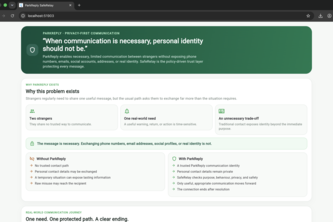
ParkReply is a privacy-first communication platform for real-world interactions. The project describes itself as building a system that allows strangers to communicate about specific, temporary needs without revealing personal identity. It introduces a "SafeRelay" engine that evaluates messages and decides whether to allow, warn, or block them based on policy-driven rules.
What changed
The author states that this is an isolated prototype built during OpenAI Build Week, focused on demonstrating a deterministic trust engine (SafeRelay) separate from the main ParkReply platform. It does not currently integrate with production systems or call external AI services.
Single most important open question — the commercial due-diligence read
Is there evidence of traction, revenue, or customer adoption beyond this self-reported prototype? The description provides no data on usage, monetization, or market validation.
What The Product Actually Is
The description states that ParkReply is a privacy-first communication platform for real-world interactions. It uses QR codes as entry points (e.g., vehicle stickers, key tags) to initiate limited-purpose communication between strangers.
A scanner can submit a message via a QR code without creating an account. This message is then processed by SafeRelay — a deterministic policy engine that evaluates the purpose, behavior, privacy risks, and safety risks before deciding whether to:
- ALLOW a safe, relevant message,
- WARN by removing risks while preserving intent (with confirmation required),
- BLOCK threats like scams, harassment, or phishing.
SafeRelay is described as an isolated, stateless Dart-based engine with typed Flutter models. It does not connect to Firebase or external AI services in the demo version.
Evidence
- The description states: “ParkReply creates a protected path between a public interaction and an intended recipient.”
- The description states: “SafeRelay is the communication protection engine inside ParkReply.”
- The description states: “We built ParkReply around a clear philosophy: Purpose should come before identity.”
Inference The product is conceptualized as a trust layer for real-world stranger-to-stranger communication, not a general-purpose messaging app.
Positioning & Claim Evolution
The author positions ParkReply as solving a communication gap in real-world scenarios where people need to interact without sharing personal information. The core claim is that useful information can be shared without identity exposure.
It emphasizes:
- Purpose-driven communication.
- Identity protection.
- Explainable decision-making.
- Deterministic safety rules over AI moderation.
The project evolved from an idea about strangers needing to communicate without knowing each other, to a structured policy engine (SafeRelay) designed to evaluate and manage such communications safely.
Evidence
- The description states: “Most people have experienced a moment when they needed to contact a stranger but had no safe way to do it.”
- The description states: “Purpose should come before identity.”
Inference The positioning is rooted in privacy-first principles, not scalability or monetization. It frames itself as a foundational trust engine rather than a consumer product.
Target Customer & ICP
The description does not name specific customers or buyer personas. However, it implies that the target users are:
- Strangers needing to communicate about temporary real-world events (e.g., car blocking garage).
- Owners of physical items (vehicles, keys, luggage) who may receive such messages.
- Organizations or environments where such interactions occur (hotels, campuses, municipal services).
The platform is built for scenarios where a limited communication channel is needed, not ongoing relationships.
Evidence
- The description states: “A QR code on a vehicle can help a stranger warn an owner about an open window.”
- The description states: “It also appears in hotels, campuses, workplaces, venues, municipal services.”
Inference The ICP seems to be individuals or institutions managing physical assets and needing secure, limited communication channels.
Business Model & Pricing Evidence
There is no evidence of a business model or pricing structure in the description. The project is described as a prototype built during a hackathon, with no mention of monetization, subscriptions, or revenue streams.
Evidence
- Not evidenced.
Inference The business model remains undefined and untested.
Technical & Delivery Signals
The project uses Flutter (Dart) for the UI and Firebase for backend services in the broader application. However, the SafeRelay prototype is isolated from these systems and runs as a stateless engine with deterministic behavior.
Key technical elements include:
- Typed Dart models.
- Deterministic policy rules.
- Policy-driven decision logic.
- Support for English, French, and mixed-language inputs.
- Tests covering 71 outcomes.
- No external API calls in the demo version.
Evidence
- The description states: “We implemented SafeRelay as a pure Dart engine with typed Flutter models.”
- The description states: “Hard safety rules have explicit precedence.”
- The description states: “The current prototype does not call the OpenAI API.”
Inference The architecture is designed for explainability and safety, not scalability or performance.
Traction & Maturity Signals
There is no evidence of traction, revenue, customers, or adoption beyond the self-reported prototype. The project is described as a demonstration built during a hackathon (OpenAI Build Week), with no indication of production use or user engagement.
Evidence
- Not evidenced.
Inference No maturity signals are evident; this is an early-stage prototype.
Competitive Context
The description does not mention competitors or existing solutions in the space. It focuses on the unique positioning of privacy-first, purpose-limited communication without identifying similar products or platforms.
Evidence
- Not evidenced.
Inference No competitive landscape is described; this may be a novel niche or an unaddressed gap.
Open Questions & Risks
- No traction or revenue evidence: The project is described as a prototype with no validated users or monetization.
- Unproven scalability: The system is built for deterministic rules and explainability, but lacks any indication of how it would scale to real-world usage.
- Limited integration: SafeRelay is isolated from the main platform; future integration remains undefined.
- No AI use in demo: Despite mentioning GPT-5.6 as a collaborator, the prototype does not call external APIs or integrate AI into its decision-making process.
- Unverified claims: All statements are self-reported and unverified.
Evidence
- The description states: “The current prototype does not call the OpenAI API.”
- The description states: “This is an isolated, stateless demonstration.”
Inference The project lacks commercial viability or traction signals, raising questions about its readiness for production or investment.
Questions the description leaves open
- What real-world use cases have been identified beyond the demo scenarios?
- How will the deterministic policy evolve into a scalable system?
- Is there any plan to integrate AI in a way that preserves privacy and explainability?
- What are the next steps for production deployment or platform integration?
- Are there any early adopters or pilot users of ParkReply or SafeRelay?
- How is the team planning to monetize this product if at all?
Overall Assessment
The description presents a prototype built during a hackathon, with no evidence of traction, revenue, or customer adoption. The project is described as an isolated, deterministic trust engine (SafeRelay) that evaluates communication for safety and privacy.
Confidence Level Low This is a self-reported, unverified account of a prototype with no commercial data or market validation.
Assessment Summary
Not evidenced as a viable investment or partnership opportunity at this stage. The project lacks key signals of product-market fit, traction, or monetization strategy. It is positioned as a foundational trust engine but has not demonstrated real-world usage or scalability.
User Stories BotA demo video on every pull request
Get a demo video on every new feature
GitHub App that watches your pull requests and records a narrated, captioned demo.
Save time on demo prep and make informed decisions faster with a video walkthrough of every new feature.
Source
Submitted to the OpenAI 2026 hackathon on Devpost. Project home on Devpost. Back to the full gallery on Devpost.
This competitive analysis was produced by top-founders.com (opens in a new tab)
Generated by a language model from this project's public Devpost page — its tagline, the author's own write-up and any built-with tags listed there — as captured in August 2026. Short quotations are the author's words. It is an opinion on the idea as a business, not on the people behind it, and it reflects the description as published then. If the project has moved on, request a correction below. The analysis is not independent research and contains no verified traction, revenue or customer data.
An independent guide by KFG International LLC — not affiliated with, endorsed by, or connected to Devpost or OpenAI.