

Archive position — measured, not model output
0 likes on Devpost
2,263 of the 7,850 archived projects have more likes, and 5,587 share exactly 0 — so this project's #5,775 place in the like-ranked listing is a tie-break inside that group, not a ranking.
Projects (log scale)
Likes on Devpost. ▲ marks this project's group.
Show the figures
| Likes | Projects | Share of archive |
|---|---|---|
| 0 | 5,587 | 71.2% |
| 1 | 1,758 | 22.4% |
| 2 | 284 | 3.6% |
| 3–4 | 132 | 1.7% |
| 5–9 | 75 | 1.0% |
| 10+ | 14 | 0.2% |
 User Stories BotA demo video on every pull request
Get a demo video on every new feature
GitHub App that watches your pull requests and records a narrated, captioned demo.
Save time on demo prep and make informed decisions faster with a video walkthrough of every new feature.
Executive Summary
What the company appears to be
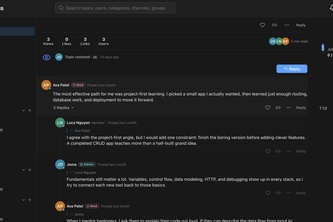
Overpass Community is a self-reported chat-and-forum hybrid platform designed for teams and communities to collaborate in real-time while preserving structured knowledge. The author states it combines real-time communication with asynchronous discussion threads, aiming to bridge the gap between fast-moving chat and rigid forums.
What changed
The project was submitted as part of the OpenAI 2026 hackathon on Devpost. It is described as a modular, multi-service platform built using modern web technologies including React, Node.js, PostgreSQL, Cassandra/ScyllaDB, Redis, RabbitMQ, Meilisearch, and LiveKit.
The single most important open question
Is there evidence of any traction, revenue, or customer adoption beyond the author's own description? The self-reported nature of this information means that all claims about product use, market fit, or commercial viability must be treated as unverified.
What The Product Actually Is
- The description states Overpass Community is a platform combining real-time chat with structured community discussions.
- Users can chat instantly in real-time channels and create categorized topics for deeper asynchronous discussions.
- It supports replies in structured conversation threads, tracking unread activity, saving and syncing drafts across sessions, uploading media, searching past discussions, controlling access through groups/roles/category permissions, managing notifications, and building a long-term knowledge base from everyday collaboration.
- The platform is built as a modular, multi-service architecture with frontend using React and TypeScript, and backend services including PostgreSQL, Cassandra/ScyllaDB, Redis/Valkey, RabbitMQ, Meilisearch, and LiveKit.
- It supports self-hosted deployments using containers.
Positioning & Claim Evolution
- The description states the product was built to bridge the gap between real-time chat that moves quickly but loses context, and traditional forums that preserve knowledge but feel slow and rigid for everyday collaboration.
- The author claims Overpass Community helps teams communicate quickly, hold deeper asynchronous discussions, and turn useful conversations into lasting, searchable knowledge.
- It is positioned as a unified experience for real-time and asynchronous collaboration, where quick conversations can happen naturally while important ideas become organized, durable knowledge.
- The project evolved from a simple chat application or forum prototype to something more structured with nested replies, discussion tools, granular roles and permissions, draft synchronization, read-state tracking, and searchable discussions.
Target Customer & ICP
- Not evidenced. The description does not specify target customers or ideal customer profiles beyond general mentions of "teams and communities."
Business Model & Pricing Evidence
- Not evidenced. There is no mention of pricing models, monetization strategies, or business model details in the provided description.
Technical & Delivery Signals
- The platform is built with modern web technologies including React, TypeScript, Node.js, PostgreSQL, Cassandra/ScyllaDB, Redis/Valkey, RabbitMQ, Meilisearch, and LiveKit.
- It supports self-hosted deployments using containers.
- The architecture separates responsibilities across several services:
- PostgreSQL stores users, permissions, categories, topics, notifications, and other structured data
- Cassandra / ScyllaDB supports high-volume chat messages and timelines
- Redis / Valkey handles caching, presence, and real-time coordination
- RabbitMQ provides durable communication between services
- Meilisearch powers fast content discovery
- LiveKit supports real-time audio and video capabilities
- The frontend uses reusable components for topics, replies, messaging, media, notifications, moderation, and administration.
- It is described as a modular architecture designed for self-hosting and future growth.
Traction & Maturity Signals
- Not evidenced. There is no mention of revenue, customers, user base, or any form of traction beyond the author's own description.
Competitive Context
- Not evidenced. The description does not provide information about competitors or competitive positioning.
Open Questions & Risks
- The project is self-reported and unverified; all claims are based on the author's own account.
- No evidence of revenue, customers, or traction exists beyond the author's description.
- The platform appears to be a hackathon submission with no indication of commercial deployment or market validation.
- The single-member team size raises questions about scalability and resource allocation for product development and growth.
- The technical complexity (multiple services, real-time features) may pose challenges without proven execution capability.
Questions the description leaves open
- What specific problems are you solving that existing tools don't address?
- How do you plan to acquire users or customers beyond the initial prototype?
- What is your go-to-market strategy and how will you scale the product?
- Are there any early adopters or pilot users who have provided feedback?
- What are your plans for monetization and revenue generation?
- How do you intend to handle the technical complexity of real-time features and multi-service architecture at scale?
- What is your roadmap for addressing user feedback and improving the product post-hackathon?
Overall Assessment
- Not evidenced. There is insufficient information to assess investment or partnership potential due to lack of financial data, customer traction, or market validation beyond the author's own description.
Note: This analysis is based entirely on self-reported information from the project description provided by the caller. No external verification or historical data was used.
User Stories BotA demo video on every pull request
Get a demo video on every new feature
GitHub App that watches your pull requests and records a narrated, captioned demo.
Save time on demo prep and make informed decisions faster with a video walkthrough of every new feature.
Source
Submitted to the OpenAI 2026 hackathon on Devpost. Project home on Devpost. Back to the full gallery on Devpost.
This competitive analysis was produced by top-founders.com (opens in a new tab)
Generated by a language model from this project's public Devpost page — its tagline, the author's own write-up and any built-with tags listed there — as captured in August 2026. Short quotations are the author's words. It is an opinion on the idea as a business, not on the people behind it, and it reflects the description as published then. If the project has moved on, request a correction below. The analysis is not independent research and contains no verified traction, revenue or customer data.
An independent guide by KFG International LLC — not affiliated with, endorsed by, or connected to Devpost or OpenAI.