

Archive position — measured, not model output
0 likes on Devpost
2,263 of the 7,850 archived projects have more likes, and 5,587 share exactly 0 — so this project's #5,757 place in the like-ranked listing is a tie-break inside that group, not a ranking.
Projects (log scale)
Likes on Devpost. ▲ marks this project's group.
Show the figures
| Likes | Projects | Share of archive |
|---|---|---|
| 0 | 5,587 | 71.2% |
| 1 | 1,758 | 22.4% |
| 2 | 284 | 3.6% |
| 3–4 | 132 | 1.7% |
| 5–9 | 75 | 1.0% |
| 10+ | 14 | 0.2% |
 User Stories BotA demo video on every pull request
Get a demo video on every new feature
GitHub App that watches your pull requests and records a narrated, captioned demo.
Save time on demo prep and make informed decisions faster with a video walkthrough of every new feature.
Executive Summary
What the company appears to be
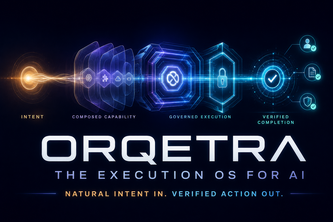
Orqetra, as described by its founder, is a system designed to mediate between AI-generated intent and real-world action. It is described as an "Execution OS for AI" that enforces boundaries around AI reasoning, prevents unsupported actions from becoming real-world outcomes, and requires human authorization before execution.
What changed
The project was developed during OpenAI Build Week 2026 using GPT-5.6 and Codex. It is presented as an extension of a pre-existing system, with the demonstrator focusing on core principles such as proposal generation, containment of hallucinations, human approval, bounded execution, readback, and verified completion.
The single most important open question
Is there evidence that Orqetra has moved beyond concept or demonstration into actual usage or adoption by users or organizations? The description states no revenue, customers, or traction data are available — all claims are self-reported and unverified.
What The Product Actually Is
The description states that Orqetra is a system designed to transform natural-language intent into controlled, reviewable, and verifiable action. It operates through an execution lifecycle:
- Natural intent
- AI proposal
- Contract checks
- Human authorization
- Bounded execution
- Readback
- Verified completion
It is described as not being a traditional AI assistant but rather a governed execution layer between AI reasoning and external systems (e.g., browsers, desktop environments, business systems). It does not require dedicated APIs from target applications.
The system uses AI selectively for interpretation and composition, while conventional software handles repeatable checks, permissions, and mechanical operations. The goal is to use intelligence where it adds value and deterministic execution where predictability is more important.
Evidence
- The author describes Orqetra as a human-directed Execution OS.
- It separates AI reasoning from execution authority.
- It enforces safety boundaries via programs.
- Human approval is required at defined points.
- Execution must be verified post-action, not assumed from the plan.
- It supports workflows across different execution surfaces without requiring APIs.
Inference The system appears to be built around a “human-in-the-loop” model where AI proposes actions, but execution is bound by programmatic checks and human judgment.
Positioning & Claim Evolution
The description states that Orqetra was inspired by the problem of AI generating useful answers but not being able to execute real-world actions without additional safeguards. It positions itself as a solution for moving from "natural intent in" to "verified action out."
It claims to contain hallucination at the execution boundary, distinguishing between what an AI proposes and what is actually executed or verified.
The project also states it began with a personal challenge — the founder cannot code, so Orqetra was built using natural language and AI tools like ChatGPT and Codex.
Evidence
- The tagline: “Natural intent in. Verified action out.”
- The author’s stated inspiration: AI can generate answers but not execute actions without safeguards.
- The system is described as a human-directed Execution OS.
- It is designed to prevent unsupported output from becoming real-world action merely because a model produced it.
Inference Orqetra positions itself as a governance layer for AI execution, emphasizing safety and control over automation. It frames its value in terms of preventing AI hallucinations and ensuring accountability through human oversight.
Target Customer & ICP
The description does not clearly identify a specific customer segment or ideal customer profile (ICP). However, it implies that Orqetra is intended for users who want to use AI to perform actions in environments where those actions must be controlled, reviewed, and verified.
It suggests that the system works across different execution surfaces — including legacy systems without APIs — which may appeal to enterprises or organizations with complex, non-modernized IT infrastructures.
The author notes that Orqetra is user-first rather than developer-first, meaning it allows users to describe goals in natural language without needing technical knowledge of APIs or schemas.
Evidence
- The system works across browser and desktop environments.
- It does not require dedicated APIs from target applications.
- It supports workflows involving legacy systems.
- It is described as user-first, allowing users to express intent in natural language.
Inference The likely target includes enterprise users or teams who need AI-assisted automation but operate within systems that lack modern integrations. The system may appeal to non-technical users or those managing complex, multi-system workflows.
Business Model & Pricing Evidence
There is no evidence of a business model or pricing structure in the provided description. The author does not describe how Orqetra would be monetized or whether it offers any paid services or tiers.
Evidence
- No mention of revenue streams.
- No indication of pricing plans.
- No information on licensing, subscriptions, or usage models.
Inference The business model remains unknown. The project is presented as a demonstration and not yet commercialized.
Technical & Delivery Signals
The system is described as built using GPT-5.6 and Codex during Build Week. It was developed through natural language input, with the founder making architectural decisions and directing iterations in natural language rather than writing code directly.
It uses AI selectively for interpretation and reasoning, while conventional software handles permissions, checks, and deterministic operations.
The system is described as patent-pending in Japan, though the submitted repository contains only a demonstrator, not the full production implementation.
Evidence
- Built with: ai, api, automation, chatgpt, codex, css3, github, gpt-5.6, html5, human-in-the-loop, javascript, node.js, openai, responsible, safety, workflow.
- The author used GPT-5.6 and Codex to structure requirements, compose proposals, and evaluate behavior.
- The system is designed to observe and operate through existing browser and desktop interfaces.
- It does not require APIs from target applications.
Inference The technical architecture appears to be hybrid — combining AI for reasoning with traditional software for enforcement and execution. The development process was largely natural-language-driven, suggesting a low-code or no-code approach.
Traction & Maturity Signals
There is no evidence of traction, revenue, customers, or adoption beyond the author’s own description. The project is presented as a demonstration built during a hackathon.
Evidence
- No mention of users, customers, or revenue.
- No data on usage volume or product maturity.
- The system is described as a demonstrator for Build Week.
- The repository contains only the demonstrator and development history; no production implementation is included.
Inference The project has not yet reached a stage of commercial traction or widespread use. It remains in early-stage development or demonstration form.
Competitive Context
There is no mention of competitors or competitive positioning in the description. The author does not reference similar products, platforms, or solutions in the market.
Evidence
- No comparison to existing tools.
- No indication of how Orqetra fits into the broader AI execution or automation landscape.
Inference The competitive context is unknown. It is unclear whether Orqetra competes with AI agents, workflow automation platforms, or enterprise integration tools.
Open Questions & Risks
- Lack of traction or commercialization: The project is described as a hackathon demo with no evidence of real-world usage.
- Founder’s lack of technical background: The founder states they cannot read or write code, which raises questions about long-term development capacity.
- Unverified claims: All descriptions are self-reported and unverified; there is no independent confirmation of the system's functionality or effectiveness.
- No business model or monetization strategy: No indication of how Orqetra would generate revenue.
- Limited scope in demo: The demonstrator only works within a fictional environment, not real-world systems.
Evidence
- No revenue, customers, or adoption data.
- Founder is non-technical.
- System is presented as a hackathon demo.
- No mention of monetization or business model.
Questions the description leaves open
- What specific workflows or use cases have you tested Orqetra with beyond the Build Week demonstrator?
- How does Orqetra handle edge cases where AI proposals are ambiguous or incomplete?
- Can you describe how the system enforces safety boundaries in practice, and what happens when those boundaries are violated?
- What is your roadmap for moving from a demo to a production-ready product?
- Are there any existing partnerships or pilot programs with organizations using Orqetra?
- How do you plan to scale beyond a single founder and natural-language-driven development?
Overall Assessment
Not evidenced.
The description provides no information about revenue, customers, traction, or commercial viability. All claims are self-reported and unverified.
This is a demonstration project built during a hackathon with no evidence of product-market fit, adoption, or monetization strategy.
Confidence Level Very Low
Reasoning
The entire analysis is based on a single self-reported description, with no external validation, data, or evidence of real-world use. The project has not demonstrated any commercial traction or clear path to market.
User Stories BotA demo video on every pull request
Get a demo video on every new feature
GitHub App that watches your pull requests and records a narrated, captioned demo.
Save time on demo prep and make informed decisions faster with a video walkthrough of every new feature.
Source
Submitted to the OpenAI 2026 hackathon on Devpost. Project home on Devpost. Back to the full gallery on Devpost.
This competitive analysis was produced by top-founders.com (opens in a new tab)
Generated by a language model from this project's public Devpost page — its tagline, the author's own write-up and any built-with tags listed there — as captured in August 2026. Short quotations are the author's words. It is an opinion on the idea as a business, not on the people behind it, and it reflects the description as published then. If the project has moved on, request a correction below. The analysis is not independent research and contains no verified traction, revenue or customer data.
An independent guide by KFG International LLC — not affiliated with, endorsed by, or connected to Devpost or OpenAI.