

Archive position — measured, not model output
1 like on Devpost
505 of the 7,850 archived projects have more likes, and 1,758 share exactly 1 — so this project's #1,833 place in the like-ranked listing is a tie-break inside that group, not a ranking.
Projects (log scale)
Likes on Devpost. ▲ marks this project's group.
Show the figures
| Likes | Projects | Share of archive |
|---|---|---|
| 0 | 5,587 | 71.2% |
| 1 | 1,758 | 22.4% |
| 2 | 284 | 3.6% |
| 3–4 | 132 | 1.7% |
| 5–9 | 75 | 1.0% |
| 10+ | 14 | 0.2% |
 User Stories BotA demo video on every pull request
Get a demo video on every new feature
GitHub App that watches your pull requests and records a narrated, captioned demo.
Save time on demo prep and make informed decisions faster with a video walkthrough of every new feature.
Executive Summary
What the company appears to be
Roll Over Fitness is a self-reported six-week Android mobile application designed for people not ready for beginner workouts. The app aims to build mobility, stamina, confidence, and healthy habits through safe, adaptable daily movement. It is described as a native Android app built with Kotlin, Jetpack Compose, and AI-assisted development tools like GPT-5.6 and OpenAI Codex.
What changed
The project was submitted by one developer (Jason Bowers) to the OpenAI 2026 hackathon. It is presented as a personal development effort focused on accessibility in fitness, with no evidence of prior traction or commercial activity.
Single most important open question
Is there any indication that this app has been tested with real users beyond the developer’s own use and iteration?
What The Product Actually Is
The description states that Roll Over Fitness is a six-week Android program for people who are not ready for beginner workouts. It includes:
- A structured movement-readiness program
- Daily short movement sessions
- Adaptive workout selection based on user fatigue, flexibility, and physical needs
- Features such as:
- Water and stretching reminders
- Timed workouts with extra-time recording
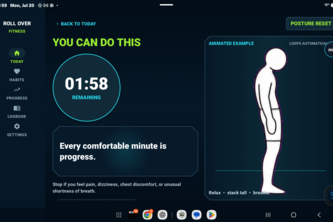
- Animated exercise examples
- Automatic logbook entries
- Progress tracking and milestones
- Weekly healthy-habit goals
- Nutrition education and food facts
- Affirmations
- Advanced versions of Weeks 5 and 6 for continued improvement
It is described as a local-only storage app, with no account, advertising, or subscription.
Evidence
- The author states: “Roll Over Fitness creates a starting plan based on the user’s fatigue level, flexibility, need for chair support, mobility aids, movement restrictions, and sensitive body areas.”
- The app includes “timed workouts with extra-time recording,” “animated exercise examples,” and “automatic logbook entries.”
Inference The app is built as a native Android application using Kotlin and Jetpack Compose.
Positioning & Claim Evolution
The author claims that most fitness apps assume users are already capable of beginner workouts, but many people find even those overwhelming. The app is positioned to meet users where they are — not pushing them hard, but preparing them for traditional beginner programs.
Key positioning elements
- For people not ready for beginner workouts
- Safe, adaptable, and approachable
- Focus on mobility, stamina, confidence, and habit-building
- Emphasis on accessibility and emotional support
Evidence
- The author states: “Most fitness apps begin with the assumption that users are already capable of completing a beginner workout. But for many people, even a beginner program can feel physically overwhelming or emotionally intimidating.”
- The app is described as meeting users "where they are" and preparing them to succeed in a traditional beginner workout program.
Inference The app is not positioned as a replacement for traditional fitness apps but as a bridge between inactivity and beginner-level training.
Target Customer & ICP
The description states that the app targets people who are not ready for beginner workouts, implying those who may be physically or emotionally hesitant to begin any structured exercise program.
Evidence
- “It builds mobility, stamina, confidence, and healthy habits through safe, adaptable daily movement.”
- “For people who need a step before ‘beginner.’”
Inference The target user is likely someone with physical limitations, low fitness levels, or emotional barriers to starting a workout routine.
Absence of evidence
No specific demographics, health conditions, or behavioral data are provided. No customer personas or market segmentation are described.
Business Model & Pricing Evidence
The app is described as local-only storage, with no account, advertising, or subscription required. It is built for personal use and not monetized in the description.
Evidence
- “Local-only storage with no account, advertising, or subscription.”
Inference There is no commercial business model evident in the self-reported description. The app appears to be a personal project without monetization plans.
Technical & Delivery Signals
The app was built as a native Android application using Kotlin and Jetpack Compose. It uses modular architecture with feature modules for onboarding, Today, Progress, Logbook, Healthy Habits, and Settings.
Evidence
- “I built Roll Over Fitness as a native Android application using Kotlin, Jetpack Compose, Material 3, Navigation Compose, Coroutines, and Android Data Store.”
- “The project uses a modular architecture: app handles navigation, theming, and application state; core: model contains program content and domain models; core: data manages local persistence.”
AI-assisted development
- The developer used GPT-5.6 and OpenAI Codex throughout the process.
- These tools were used for code translation, debugging, layout refinement, testing, and build iteration.
Inference The app is technically sound for a personal project but lacks evidence of scalability or enterprise-grade architecture.
Traction & Maturity Signals
There is no evidence of traction, customers, revenue, or adoption. The project is described as a single-developer hackathon submission with no commercial activity beyond the developer’s own use and iteration.
Evidence
- “This was not a single-prompt project. I tested each version, identified what felt confusing or weak, and directed the next iteration.”
- “Context: this project was submitted to the OpenAI 2026 hackathon on Devpost.”
Inference The app is in early development and has no market presence or user base.
Competitive Context
No competitive analysis is provided. The description does not mention any existing apps or platforms in the fitness or wellness space, nor does it compare Roll Over Fitness to others.
Evidence
- No mention of competitors or market positioning against other fitness apps.
- No indication of how this app differs from or complements existing offerings.
Inference The competitive landscape is unknown. The app may be a niche solution for users who are underserved by current apps, but this is speculative without data.
Open Questions & Risks
- No commercial traction or user feedback: The app is described as a personal project with no evidence of real-world use.
- Single developer: The team size is listed as one, which may limit scalability and long-term maintenance.
- Unverified claims: All descriptions are self-reported and unverified.
- No monetization strategy: No indication of how the app would be monetized or scaled.
- AI dependency: Heavy reliance on AI-assisted development may not translate into a sustainable product if those tools change or become unavailable.
Questions the description leaves open
- How many real users have tested this app beyond your own use and iteration?
- What is the intended path to monetization, if any?
- Have you considered how this app would scale beyond a single developer?
- What are the limitations of relying on AI tools like GPT-5.6 for development?
- How do you plan to validate that the app meets the needs of users who are not ready for beginner workouts?
Overall Assessment
Not evidenced.
There is no evidence of revenue, customers, or commercial traction. The project is described as a personal hackathon submission with no indication of market readiness or scalability.
Confidence level Low The description is self-reported and unverified, with no data on adoption, user feedback, or business model. Any investment or partnership decision would require further due diligence beyond this report.
User Stories BotA demo video on every pull request
Get a demo video on every new feature
GitHub App that watches your pull requests and records a narrated, captioned demo.
Save time on demo prep and make informed decisions faster with a video walkthrough of every new feature.
Source
Submitted to the OpenAI 2026 hackathon on Devpost. Project home on Devpost. Back to the full gallery on Devpost.
This competitive analysis was produced by top-founders.com (opens in a new tab)
Generated by a language model from this project's public Devpost page — its tagline, the author's own write-up and any built-with tags listed there — as captured in August 2026. Short quotations are the author's words. It is an opinion on the idea as a business, not on the people behind it, and it reflects the description as published then. If the project has moved on, request a correction below. The analysis is not independent research and contains no verified traction, revenue or customer data.
An independent guide by KFG International LLC — not affiliated with, endorsed by, or connected to Devpost or OpenAI.