

Archive position — measured, not model output
0 likes on Devpost
2,263 of the 7,850 archived projects have more likes, and 5,587 share exactly 0 — so this project's #5,759 place in the like-ranked listing is a tie-break inside that group, not a ranking.
Projects (log scale)
Likes on Devpost. ▲ marks this project's group.
Show the figures
| Likes | Projects | Share of archive |
|---|---|---|
| 0 | 5,587 | 71.2% |
| 1 | 1,758 | 22.4% |
| 2 | 284 | 3.6% |
| 3–4 | 132 | 1.7% |
| 5–9 | 75 | 1.0% |
| 10+ | 14 | 0.2% |
 User Stories BotA demo video on every pull request
Get a demo video on every new feature
GitHub App that watches your pull requests and records a narrated, captioned demo.
Save time on demo prep and make informed decisions faster with a video walkthrough of every new feature.
Executive Summary
What the company appears to be
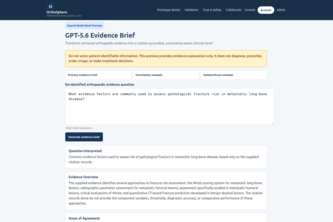
OrthoSphere is a self-reported orthopaedic intelligence platform built by a solo clinician-developer. The project includes components such as OrthoPath (a deterministic clinical decision-support rules engine), OrthoRAG (a citation-oriented evidence retrieval layer), and a new GPT-5.6 Evidence Brief feature added during OpenAI Build Week. The platform is described as designed to support clinicians in organizing, assessing, and communicating orthopaedic evidence under time pressure.
What changed
During OpenAI Build Week, the author added a new isolated GPT-5.6-based evidence synthesis path to OrthoSphere. This feature retrieves bounded evidence sets, structures output using a strict schema, and enforces safety boundaries that prevent clinical directives or diagnoses from being generated by the model. It is described as separate from existing components like OrthoPath and not altering its logic.
The single most important open question
Is there any evidence of real-world usage, adoption, or feedback from clinicians beyond the author’s own development experience?
What The Product Actually Is
The description states that OrthoSphere is an assistive orthopaedic intelligence platform. It includes:
- OrthoPath, a deterministic clinical decision-support rules engine.
- OrthoRAG, a citation-oriented evidence retrieval layer.
- A GPT-5.6 Evidence Brief feature introduced during OpenAI Build Week.
The GPT-5.6 Evidence Brief is described as:
- Producing structured output based on a question and retrieved evidence.
- Including areas of agreement, uncertainty, limitations, missing context, and citation-linked claims.
- Being isolated from other components like OrthoPath.
- Using a strict JSON schema via the OpenAI Responses API.
- Enforcing safety controls to avoid generating clinical recommendations or diagnoses.
The platform also includes:
- Authenticated web and API services.
- PostgreSQL and pgvector infrastructure.
- Server-side handling of OpenAI API keys.
- Feature flags, rate limits, and deterministic regression tests.
Not evidenced There is no evidence of actual product usage, customer feedback, or deployment beyond the author’s development work. No mention of real users, clinical workflows, or integration into existing systems.
Positioning & Claim Evolution
The description states that OrthoSphere was built to support orthopaedic clinicians who work across fragmented information sources and face challenges in organizing, assessing, and communicating evidence under time pressure.
It positions itself as:
- An assistive tool, not a replacement for clinical judgment.
- Designed to make evidence easier to inspect rather than to make treatment decisions.
- With a strong emphasis on safety boundaries—explicitly rejecting diagnostic or procedural prompts before model invocation.
The evolution of the product is described as:
- Starting with OrthoPath and OrthoRAG.
- Adding GPT-5.6 Evidence Brief during OpenAI Build Week.
- Maintaining architectural isolation between components.
- Focusing on structured output, citation grounding, uncertainty awareness, and safety validation.
Not evidenced No claims about market positioning, competitive differentiation, or strategic direction beyond the author’s personal development goals are provided.
Target Customer & ICP
The description states that OrthoSphere targets orthopaedic clinicians, including surgeons working in fragmented clinical environments. These users are said to struggle with organizing and assessing evidence under time pressure.
Not evidenced
There is no information about:
- Specific customer segments within orthopaedics.
- Clinical roles or settings (e.g., hospital vs. private practice).
- Any user personas, interviews, or feedback from clinicians.
- Whether the platform is intended for individual practitioners or institutions.
Business Model & Pricing Evidence
The description does not contain any information about:
- Revenue streams.
- Pricing models.
- Monetization strategy.
- Subscription tiers or usage-based billing.
- Customer acquisition or retention plans.
Not evidenced No evidence of a business model or pricing structure is provided. The project is described as a prototype and not intended for autonomous diagnosis, prescribing, ordering, triage, or treatment selection.
Technical & Delivery Signals
The author reports:
- Built with technologies including Caddy, FastAPI, Next.js, React, Docker, PostgreSQL, pgvector, TypeScript, Python, OpenAI, Codex.
- Implementation involved strict schema enforcement, server-side API handling, and safety controls.
- Use of feature flags, rate limits, deterministic regression tests, and local reproducibility.
- Integration with existing OrthoPath and OrthoRAG components without altering their authority boundaries.
Not evidenced
There is no evidence of:
- Deployment architecture or scalability.
- Performance metrics or system reliability.
- Production-grade infrastructure or monitoring tools.
- Any integration with external systems beyond the described internal layers.
Traction & Maturity Signals
The description states that OrthoSphere:
- Was developed by a solo clinician-developer.
- Includes components like OrthoPath and OrthoRAG that already existed.
- Added GPT-5.6 Evidence Brief during OpenAI Build Week.
- Is described as an “assistive prototype” not intended for autonomous use.
Not evidenced
There is no evidence of:
- Customer adoption or usage.
- Real-world testing or clinical validation.
- Product maturity beyond the author’s development efforts.
- Any form of product-market fit or traction indicators.
Competitive Context
The description does not provide any information about:
- Competitors in the orthopaedic AI space.
- Market positioning relative to other tools.
- Differentiation from existing evidence synthesis platforms.
- Industry trends or regulatory considerations.
Not evidenced No competitive analysis or market context is included. The project appears to be self-contained and not part of a broader competitive landscape.
Open Questions & Risks
Key risks and open questions based on the description:
- Single-person development: The platform is built by one person, raising concerns about scalability, maintenance, and long-term viability.
- Prototype status: Described as an “assistive prototype,” not intended for autonomous use, suggesting limited commercial readiness.
- No external validation or feedback: No evidence of real-world testing or clinician input beyond the author’s own experience.
- Unverified model claims: The project is built around GPT-5.6, which is not a verified product; its capabilities are self-reported.
- Limited product scope: The new GPT-5.6 feature is isolated and does not integrate into broader clinical workflows or decision-making systems.
Questions the description leaves open
- What specific orthopaedic clinical problems does OrthoSphere aim to solve, and how do you know?
- How many clinicians have tested the platform beyond your own development experience?
- Are there any plans for clinical validation or usability studies with actual users?
- What is the long-term vision for integrating GPT-5.6 into existing orthopaedic workflows?
- How does the platform plan to scale beyond a solo developer and prototype stage?
- What are the technical and regulatory challenges in deploying such a system in real clinical settings?
Overall Assessment
The description indicates that OrthoSphere is a self-reported prototype built by a single clinician-developer. It includes components like OrthoPath and OrthoRAG, with a new GPT-5.6 Evidence Brief feature added during OpenAI Build Week.
While the project shows technical sophistication in terms of safety controls, structured output, and architectural isolation, there is no evidence of traction, revenue, or customer adoption beyond the author’s own development work.
The platform is described as not intended for autonomous diagnosis or treatment decisions, which limits its immediate commercial potential. It remains a conceptual and experimental tool, with no clear path to market or monetization.
Assessment Not evidenced as a viable investment or partnership opportunity at this stage. The project lacks commercial signals, user feedback, or product-market fit indicators. Further due diligence would require evidence of real-world usage, clinical validation, or a defined go-to-market strategy.
User Stories BotA demo video on every pull request
Get a demo video on every new feature
GitHub App that watches your pull requests and records a narrated, captioned demo.
Save time on demo prep and make informed decisions faster with a video walkthrough of every new feature.
Source
Submitted to the OpenAI 2026 hackathon on Devpost. Project home on Devpost. Back to the full gallery on Devpost.
This competitive analysis was produced by top-founders.com (opens in a new tab)
Generated by a language model from this project's public Devpost page — its tagline, the author's own write-up and any built-with tags listed there — as captured in August 2026. Short quotations are the author's words. It is an opinion on the idea as a business, not on the people behind it, and it reflects the description as published then. If the project has moved on, request a correction below. The analysis is not independent research and contains no verified traction, revenue or customer data.
An independent guide by KFG International LLC — not affiliated with, endorsed by, or connected to Devpost or OpenAI.