

Archive position — measured, not model output
0 likes on Devpost
2,263 of the 7,850 archived projects have more likes, and 5,587 share exactly 0 — so this project's #5,761 place in the like-ranked listing is a tie-break inside that group, not a ranking.
Projects (log scale)
Likes on Devpost. ▲ marks this project's group.
Show the figures
| Likes | Projects | Share of archive |
|---|---|---|
| 0 | 5,587 | 71.2% |
| 1 | 1,758 | 22.4% |
| 2 | 284 | 3.6% |
| 3–4 | 132 | 1.7% |
| 5–9 | 75 | 1.0% |
| 10+ | 14 | 0.2% |
 User Stories BotA demo video on every pull request
Get a demo video on every new feature
GitHub App that watches your pull requests and records a narrated, captioned demo.
Save time on demo prep and make informed decisions faster with a video walkthrough of every new feature.
Executive Summary
What the company appears to be
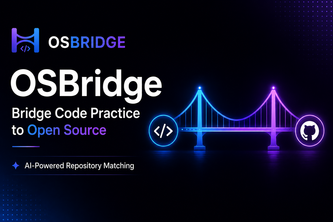
OSBridge is a self-reported tool that uses AI to help developers find and contribute to open-source projects. It claims to recommend repositories and issues, explain their fit, and guide newcomers through their first contribution.
What changed
The project was submitted to the OpenAI 2026 hackathon on Devpost. No further development or commercial activity is evidenced.
Single most important open question
Is there any evidence of actual developer adoption, usage, or traction beyond the hackathon submission?
The description states that OSBridge is a tool for developers to find and contribute to open-source projects using AI. It does not provide information on revenue, customers, product-market fit, or any commercial activity beyond its hackathon submission.
What The Product Actually Is
The description states: "OSBridge uses AI to recommend the right repositories and issues, explain why they fit, and guide developers to their first contribution."
This is a self-reported claim about the product's function. It does not describe whether this is a web application, browser extension, CLI tool, or other delivery mechanism.
Not evidenced: The actual technical architecture, UI/UX, or functionality of the product beyond its AI-based recommendation system.
Positioning & Claim Evolution
The description states: "Bridge the gap between coding practice and open source."
This is a positioning statement. It suggests that OSBridge aims to help developers transition from learning to contributing in open-source ecosystems.
Not evidenced: Whether this claim has evolved over time, or if there are any other positioning statements or messaging around the product’s value proposition beyond what is written in the tagline.
Target Customer & ICP
The description states: "OSBridge uses AI to recommend the right repositories and issues, explain why they fit, and guide developers to their first contribution."
This implies that the primary user is a developer who wants to contribute to open-source projects. The target customer appears to be someone new or inexperienced in open-source contributions.
Not evidenced: Specific customer segments, personas, or ideal customer profiles beyond the general category of "developer".
Business Model & Pricing Evidence
The description does not state anything about pricing, monetization, or business model.
Not evidenced: No information on how OSBridge intends to make money, if at all. Whether it is free, subscription-based, ad-supported, or otherwise.
Technical & Delivery Signals
The description states that the project was built with:
- codex
- drizzle
- github
- next.js
- openai
- postgresql
- react
- shadcn/ui
- tailwind
- typescript
This indicates a modern web stack, likely a frontend-heavy application using React and Next.js, with AI integration via OpenAI and database storage using PostgreSQL.
Not evidenced: Whether the product is live, accessible, or used by developers. No evidence of deployment, infrastructure, or delivery mechanism beyond the tech stack mentioned.
Traction & Maturity Signals
The description states that this project was submitted to the OpenAI 2026 hackathon on Devpost.
There is no evidence of any traction, user base, revenue, or product maturity beyond this single submission.
Not evidenced: No data on usage, retention, customer acquisition, or product development beyond the hackathon entry.
Competitive Context
The description does not mention any competitors or existing solutions in the open-source contribution space.
Not evidenced: No information about competitive landscape, alternative tools, or market positioning relative to other platforms that help developers contribute to open source.
Open Questions & Risks
- The project is only described as a hackathon submission with no evidence of further development.
- No commercial activity or traction is reported.
- The team size is listed as one person (Priyanshu Agarwal), which may indicate limited capacity for execution.
- The lack of any revenue, customer data, or product usage signals raises questions about viability.
Questions the description leaves open
- What is the current state of development beyond the hackathon submission?
- Have you begun building a user base or collecting feedback from developers?
- How do you plan to monetize OSBridge if at all?
- What are your plans for scaling and growing the product after the hackathon?
Overall Assessment
Not evidenced: No basis for evaluating investment or partnership potential due to lack of information on traction, business model, or commercial viability.
The description is limited to a single hackathon submission with no evidence of product-market fit, revenue, or customer engagement. The project does not appear to have moved beyond the idea stage, and there is no indication that it has been developed into a functional product for developers.
User Stories BotA demo video on every pull request
Get a demo video on every new feature
GitHub App that watches your pull requests and records a narrated, captioned demo.
Save time on demo prep and make informed decisions faster with a video walkthrough of every new feature.
Source
Submitted to the OpenAI 2026 hackathon on Devpost. Project home on Devpost. Back to the full gallery on Devpost.
This competitive analysis was produced by top-founders.com (opens in a new tab)
Generated by a language model from this project's public Devpost page — its tagline and any built-with tags listed there, since the author published no write-up — as captured in August 2026. Short quotations are the author's words. It is an opinion on the idea as a business, not on the people behind it, and it reflects the description as published then. If the project has moved on, request a correction below. The analysis is not independent research and contains no verified traction, revenue or customer data.
An independent guide by KFG International LLC — not affiliated with, endorsed by, or connected to Devpost or OpenAI.